We’ve all seen it. You walk into a busy tiffin center or a local cafe, and you feel a momentary sense of relief. The server is wearing bright blue or clear plastic gloves. “Ah,” you think, “they care about hygiene here.”
Then, the illusion shatters.
With the gloves on, the server wipes a grime-streaked counter with a damp, dirty tea towel. They accept a sweaty currency note from a customer. A notification pings—they tap away at a smartphone screen. They might even adjust their face mask, pull a chair for a guest, or grab a water bottle by the cap. Finally, they reach out and pluck two steaming idlis from the steamer to place them on your plate.
Purpose dissolved. The purpose of hygiene and why a glove is worn, has been forgotten.
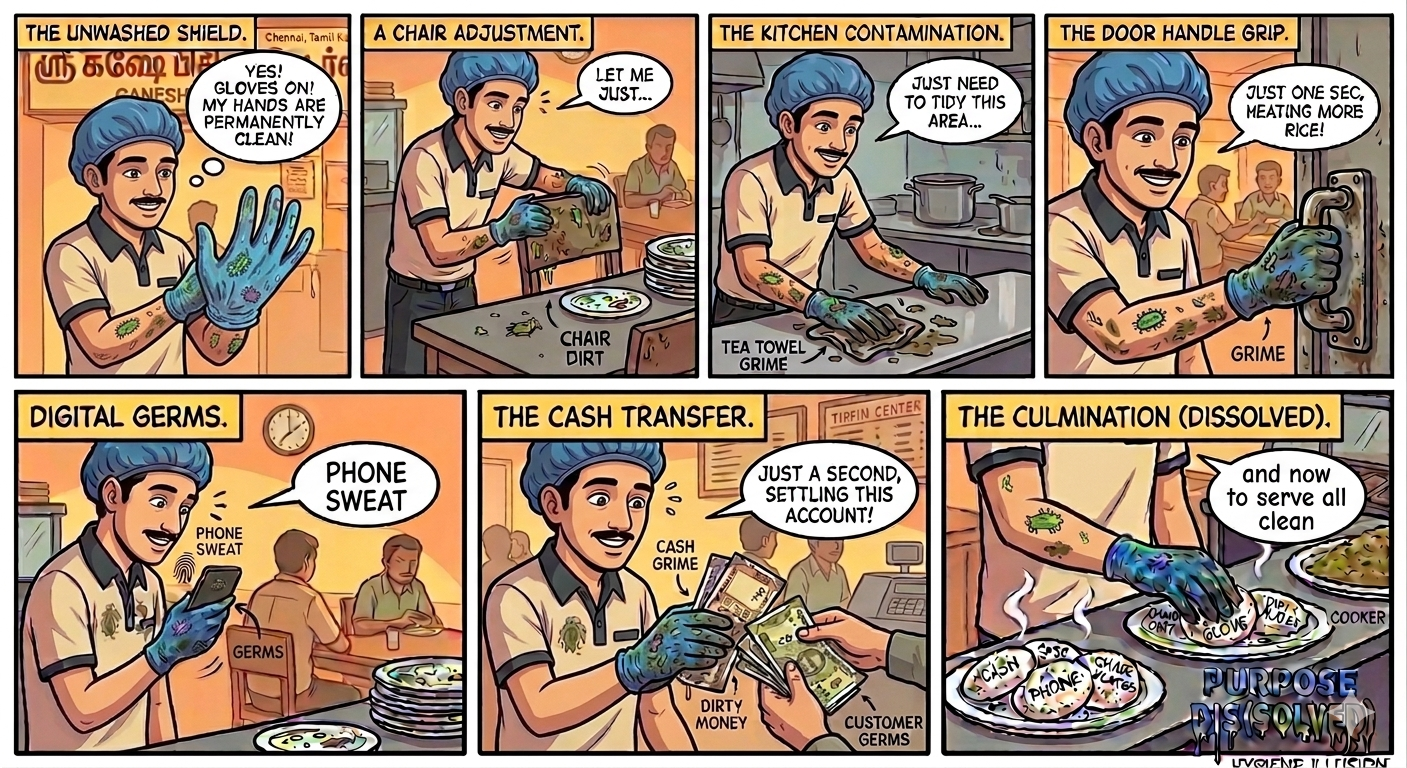
The “Magic Shield” Fallacy
The primary issue is a fundamental lack of understanding of what a glove is for. Many staff members treat gloves like a magical barrier that keeps their hands clean, rather than a tool to keep the food safe.
- The Reality: Bacteria don’t care if they are hitching a ride on human skin or latex.
- The Irony: A person with bare hands is more likely to feel the “stickiness” of dirt and wash their hands. A person in gloves feels “permanently clean,” leading to a dangerous lapse in sensory awareness.
The Invisible Path of Contamination
In the food industry, “Hygiene Theater” creates a trail of germs across every surface:
- The Multi-Tasking Towel: Using gloves to handle a “tea towel”—which is often a breeding ground for bacteria—and then returning to food service.
- The Currency Exchange: Currency notes are arguably one of the dirtiest objects in circulation. Using a gloved hand to handle cash and then immediately touching “ready-to-eat” food is a direct bypass of all safety protocols.
- The Digital Contaminant: Phones are high-touch surfaces covered in germs. Checking a message mid-service “dissolves” the hygiene of the glove instantly.
- The Infrastructure Trap: Every time a gloved hand touches a door handle, a POS terminal, a refrigerator grip, or a customer’s chair, it collects a new layer of contaminants.
Reclaiming the Purpose
If the glove doesn’t change when the task changes, the glove is the problem, not the solution. Proper hygiene isn’t about wearing the gear; it’s about understanding the flow of contamination.
The Golden Rule for Food Safety:
“A glove is only as clean as the last thing it touched.”
If a server touches a phone, a currency note, or a cleaning rag, those gloves are now “dirty.” They must be discarded, the hands underneath must be washed, and a new pair must be donned.
Another Practical Hack: The “Dominant Hand” Strategy
If we want to stop the cycle of cross-contamination, we have to work with human nature. Perhaps the answer isn’t more gear, but better design.
The Proposal: Glove the Non-Dominant Hand.
Since most servers are right-handed, their right hand is instinctively used for “utility tasks”—counting cash, opening doors, or handling tea towels. By keeping the right hand bare, the server retains their sense of touch and remains aware of when their hand is actually “dirty.”
Meanwhile, the left hand is gloved and reserved exclusively for touching food or clean plates.
Why this works:
- Intuitive Separation: It’s easier to remember “Left for Food, Right for Everything Else” than to remember to change gloves twenty times a shift.
- Tactile Feedback: The moment the bare right hand touches a greasy surface, the brain receives a “dirty” signal. That instinct to wash is lost when the hand is encased in plastic.
- Reduced Waste: This method uses half the number of gloves while providing significantly higher actual safety.
Final Thoughts
Hygiene isn’t a costume. If your staff is wearing gloves but still touching everything in sight, you aren’t protecting your customers—you’re just performing “Hygiene Theater.” Let’s trade the “Glove Habit” for “Hand Awareness.” Whether it’s through the dominant hand strategy or frequent, visible handwashing, let’s ensure the purpose of food safety is no longer dissolved, but strictly upheld.
I’d love to hear from you: What is the most “purpose-dissolving” thing you’ve seen a gloved server do while preparing your food? Do you think the One-Hand Rule would work in our busy local tiffin centers, or is there a better way to stay safe? Drop your stories and thoughts in the comments!
Note from the Author: This post isn’t about pointing fingers at the hardworking individuals who feed us every day. We have immense respect for the long hours and dedication of restaurant staff. Instead, this is a look at how a lack of specific hygiene training can turn a good intention into a safety risk. Let’s move from “hygiene theater” to true food safety, together.
PS: The credit for the title “Purpose Dis(solved)” goes to my former colleague, Mr. Dhanasekar. He originally used the phrase on his blog, Testing Ideas, years ago. I felt the wordplay perfectly captured the “dissolving” hygiene standards I witnessed here.
*This blog post was refined using Gemini.


Right,
The concept of moving from “hygiene theater” to genuine food safety is especially relevant for busy food establishments.
Thought-provoking article.
Dear Sanju, Thanks for compliments 🙂
The Computer God and the Art of Handwashing: A Tale of Two Worlds
A Quantum Leap in Gunnery
The induction of the 155mm Bofors Guns into the Indian Army in 1987 was nothing short of a quantum leap – bringing computing power into the field of gunnery for the first time. Until then, we had relied on cumbersome manual procedures: logarithmic tables, range tables, graphical instruments, and handheld calculators. The arrival of computers promised speed, precision, and a new way of thinking about artillery.
In our Regiment, I took on the responsibility of training our soldiers on these new machines. As the old military adage goes, “It is easier to put a new idea into a military mind, but next to impossible to take out an old one.” Armed with this wisdom, I selected the youngest soldiers for training first, rather than the experienced Havildars and Naiks (Sergeants and Corporals). The old ideas, I reasoned, had not yet taken root in them.
Sepoy Nem Pal: A Star in the Making
The class began with full earnestness. We were all eager to learn about the computers and their unheard-of capabilities—and to see them put into real effect. Among the trainees was Sepoy Nem Pal, a highly intelligent soldier with nimble fingers and a fierce desire to excel. He was the ideal candidate.
After a few days, we moved on to the procedure for engaging targets. I demonstrated the process, and each soldier was asked to practice. Then, I was summoned by our Commanding Officer and had to leave the class.
Fifteen minutes later, I returned to find Sepoy Nem Pal visibly worked up. He approached me and said, “Sir, it works perfectly when you do it on the computer. But when we do it, nothing happens. Why?”
I had no logical answer. But I shot back, “It is because you do not wash your hands in the morning with soap and water. When you touch the computer with dirty hands, the Computer God becomes displeased—and you end up unsuccessful.”
Sepoy Nem Pal left the class for a few minutes, then returned and tried again. Fifteen minutes later, he came back to me, earnest and puzzled. “Sir, I did wash my hands properly with soap and water. Still, I do not get the desired results.”
That, I realised, was the Indian Army way of handwashing. There was no national drill for it. No standard operating procedure. Everyone developed their own method—or none at all.
A Different Kind of Training
On landing in Canada, gardening became my hobby. Marina always insisted I wear gloves while gardening, but I found them uncomfortable and mostly avoided them.
One spring weekend, we decided to eat out for lunch. As I changed after gardening, Marina said, “Look at your fingers! They are so dirty. Please clean up before we set out.”
I spent the next several minutes scrubbing dirt from under my nails. After that day, I wore the gloves.
The Technician’s Secret
Some years later, as CEO of a pharmacy chain in Canada, I was visiting one of our locations. I noticed a young technician putting on four pairs of gloves—one over another. Amused, I asked her why.
She explained, “Every time I handle a different medication, or if a glove touches a non-medicine surface, I simply peel off the top glove to reveal a clean one underneath.”
“Where did you learn this?” I asked, genuinely curious.
“I worked part-time at a fast-food restaurant in high school,” she said. “The manager taught me this technique. Otherwise, I’d have to wash and dry my hands before putting on a new pair of gloves.”
The Lesson
What a brilliant idea. Efficient, hygienic, and practical – born not in a hospital or a pharmacy, but in a fast-food restaurant.
Like all skills and habits, handwashing – and the discipline behind it – begins at home, gets firmed at school, and is bricked in at the university. Or, in some cases, learned from a restaurant manager and carried into a pharmacy, where it might one day save a life.
As for the Computer God? I like to believe that by now, Sepoy Nem Pal has made his peace with Him. Perhaps, somewhere, he is still washing his hands – just in case.
Dear sir, Thank you for reading the post and sharing a fantastic anecdote.