In my previous post on the Problem with Free, we explored a fundamental human truth: when something is given entirely for free, we tend to undervalue it. True value is born when we invest even a small amount of our own skin in the game. In this post, I want to highlight how shifting the model from a total “freebie” to a strategically subsidized partnership can have a massive, lasting impact on both our society and our environment.
“Outer order contributes to inner calm.” – Gretchen Rubin
If we want to bring that order and calm to our expanding cities, we have to look closely at our daily civic habits.
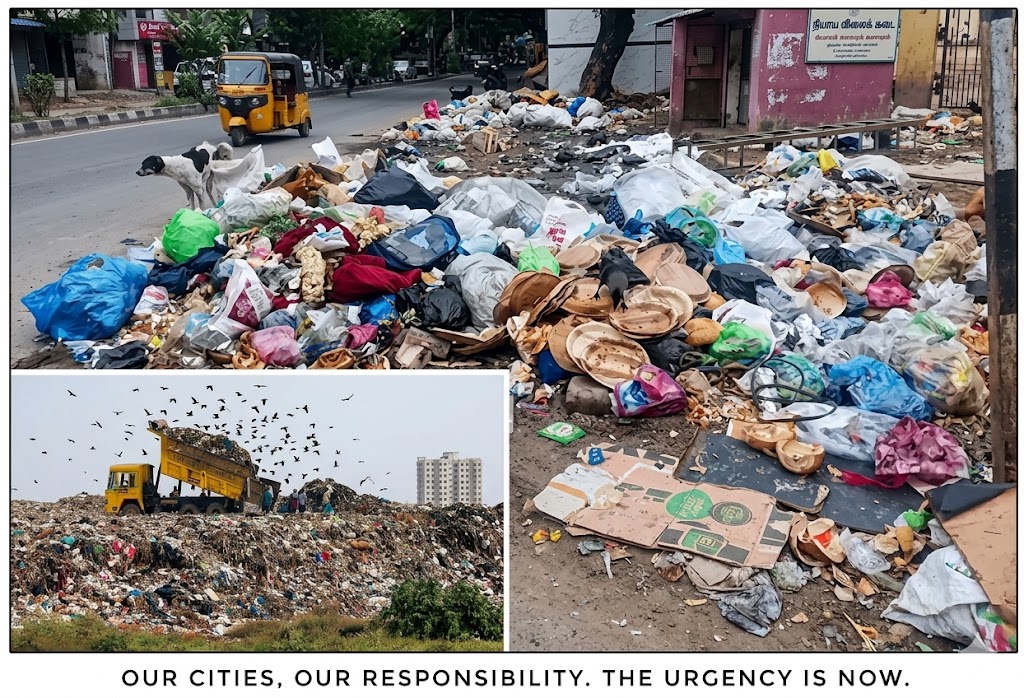
When looking at the complex challenges of urban governance, waste management consistently ranks near the top. Traditional state interventions usually focus on the end of the line—building massive landfills or upgrading heavy processing plants. However, the most sustainable, cost-effective solutions begin right inside the citizen’s kitchen.
The fundamental hurdle isn’t technology; it’s getting households to consistently separate wet and dry waste at the source. If state and municipal administrations want to solve this permanently, they can leverage an incredibly elegant, behavioral tool: incorporating a high-quality, two-bin system into annual welfare distributions—such as the state’s traditional Pongal gift hampers—backed by a smart co-payment model. Because true civic change begins at home, shifting the narrative from a “welfare handout” to a “partnership for the future” can revolutionize public psychology and create a cleaner, prouder society.
The Power of a Behavioral “Nudge”
Why should a government hand out dustbins for free? The answer lies in behavioral economics and Nudge Theory, which suggests that positive reinforcement and indirect suggestions are far more effective at changing human habits than strict mandates or penalties. What might look like an upfront public expense is actually a highly strategic civic investment that can pay massive dividends.
Overcoming the “Free” Trap: The ₹50 Co-Payment Model
Handing out bins entirely for free risks them being relegated to storage rooms or misused for other household purposes. To prevent this “freebie bias,” the administration can introduce a nominal co-payment of ₹50, which in turn will unlock the annual festive gift hamper.
A breakdown of the unit economics reveals how incredibly viable this model is:
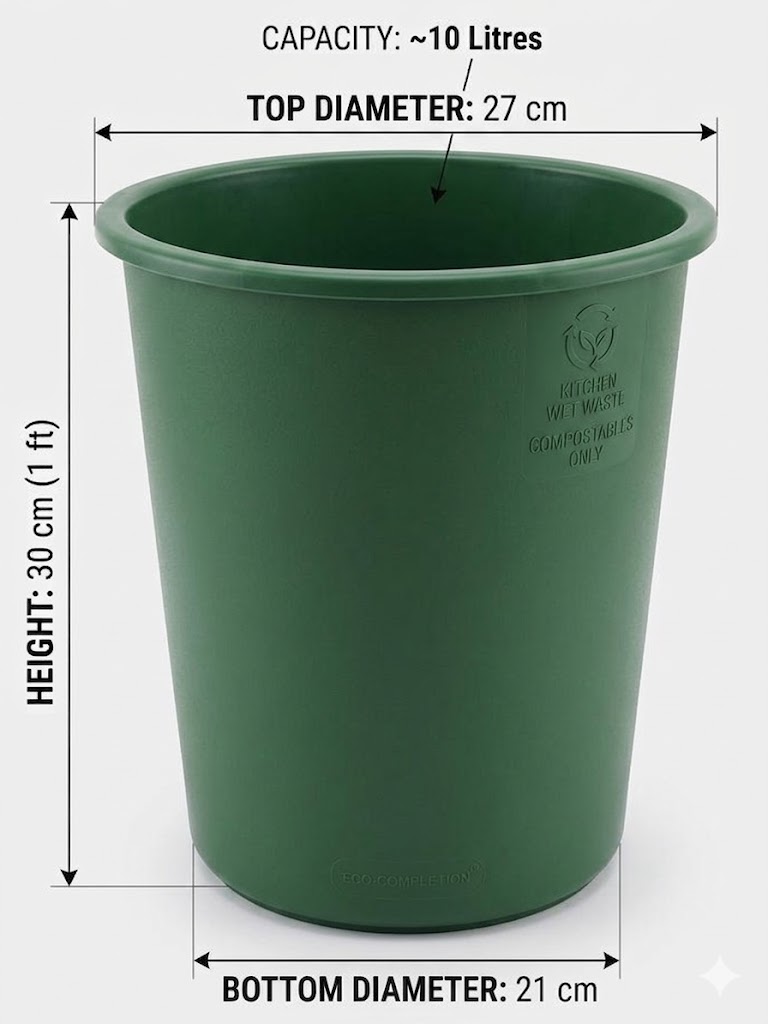
- The Math: Accounting for virgin plastic raw materials, bulk injection-mold manufacturing, transport, and warehousing, a single blue mesh bin costs roughly ₹30 to produce, while a sturdy, solid green bin costs around ₹60.
- The Subsidy: Rounded off, the actual manufacturing cost for a complete pair sits right at ₹100. For a state government already distributing a cash incentive of ₹1,000 per family as a Pongal gift, an additional expense of ₹100 is minuscule.
By subsidizing the cost—charging the citizen ₹50 and absorbing the remaining ₹50 as a targeted welfare measure—the household receives:
- One blue open-mesh bin designed specifically for dry plastics and recyclables.
- One sturdy green solid bin meant for kitchen wet waste.
This micro-investment completely alters user psychology. It removes the financial barrier for low-income households while ensuring that every citizen feels a true sense of ownership, because they paid for it.
Prioritizing Functionality Over Aesthetics
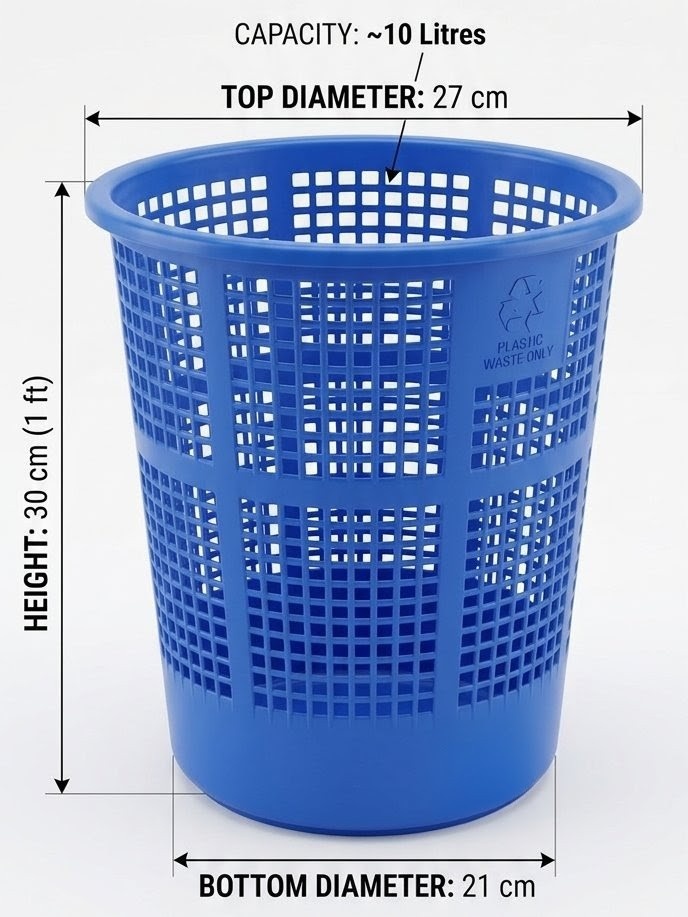
For a long time, home decor trends have dictated the look of household utilities. Plastic manufacturers design dustbins in whites, pinks, beige, and grays to match living room curtains or kitchen tiles. But when it comes to mass civic behavior, functionality must take priority over aesthetics. The state administration should advise and mandate plastic manufacturing companies to stick to strict, standardized color profiles for domestic waste bins. If households can only easily purchase green sturdy buckets and blue meshed bins in retail stores, it creates a universal visual language. No matter whose house you visit, blue always means plastic and green always means kitchen waste. This systemic uniformity makes it incredibly easy for the human brain to build a permanent, automatic habit.
Smart Logistics: The “No-Lid” Stacking Strategy
One of the largest hidden failures of municipal rollouts is the sheer nightmare of logistics and transport. Shipping millions of fully assembled pedal bins to local Public Distribution System (PDS) shops requires enormous truck volumes, driving up carbon footprints and warehousing costs.
The solution is brilliant in its simplicity: distribute only the open-top conical bins through the PDS system. Because the blue mesh bins and green solid buckets are tapered, they can be easily stacked one over the other and stored in a fraction of the space, making mass transport to rural and urban ration shops highly efficient.
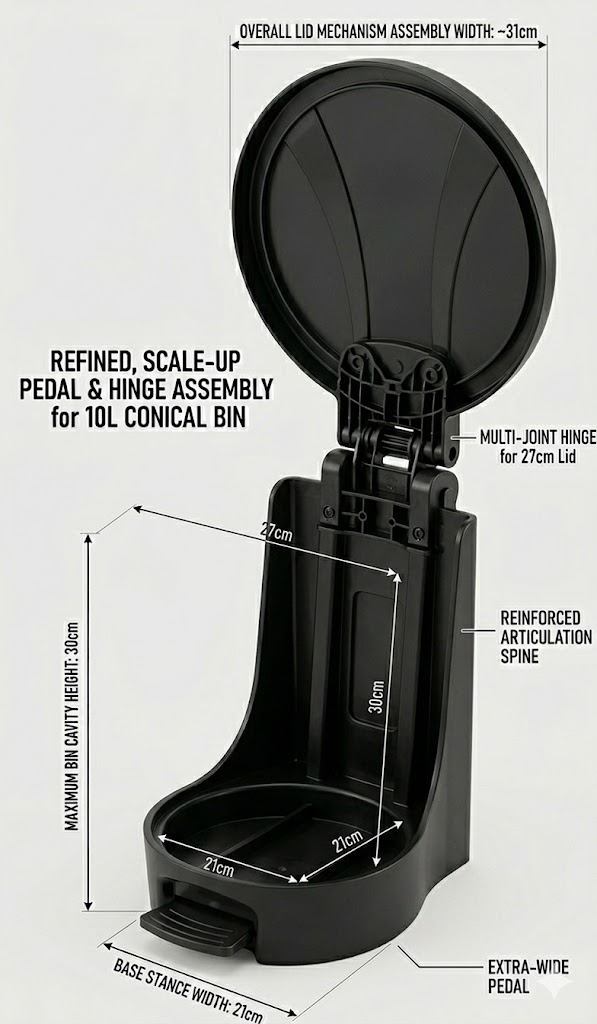
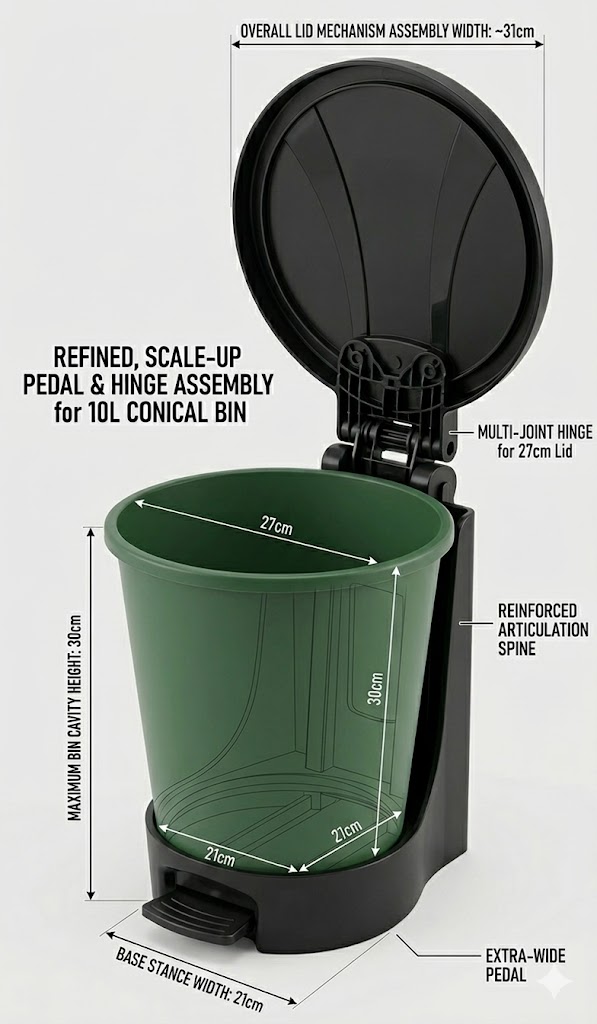
Where does the cover come from? The state administration can publish the standard dimensional blueprints of the bins (e.g., a standard 27 cm top diameter). Local plastic manufacturers and MSMEs can then produce matching lids and hands-free pedal assemblies to sell independently through local retail stores. Citizens who desire the premium convenience of a pedal lid can purchase it separately, fueling the local retail economy while keeping the government’s core distribution model lean and agile.
The Human Nudge: Empowering Our Sanitary Workers
Even with the right bins in place, old habits die hard. We have all seen waste collection vehicles blaring instructions on loudspeakers, yet many people still mindlessly hand over mixed garbage, often operating under the cynical assumption that all waste eventually ends up mixed together in the same landfill anyway. Loudspeakers can be ignored; human connection and clarity cannot.
The ultimate behavioral nudge happens right at the doorstep. When a municipal worker receives unsegregated waste, they should be empowered and trained to gently advise the resident on the spot, explicitly explaining the logistics of the operation: that the wet waste from their green bin is collected by a specific truck destined for composting, while the recyclable waste from their blue bin goes into an entirely separate vehicle headed straight for recycling. Human beings are deeply empathetic; while citizens easily tune out a recorded loudspeaker announcement, they listen, understand, and oblige when a hardworking sanitary worker looks them in the eye, clarifies exactly where their effort goes, and asks for cooperation. This brief, respectful request can bridge the gap between urban infrastructure and household empathy.
Focus First, Expand Later: The Phased Roadmap
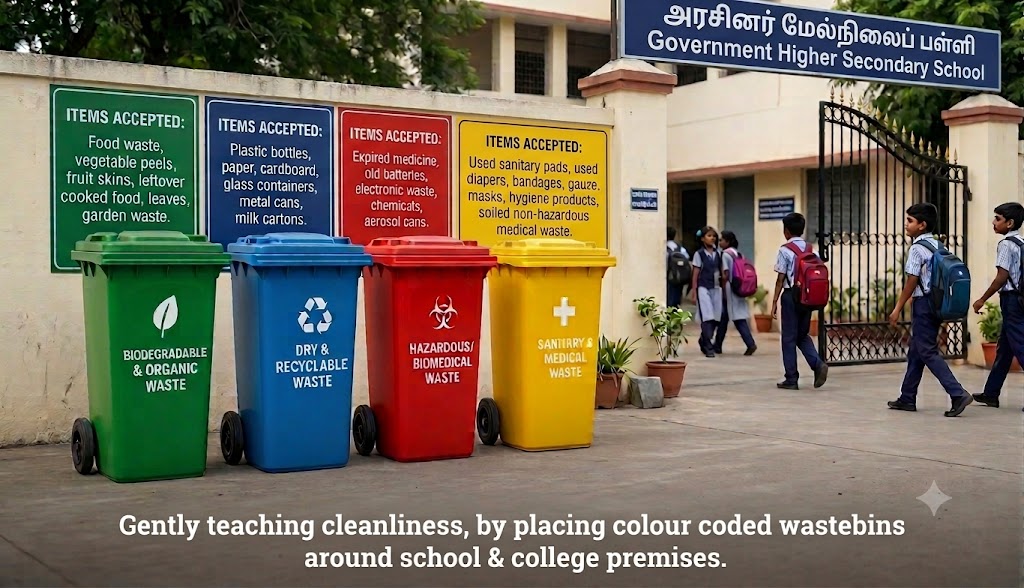
A comprehensive waste management framework globally relies on multiple colors: Green for organic, Blue for recyclables, Yellow for medical/sanitary waste, and Red for hazards. However, attempting to teach a large population to sort four or five streams of waste all at once creates cognitive overload, leading to confusion and systemic failure.
Progressive governance dictates a phased roadmap. For Year One, the administration should strictly restrict the exercise to the two fundamental pillars of household waste: Green and Blue.
Mastering the separation of wet kitchen scraps from dry plastic wrappers forms the foundation of environmental literacy. Once this habit is locked into the daily routine of every household, the government can naturally expand the initiative in subsequent years, introducing Yellow and Red bins to handle sanitary and hazardous waste. Success is built sequentially, one habit at a time.
Flipping the Script: Changing the Political Narrative
When any government introduces a household cleanliness tool like a dustbin into a public welfare program, opposition groups can often attempt to weaponize it. A cynical narrative can easily emerge, claiming the administration is “handing out trash cans to its citizens.”
To neutralize political friction, the entire initiative must be wrapped in an inspiring, behavior-shaping narrative. The communication should explicitly move away from “waste disposal” and focus heavily on civic pride, health, and our deep cultural roots. Centuries ago, John Wesley remarked that “Cleanliness is next to godliness,” and Mahatma Gandhi famously stated that “Sanitation is more important than independence.”
Messaging Shift:
- The Old Narrative: “The government is giving you bins to manage your garbage.”
- The Inspiring Narrative: “This festive season, we aren’t just celebrating our harvest; we are investing in the soil that gives it to us. The Green and Blue bins are tools of citizen pride—a partnership between the state and the people to build a healthier, disease-free environment for our children.”
When presented as an upgrade to a time-honored tradition, the bins cease to be perceived as political commodities. Instead, they become a badge of civic responsibility.
The Ultimate Return on Investment: A Triple-Win for the State
Great governance is rarely about building the most complex, high-cost infrastructure; it is about designing an environment that makes civic virtue the easiest path to choose. By splitting the estimated ₹100 manufacturing cost of the two-bin system equally between a government subsidy and a citizen’s ₹50 co-payment, a state-wide rollout becomes incredibly affordable. This micro-investment triggers a massive chain reaction of benefits that easily pays for the project within its very first year.
First, the city experiences immense financial relief; receiving pre-segregated waste drastically slashes landfill transportation costs and “tipping fees” because clean dry waste can be routed straight to recycling streams while organic waste moves to processing plants. Second, it unlocks economic opportunities and revenue generation, transforming a municipal cleanliness department from a pure cost center into a value creator. Clean wet waste from green bins can feed compressed bio-gas (CBG) facilities to generate rich fertilizers for agriculture, while clean plastic from blue bins fuels local recycling industries, boosting green jobs. Finally, it creates a healthier planet. When food waste is buried mixed-up in a traditional landfill, it is starved of oxygen. This leads to anaerobic decomposition, which releases methane—a greenhouse gas over 25 times more potent than carbon dioxide at trapping heat. Proper source segregation ensures kitchen waste is aerated and composted safely, cutting down a city’s carbon footprint overnight while reducing the public health hazards of vector-borne diseases from open dumpsites.
Ultimately, transforming a festive gift into a shared social contract empowers everyday citizens to protect their environment—one household, two bins, and three seconds at a time.
P.S. Writing about dustbins, waste, and public distribution might feel like an unusually mundane topic for a policy discussion. But the intention of this post isn’t about garbage or to demean the citizens — it is about nudging behavioral change in a respectful way and as a shared responsibility, thereby aiming for a cleaner, healthier society.
Dustbin is how the container that is used to temporarily store and discard waste is called in India. Other countries use the terms like Trash can, Trash bin, Rubbish bin, Garbage can, Waste basket…etc.
*This blog post was refined using Gemini.
Addendum: The Institutional Nudge
A comment from my school type Reji sir, about how civic discipline is hardwired into children, directly by their schools rather than at home, made me think: What if our education departments led by example?
Instead of treating cleanliness as an abstract textbook lesson, what if the Department of School Education and the Department of Higher Education nudged campuses to install standardized, color-coded bin stations with clear instructional boards. Leading by example, with this physical infrastructure can make source segregation an automatic, daily reflex and a life long behaviour.
Change begins at home, and is polished in classrooms.