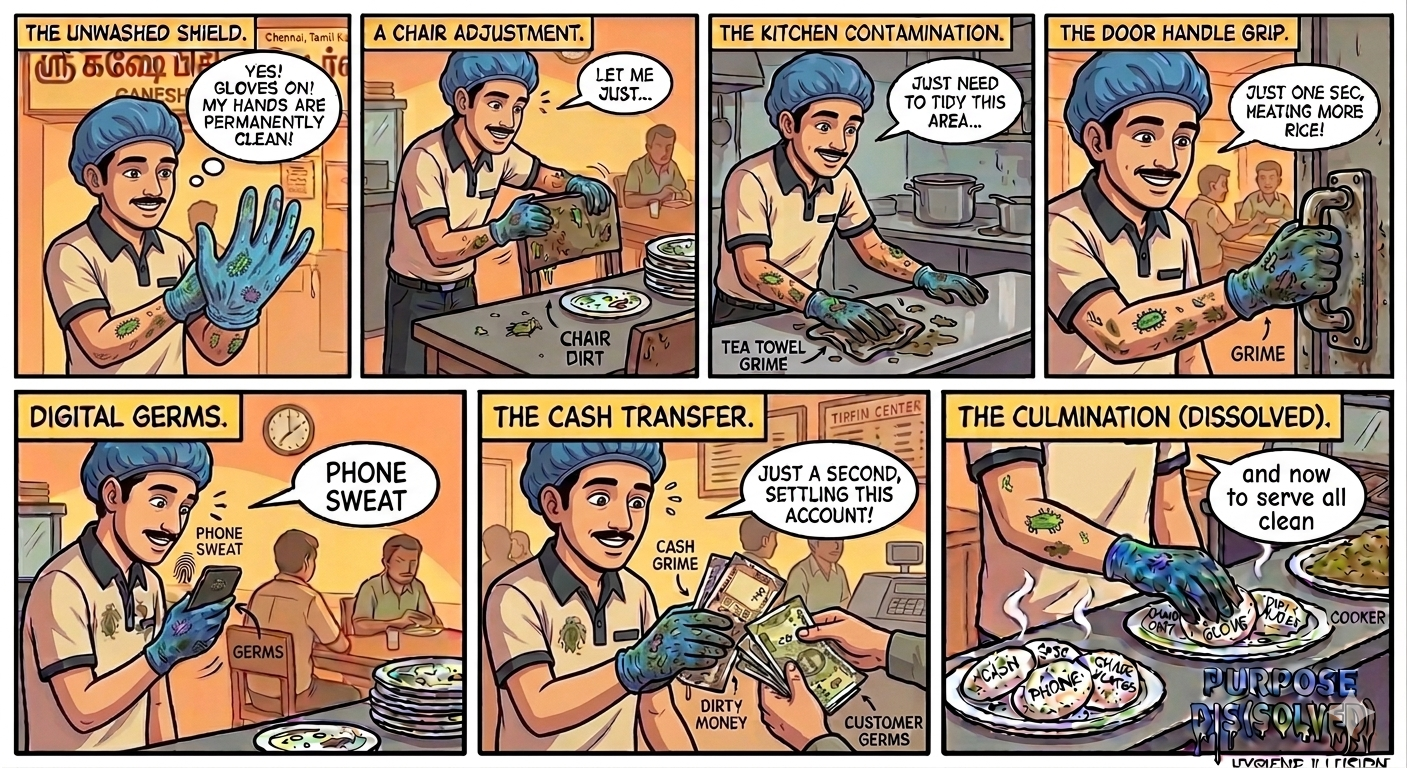
A few years ago, observing the broken home boundary wall led me to write about Frank and Lillian Gilbreth’s Therbligs—the fundamental units of physical motion designed to eliminate friction and wasted effort. The premise was simple: when a system fails to standardize basic units of work, confusion and inefficiency inevitably fill the vacuum.
I was reminded of this principle recently while holding a laboratory test requisition form at a children’s hospital in Chennai.
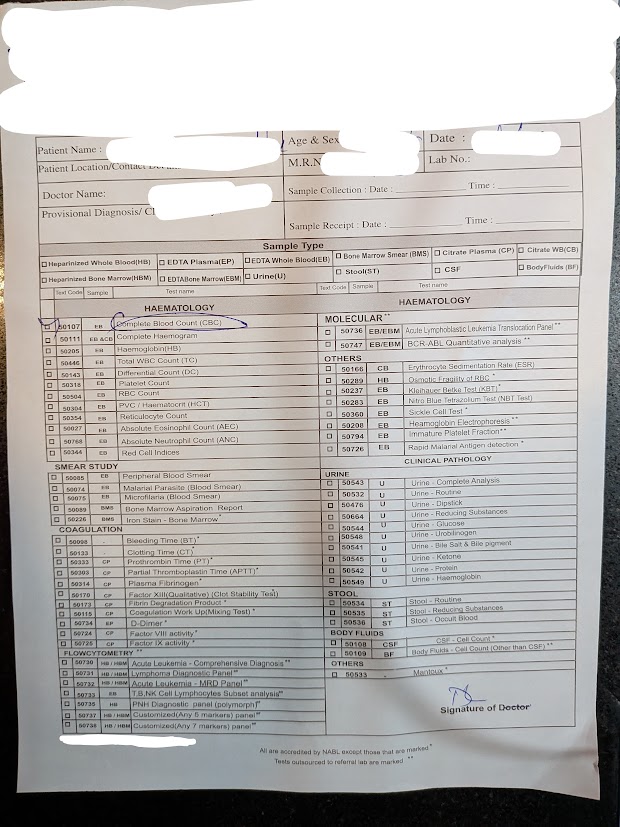
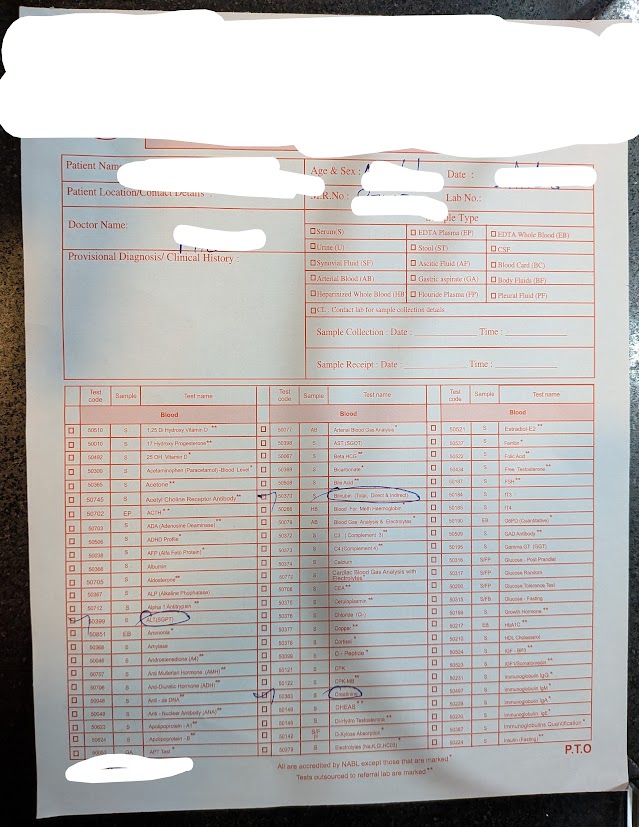
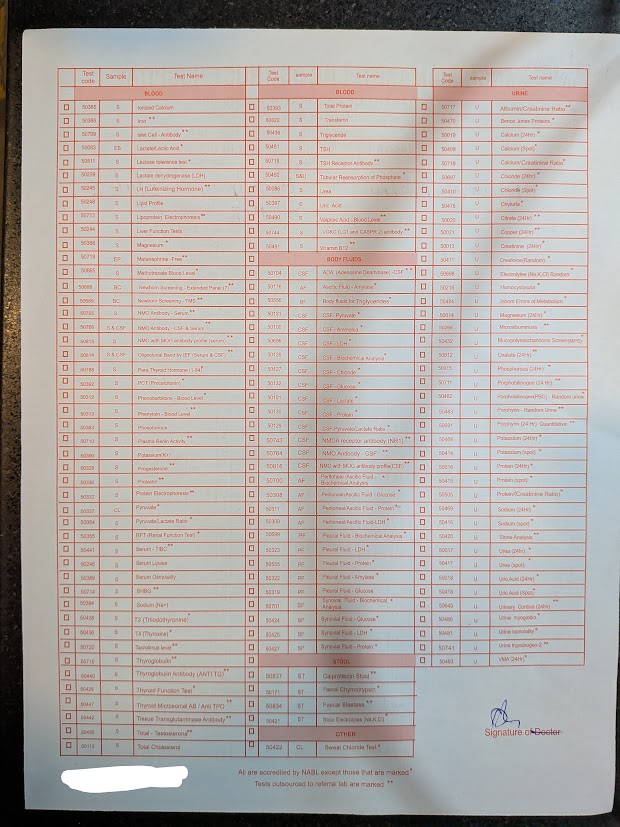
Instead of the usual hurried scribble on a prescription slip, the hospital handed over a structured, cataloged sheet. Across multiple columns, tests were neatly indexed with dedicated checkboxes, sample requirements (serum, EDTA blood, urine), and unique 5-digit test codes.
Seeing that grid immediately brought the system architect in me to attention. It proved that diagnostic ambiguity isn’t an inevitable byproduct of clinical practice—it is an operational problem with an obvious design solution.
The Prescription Pad Gamble
In most clinics and outpatient consultations, lab investigations are still handwritten on general prescription pads. While illegible handwriting has long been a cultural cliché, in clinical testing, ambiguity introduces real operational hazards:
- Diagnostic Ambiguity: A handwritten note for a chest X-ray often omits critical orientation details (e.g., whether the radiologist requires an anterior-posterior, lateral, or oblique view).
- Transcription Errors: Similar-sounding tests or distinct sub-profiles can easily be conflated at billing or phlebotomy counters, leading to incorrect vial collection or invalid fasting instructions.
- Wasted Motion: When technicians cannot decipher a doctor’s handwriting, the workflow halts. The patient is shuttled back, phone calls are made, or an educated guess is taken—a needless loop of friction for an anxious family.
Pre-printed requisition sheets eliminate this guesswork. A checkbox next to an indexed entry—such as a Complete Blood Count or a specific liver enzyme panel—leaves zero room for misinterpretation. The phlebotomist immediately knows the exact investigation, the required vial type, and the handling protocol.
Yet, the moment you leave that hospital’s diagnostic desk, a glaring flaw emerges: the system is an island.
The Friction of Hospital-Specific Codes
In that particular hospital, an ALT (SGPT) test might be cataloged under code 50399. Walk across the street to another diagnostic laboratory or multi-specialty hospital, and that number is completely meaningless. The next provider either uses an entirely different internal numbering scheme or reverts to an unstandardized paper slip.
When every healthcare institution invents its own proprietary catalog, patients shoulder the systemic burden:
- Portability Breaks: If a specialist at a tertiary hospital recommends a panel of tests, but the patient chooses to get them done at a trusted neighborhood laboratory closer to home, the requisition sheet loses its systematic value. The local lab must manually decipher, translate, and re-enter each investigation into their own internal software.
- Health Records Fragment: Tracking longitudinal health trends across different clinics becomes a tedious chore of reconciling non-standardized reports and differing panel names.
The Four-Step Roadmap: How the Ministry Can Build the Standard
Creating a national diagnostic taxonomy does not require reinvention from scratch; it requires crowdsourcing and central curation.
The Ministry of Health and Family Welfare (MoHFW), Government of India, working in tandem with state health departments and leading public and private hospital chains, can roll this out through a straightforward framework:
- Collate the Ground Truth Across States: The Ministry can issue a directive requesting sample requisition forms and diagnostic master catalogs from government medical colleges, private hospital chains, and standalone lab networks across the country. Even if collating these uncovers over 500 distinct clinical tests, compiling them side by side will immediately expose overlapping nomenclature and common test groupings.
- Publish an Open National Diagnostic Code Master: A clinical expert committee can rationalize the master list into a single, standardized directory—assigning a universal test code, official standardized name, specimen parameter, and baseline methodology to each investigation. This master index can be published directly on the MoHFW portal as an open, freely accessible data dictionary.
- Distribute Standardized, Reusable Print Templates: To drive adoption across smaller clinics, nursing homes, and standalone labs with limited IT budgets, the Ministry can design standard, modular printable templates (organized logically by Biochemistry, Hematology, and Clinical Pathology). The core body of the form—complete with checkboxes, national test codes, and specimen parameters—remains strictly standardized. Healthcare facilities can simply download the official template, add their own hospital logo and patient registration details to the top header, and put it to work immediately.
- Incentivize Compliance via Accreditation: Adopting these standard codes can be integrated into existing quality benchmarks, such as NABH accreditation standards and digital integration milestones under the Ayushman Bharat Digital Mission (ABDM).
Democratizing Price Discovery
Standardizing diagnostic nomenclature solves clinical ambiguity, but its broader economic impact is even more significant: it democratizes cost transparency.
In consumer retail, universal barcodes (UPCs and EANs) enable consumers to instantly check and compare product prices across different sellers. In healthcare, comparing diagnostic costs is nearly impossible. If you try to compare the cost of a “Thyroid Profile” or a “Kidney Function Test” across three private hospitals, you are rarely comparing identical offerings. One facility bundles specific electrolytes while another bills them separately as an add-on.
Anchoring every diagnostic investigation to a universal national code allows:
- Patients to search an investigation code and view real-time price distributions across nearby accredited facilities.
- Discrepancies in markup between neighborhood labs and corporate hospitals to become transparent.
- Market forces and informed patient choices to naturally check arbitrary pricing for routine, high-volume blood work.
The Next Frontier: Standardizing the Inpatient Hospital Bill
The diagnostic requisition slip is only one visible symptom of a broader issue. The exact same ambiguity plagues inpatient hospital billing.
Anyone who has settled an inpatient hospital bill—or navigated a health insurance reimbursement claim—knows the bewilderment of reading the final summary:
- Nursing Charges – Level 2
- Consumables & Tray Setup
- Procedure Assist Overhead
- Ward Service Fee
No two healthcare institutions categorize, bundle, or name these expenses identically. A daily bed charge in one hospital might bundle basic nursing monitoring, while another itemizes it into three separate ancillary charges.
Standardizing hospital billing software with a unified catalog for room categories, procedural steps, equipment utilization, and consumable packs would transform healthcare administration:
- Instant Adjudication of Insurance Claims: Today, claims processing is bogged down by manual audits, back-and-forth query letters, and arbitrary deductions for “non-payable items.” A standardized billing schema enables automated, rule-based claim settlement, slashing overhead for insurers and ending payment anxiety for families.
- Elimination of Hidden Cross-Subsidies: Clear, non-fungible billing codes bring clarity to how facilities structure basic overheads versus applying high markups to basic disposables.
- Auditable Benchmarks for Public Health: Health authorities can easily track median procedure and room costs across districts, identifying price gouging and establishing realistic baselines for government-sponsored welfare schemes.
Standardization is not administrative bureaucracy; it is the fundamental infrastructure that makes scale, trust, and operational efficiency possible. Just as standardized shipping container dimensions transformed global logistics, standardizing medical taxonomy is essential for genuine digital health portability.
Eliminating handwriting ambiguity with a simple pre-printed checkbox is a great first step. The real milestone lies in building an interoperable public health framework where every test, every code, and every rupee is universally understood across the country.
Samples of Test Requisition Forms
*This post has been refined using Gemini.