Change Begins at Home: Can Gifting Bins Nudge a Change?

In my previous post on the Problem with Free, we explored a fundamental human truth: when something is given entirely for free, we tend to undervalue it. True value is born when we invest even a small amount of our own skin in the game. In this post, I want to highlight how shifting the model from a total “freebie” to a strategically subsidized partnership can have a massive, lasting impact on both our society and our environment.

“Outer order contributes to inner calm.” – Gretchen Rubin
If we want to bring that order and calm to our expanding cities, we have to look closely at our daily civic habits.
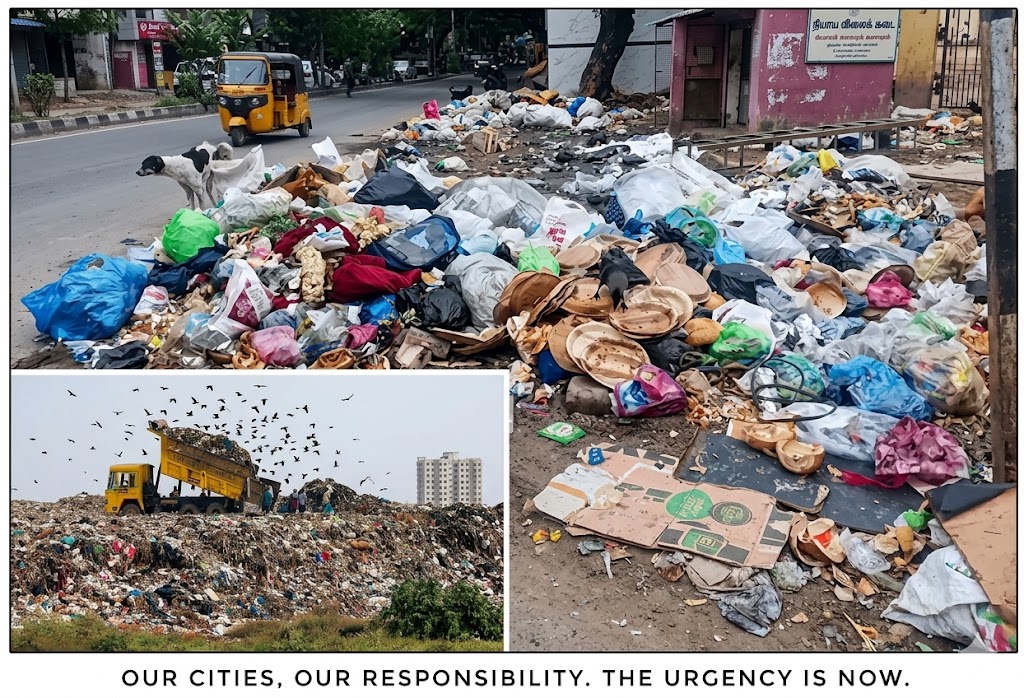
Image generated using Gemini

When looking at the complex challenges of urban governance, waste management consistently ranks near the top. Traditional state interventions usually focus on the end of the line—building massive landfills or upgrading heavy processing plants. However, the most sustainable, cost-effective solutions begin right inside the citizen’s kitchen.

The fundamental hurdle isn’t technology; it’s getting households to consistently separate wet and dry waste at the source. If state and municipal administrations want to solve this permanently, they can leverage an incredibly elegant, behavioral tool: incorporating a high-quality, two-bin system into annual welfare distributions—such as the state’s traditional Pongal gift hampers—backed by a smart co-payment model. Because true civic change begins at home, shifting the narrative from a “welfare handout” to a “partnership for the future” can revolutionize public psychology and create a cleaner, prouder society.

The Power of a Behavioral “Nudge”

Why should a government hand out dustbins for free? The answer lies in behavioral economics and Nudge Theory, which suggests that positive reinforcement and indirect suggestions are far more effective at changing human habits than strict mandates or penalties. What might look like an upfront public expense is actually a highly strategic civic investment that can pay massive dividends.

Overcoming the “Free” Trap: The ₹50 Co-Payment Model

Handing out bins entirely for free risks them being relegated to storage rooms or misused for other household purposes. To prevent this “freebie bias,” the administration can introduce a nominal co-payment of ₹50, which in turn will unlock the annual festive gift hamper.

A breakdown of the unit economics reveals how incredibly viable this model is:

  • The Math: Accounting for virgin plastic raw materials, bulk injection-mold manufacturing, transport, and warehousing, a single blue mesh bin costs roughly ₹30 to produce, while a sturdy, solid green bin costs around ₹60.
  • The Subsidy: Rounded off, the actual manufacturing cost for a complete pair sits right at ₹100. For a state government already distributing a cash incentive of ₹1,000 per family as a Pongal gift, an additional expense of ₹100 is minuscule.

By subsidizing the cost—charging the citizen ₹50 and absorbing the remaining ₹50 as a targeted welfare measure—the household receives:

  • One blue open-mesh bin designed specifically for dry plastics and recyclables.
  • One sturdy green solid bin meant for kitchen wet waste.

This micro-investment completely alters user psychology. It removes the financial barrier for low-income households while ensuring that every citizen feels a true sense of ownership, because they paid for it.
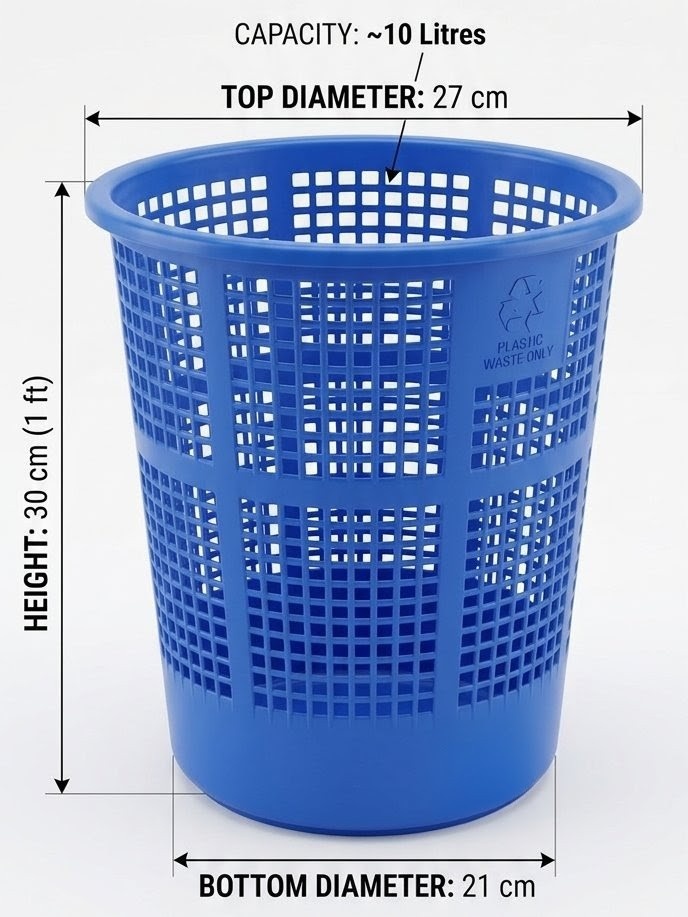
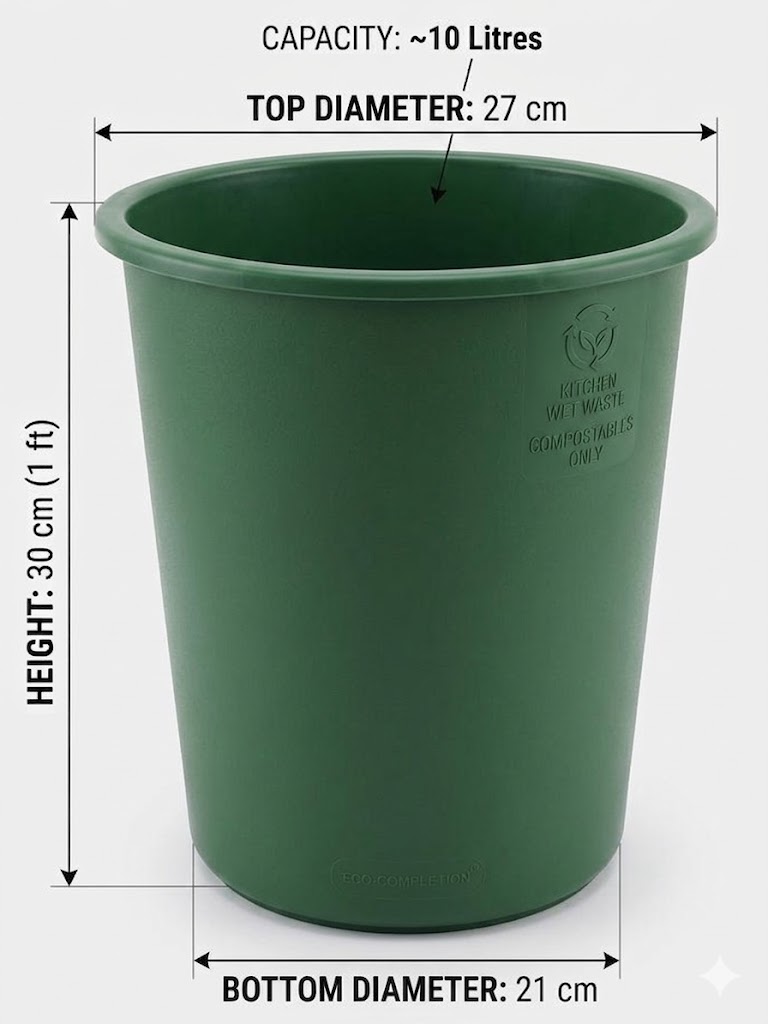
Images generated using Gemini

Prioritizing Functionality Over Aesthetics

For a long time, home decor trends have dictated the look of household utilities. Plastic manufacturers design dustbins in whites, pinks, beige, and grays to match living room curtains or kitchen tiles. But when it comes to mass civic behavior, functionality must take priority over aesthetics. The state administration should advise and mandate plastic manufacturing companies to stick to strict, standardized color profiles for domestic waste bins. If households can only easily purchase green sturdy buckets and blue meshed bins in retail stores, it creates a universal visual language. No matter whose house you visit, blue always means plastic and green always means kitchen waste. This systemic uniformity makes it incredibly easy for the human brain to build a permanent, automatic habit.

Smart Logistics: The “No-Lid” Stacking Strategy

One of the largest hidden failures of municipal rollouts is the sheer nightmare of logistics and transport. Shipping millions of fully assembled pedal bins to local Public Distribution System (PDS) shops requires enormous truck volumes, driving up carbon footprints and warehousing costs.

The solution is brilliant in its simplicity: distribute only the open-top conical bins through the PDS system. Because the blue mesh bins and green solid buckets are tapered, they can be easily stacked one over the other and stored in a fraction of the space, making mass transport to rural and urban ration shops highly efficient.

Where does the cover come from? The state administration can publish the standard dimensional blueprints of the bins (e.g., a standard 27 cm top diameter). Local plastic manufacturers and MSMEs can then produce matching lids and hands-free pedal assemblies to sell independently through local retail stores. Citizens who desire the premium convenience of a pedal lid can purchase it separately, fueling the local retail economy while keeping the government’s core distribution model lean and agile.


Images generated using Gemini

The Human Nudge: Empowering Our Sanitary Workers

Even with the right bins in place, old habits die hard. We have all seen waste collection vehicles blaring instructions on loudspeakers, yet many people still mindlessly hand over mixed garbage, often operating under the cynical assumption that all waste eventually ends up mixed together in the same landfill anyway. Loudspeakers can be ignored; human connection and clarity cannot.

The ultimate behavioral nudge happens right at the doorstep. When a municipal worker receives unsegregated waste, they should be empowered and trained to gently advise the resident on the spot, explicitly explaining the logistics of the operation: that the wet waste from their green bin is collected by a specific truck destined for composting, while the recyclable waste from their blue bin goes into an entirely separate vehicle headed straight for recycling. Human beings are deeply empathetic; while citizens easily tune out a recorded loudspeaker announcement, they listen, understand, and oblige when a hardworking sanitary worker looks them in the eye, clarifies exactly where their effort goes, and asks for cooperation. This brief, respectful request can bridge the gap between urban infrastructure and household empathy.

Focus First, Expand Later: The Phased Roadmap

A comprehensive waste management framework globally relies on multiple colors: Green for organic, Blue for recyclables, Yellow for medical/sanitary waste, and Red for hazards. However, attempting to teach a large population to sort four or five streams of waste all at once creates cognitive overload, leading to confusion and systemic failure.

Progressive governance dictates a phased roadmap. For Year One, the administration should strictly restrict the exercise to the two fundamental pillars of household waste: Green and Blue.

Mastering the separation of wet kitchen scraps from dry plastic wrappers forms the foundation of environmental literacy. Once this habit is locked into the daily routine of every household, the government can naturally expand the initiative in subsequent years, introducing Yellow and Red bins to handle sanitary and hazardous waste. Success is built sequentially, one habit at a time.

Flipping the Script: Changing the Political Narrative

When any government introduces a household cleanliness tool like a dustbin into a public welfare program, opposition groups can often attempt to weaponize it. A cynical narrative can easily emerge, claiming the administration is “handing out trash cans to its citizens.”

To neutralize political friction, the entire initiative must be wrapped in an inspiring, behavior-shaping narrative. The communication should explicitly move away from “waste disposal” and focus heavily on civic pride, health, and our deep cultural roots. Centuries ago, John Wesley remarked that “Cleanliness is next to godliness,” and Mahatma Gandhi famously stated that “Sanitation is more important than independence.”

Messaging Shift:

  • The Old Narrative: “The government is giving you bins to manage your garbage.”
  • The Inspiring Narrative: “This festive season, we aren’t just celebrating our harvest; we are investing in the soil that gives it to us. The Green and Blue bins are tools of citizen pride—a partnership between the state and the people to build a healthier, disease-free environment for our children.”

When presented as an upgrade to a time-honored tradition, the bins cease to be perceived as political commodities. Instead, they become a badge of civic responsibility.

The Ultimate Return on Investment: A Triple-Win for the State

Great governance is rarely about building the most complex, high-cost infrastructure; it is about designing an environment that makes civic virtue the easiest path to choose. By splitting the estimated ₹100 manufacturing cost of the two-bin system equally between a government subsidy and a citizen’s ₹50 co-payment, a state-wide rollout becomes incredibly affordable. This micro-investment triggers a massive chain reaction of benefits that easily pays for the project within its very first year.

First, the city experiences immense financial relief; receiving pre-segregated waste drastically slashes landfill transportation costs and “tipping fees” because clean dry waste can be routed straight to recycling streams while organic waste moves to processing plants. Second, it unlocks economic opportunities and revenue generation, transforming a municipal cleanliness department from a pure cost center into a value creator. Clean wet waste from green bins can feed compressed bio-gas (CBG) facilities to generate rich fertilizers for agriculture, while clean plastic from blue bins fuels local recycling industries, boosting green jobs. Finally, it creates a healthier planet. When food waste is buried mixed-up in a traditional landfill, it is starved of oxygen. This leads to anaerobic decomposition, which releases methane—a greenhouse gas over 25 times more potent than carbon dioxide at trapping heat. Proper source segregation ensures kitchen waste is aerated and composted safely, cutting down a city’s carbon footprint overnight while reducing the public health hazards of vector-borne diseases from open dumpsites.

Ultimately, transforming a festive gift into a shared social contract empowers everyday citizens to protect their environment—one household, two bins, and three seconds at a time.

P.S. Writing about dustbins, waste, and public distribution might feel like an unusually mundane topic for a policy discussion. But the intention of this post isn’t about garbage or to demean the citizens — it is about nudging behavioral change in a respectful way and as a shared responsibility, thereby aiming for a cleaner, healthier society.

Dustbin is how the container that is used to temporarily store and discard waste is called in India. Other countries use the terms like Trash can, Trash bin, Rubbish bin, Garbage can, Waste basket…etc.

*This blog post was refined using Gemini.

Addendum: The Institutional Nudge

A comment from my school type Reji sir, about how civic discipline is hardwired into children, directly by their schools rather than at home, made me think: What if our education departments led by example?

Instead of treating cleanliness as an abstract textbook lesson, what if the Department of School Education and the Department of Higher Education nudged campuses to install standardized, color-coded bin stations with clear instructional boards. Leading by example, with this physical infrastructure can make source segregation an automatic, daily reflex and a life long behaviour.

Change begins at home, and is polished in classrooms.
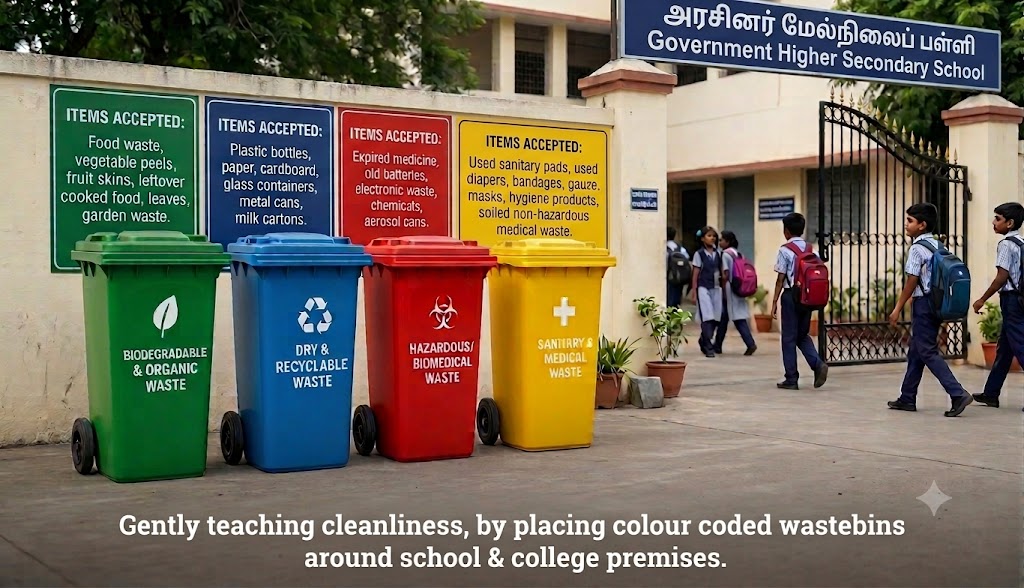
Image generated using Gemini.

The Problem with Free: We Don’t Value It

“That which we obtain too easily, we esteem too lightly.”Thomas Paine

There is a fundamental quirk in human psychology: what is given too freely is almost always valued too cheaply. When the price tag of a commodity or a gesture drops to absolute zero, its perceived value often plummets with it.

We see this play out constantly, from macro-level government policies to corporate boardrooms, and even in our closest neighborhoods.

1. The State Government Dilemma: Welfare vs. Worth

Over the years, successive state governments have rolled out massive welfare schemes distributing free televisions, fans, mixers, and grinders. This isn’t a critique of social justice—welfare has its place. However, the execution exposes a flaw in how we perceive free items.

Walk into second-hand shops, and you will find piles of these pristine, government-issued appliances. Many recipients sold their free TVs immediately—some even packaged them off to student hostels in neighboring states for quick cash.

The psychological shift happens at the price point. If the government had charged even a token amount—say, ₹100—the public narrative would have changed. It would no longer be “free junk”; it would be a heavily subsidized asset worth protecting.

The Concept of ‘Skin in the Game’ through Civic Action
If charging a nominal financial fee is politically or logistically impractical for a welfare scheme, the state can introduce cost through a different currency: personal accountability. What if freebies or social security benefits were linked to conditional milestones?

For instance, to qualify for a government benefit, a citizen might need to demonstrate that they have bought a basic term insurance policy to insulate their family from sudden poverty, or drafted a legal will to eliminate generational property disputes. By introducing these nudges, the government transforms a passive handout into an active tool for social engineering. It forces the recipient to think about long-term stability, ensuring that while the benefit is free, the right to access it requires a meaningful commitment to their family’s future.

2. The Corporate Cafeteria: From Gratitude to Grievance

Step into the corporate world, and you see the exact same behavior. Many top-tier companies offer lavish, free buffet meals to keep their employees fueled and happy. Yet, day after day, you can hear employees cribbing about the menu options or the salt levels.

Constructive feedback is healthy, but habitual complaining about a premium, free benefit is a symptom of entitlement.

The reality is, nobody is forcing employees to eat at the office cafeteria. It is an entirely optional perk. If someone feels that the free meal doesn’t cater to their specific taste, they are well within their rights to bring food from home or eat elsewhere. Blaming the company for a voluntary benefit makes little sense.

Now, imagine if the company priced that exact same buffet at a nominal ₹5. Instantly, the psychological context flips. The narrative changes from “This free food is mediocre” to “Wow, where else on earth can I get a massive, delicious buffet for just five rupees?”

There is an old, wise saying that applies perfectly here: “Don’t tell the person carrying you up a hilltop that they smell bad. If you don’t like it, get down and walk.”

3. The Commute Complaint: Nodal Points vs. Entitlement

This psychological blind spot doesn’t stop at the cafeteria; it extends right into the office transport bay.

Consider a company that provides free, air-conditioned cabs for employee pickups and drops. To keep commute times efficient and fair for everyone, the transport department asks employees to walk a few meters to a designated “nodal point” on the main road. It makes logical sense: navigating narrow residential streets during peak-hour traffic delays the entire cab and inconveniences everyone else on board.

Yet, rather than walking those few short steps or choosing to commute using their own vehicles, many employees still crib about the service. They overlook the massive financial and logistical burden the company is lifting off their shoulders.

What makes the complaining even more unreasonable is that the company does provide doorstep drops during night shifts or pre-dawn pickups to ensure safety. But during normal hours, when the policy is optimized for the collective good, the concept of a “free ride” makes people focus entirely on their minor inconvenience rather than the major benefit.

Once again, when a premium service costs zero rupees, our expectations skyrocket to unreasonable heights.

4. The Neighborhood Lesson: When Charity Hurts Self-Esteem

Perhaps the most profound example of this happens at a deeply personal level, where giving freely can inadvertently hurt the very person you want to help.

In my village, a neighbor rented a small room to a daily wage laborer for ₹800 a month. When a member of the tenant’s family developed a severe kidney complication, the medical bills broke them. Seeing their struggle, the kind-hearted house owner waived their rent for two months to let them recover.

Instead of being relieved, the tenants abruptly packed their bags and vacated the house. The house owner was stunned. Why leave when someone is actively trying to support you?

What he later realized was a masterclass in human dignity: living entirely rent-free had severely bruised the tenant’s self-esteem. Furthermore, they carried the crushing anxiety that the neighbors would look down on them as objects of charity. By trying to eliminate their financial burden entirely, the house owner had inadvertently created a psychological one.

The Takeaway

Human beings are wired to equate cost with commitment. When we pay nothing, we invest nothing—neither our gratitude nor our respect. Whether you are running a state, managing a corporate team, or helping a neighbor, sometimes the best way to preserve someone’s dignity and value for what you offer is to ensure they have skin in the game. Sometimes that means charging a token financial price; other times, it means demanding a baseline of personal accountability and civic action. True value is never found in a passive handout; it is forged when we are asked to invest something of ourselves in return.

What are your thoughts on this? Have you ever noticed a situation where giving something away for free completely changed how people valued it? Let’s discuss in the comments below!

P.S. This post is purely a psychological observation on human behavior; it is not a critique of social justice schemes or the intentions of kind-hearted samaritans.

*This blog post was refined using Gemini.

The Transparency Stack: Radical Accountability from Ward to Assembly

In my childhood, while visiting my uncle’s house in Erode, my father would always point out the sights as we passed through the central bus stand or by the district collectorate. He loved to praise how neatly planned and massive the bus stand was, and how tall the collectorate building stood. He always credited this development to a past minister in the MGR cabinet, who had transformed his constituency by bringing in the bus stand, the collectorate, and the IRTT engineering and medical colleges. It was a clear, inspiring example of how an elected representative can contribute positively and transform his constituency.

But as I grew older, I realized how difficult it is for an ordinary citizen to track what each elected representative has actually done for his constituency across different tenures. In a modern democracy, we shouldn’t need a Right to Information (RTI) application just to see what our representatives are doing. Accountability should be proactive, not reactive.

In 2019, I shared “A Common Man’s Wish List for Good Governance,” where I dreamt of portals like fundsandspends.gov.in. Today, I want to evolve that wish into a technical reality: The Transparency Stack. This is a roadmap for the new government to move accountability from the cupboard to the cloud/computer, scaling tracking from the village ward all the way to the Legislative Assembly.

Part 1: The Manifesto Tracker (Pre-Election)

Accountability begins before the first vote is cast. Currently, manifestos are treated as marketing brochures that vanish after polling day. We need to turn them into Digital Contracts overseen by the Election Commission.

  • The Database of Manifestoes: Parties and candidates should submit their manifestos in a standardized data format to be displayed transparently on the official Election Commission website.
  • The Funding Logic: For every major promise (e.g., “Free electricity”), parties must disclose the estimated budget and the source of funds. Will it come from new taxes, a reduction in other subsidies, or increased public debt?
  • Targeting & Timeline: Each promise should explicitly define its target demographic (farmers, students, SMEs), the Nodal Ministry responsible, and a clear implementation timeline (e.g., a “100-day plan” vs. a 5-year project).
  • Institutional Memory: Digitization ensures these promises aren’t swept away once campaign rallies end.

Part 2: The Transparency Dashboard (From MLAs to Ward Members)

Once a government takes power, we need to track the “Rupee Trail.” To kick this off, the government can launch a Minimum Viable Product (MVP) focusing on an MLA fund tracker, partnering with civic tech organizations like the eGov Foundation and leveraging the open-source DIGIT platform.

The MVP dashboard could look like this:

ConstituencyMLAFunds AllocatedYearProjects ImplementedFunds Utilized per ProjectContracting FirmFirm DirectorsRemaining Fund Balance
Erode EastName₹3 Crore2026Link Road X₹45 LakhsABC Infra LtdMallika, Sundar₹2.55 Crore

  • Vertical Scaling: Once fine-tuned, this digital infrastructure should scale upward to MPs and downward to Local Bodies. A citizen should be able to see the exact fund allocations and expenditures for their Panchayat President, Union Chairperson, and Ward Councilor.
  • The Citizen Wishlist: We must move beyond passive data viewing. Citizens should be able to “pin” hyper-local needs—like “Need a bridge at X location,” “Primary Health Center needs staff,” or “Need streetlights at Y street.” This builds a data-driven priority list for elected officials, replacing guesswork with the community’s true needs.

Part 3: The Public Cost Center (Which department is responsible?)

In the corporate world, every project, expense, or hire is tied to a Cost Center. You always know who the financial sponsor is. In public life, when we see a broken road or a failing utility, citizens are caught in a classic “blame game” between the MLA, the Ward Councilor, and the executive bureaucracy.

The Transparency Stack solves this by assigning a Digital Cost Center to all public infrastructure assets through QR-code asset tagging. Scanning a QR code on a street sign or water station would instantly reveal:

  • The Sponsor: Was this funded by the MLA fund, an MP grant, or a municipal budget?
  • The Executor: Which specific department (PWD, Corporation, TWAD board) owns the asset?
  • The Point of Contact: The name and office contact details of the specific Executive Engineer responsible for its upkeep.

Part 4: The Waste Watch

We have all witnessed perfectly good roads being re-laid after just six months, or pristine flyover pillars covered in expensive “plaster of paris decorations” simply to exhaust an annual budget and trigger kickbacks through the contractor-official nexus.

  • Redundancy Audits: The dashboard should automatically flag projects that overlap with recently completed work. If a road was laid recently, the system should block “re-laying” funds until an independent audit justifies the need. News Ref.

Part 5: The Reality Check

Governance frequently happens through grand promises at rallies and signed papers in corporate boardrooms. It must be actively verified on the ground to monitor implementation.

  • The Announcement Tracker: By utilizing AI to parse public speeches, the system can log stage promises (e.g., “I will build a stadium here”) as a “Pending Task” on the representative’s profile. The public can track whether an official Government Order (G.O.) follows the applause or if it was just rhetoric.
  • MoU Transparency: When the state signs high-profile Memorandums of Understanding (MoUs) with business corporations, the public deserves a “Conversion Tracker” showing if those corporate signatures genuinely translate into factories, local investment inflows, and jobs.

Why this matters?

When we make the data public, every citizen, regardless of their political awareness, can see a “Governance Scorecard” for their representative. We do more than just fight corruption; we honour the legacy of those leaders who actually did the work. As expressed in my 2013 blog post, a better nation is built with well-informed citizens. The Transparency Stack is the architectural blueprint for that information. By digitizing the lifecycle of a promise—from the manifesto to the ward-level funds & spends, we move from the “politics of rhetoric” to the “politics of performance.”

We aren’t just building a dashboard; we are building a smarter democracy. It is time we stop asking “What has my MLA done?” and start seeing it right on our screens.

What do you think?

Should such an accountability dashboard also include a “Citizen Rating” feature for completed infrastructure projects? What specific feature do you think would help citizens monitor their neighborhoods better? Please let me know your thoughts in the comments below!

*This blog post has been refined using Gemini


More references:

The Scrapbook, The Bookshelf, and an Evolving Hobby

We’ve all been there: sitting in a classroom with a blank sheet of paper, tasked with the classic essay prompt, “What is your hobby?” In those days, the answers felt almost algorithmic. Most of my classmates would dutifully write about philately (stamp collecting) or numismatics (coin collecting). These were the “respectable” hobbies—activities that sounded structured, educational, and ready for an interview panel. But for many of us, the reality of our leisure time was much more fluid.

The Midnight Pep Talk: Defining “Leisure”

I remember a pivotal night in Class 9. My House Captain, fresh from a motivational trip to the National Defence Academy (NDA), gathered us outside his dorm for a marathon pep talk that stretched until midnight. As we fought off sleep, he challenged our rigid ideas of what a hobby actually was.

He told us about a junior who nurtured a talent for drawing cartoons post-school hours, and even a senior who told an SSB (Services Selection Board) panel that his hobby was experimenting with different hairstyles. His message was simple: A hobby is simply what you actually do with your time when no one is telling you what to do.

In a school schedule packed with classes and mandatory games, those quiet hours between lunch and tea were our only true “white space.” While others played “exam pad cricket” or watched TV, I found myself drawn to something else.

The Art of the Scrapbook

My home didn’t have a TV, and I never developed much of an interest in watching one at school either. Instead, I became a curator. I found myself armed with a pair of scissors and a stack of magazines. I would cut out anything that resonated: a clever joke, a poignant poem, a striking photograph, or—most frequently—motivational quotes.

Initially, these clippings migrated to my dorm walls and the inside of my cupboard. They were my “hooks,” the small anchors I used to steady myself while navigating the pressures of school. Eventually, I began pasting them into an old, unused diary. It was only later that I learned there was a formal name for this: Scrapbooking.

As my interests evolved toward quizzing and management, my scrapbooks transformed too. The clippings became more specialized, reflecting my growing curiosity about the world and my future career.

From Paper Clippings to “Tsundoku”

That habit of physical curation eventually manifested in a new form: a love for books. Over the years, I began accumulating motivational and self-help titles. My collection grew faster than my reading pace, leading to a bookshelf filled with both well-loved pages and “yet-to-be-reads.”
Nassim Taleb’s “Anti-Library” Habit: Why Your Unread Books Are More Important Than Your Read Ones

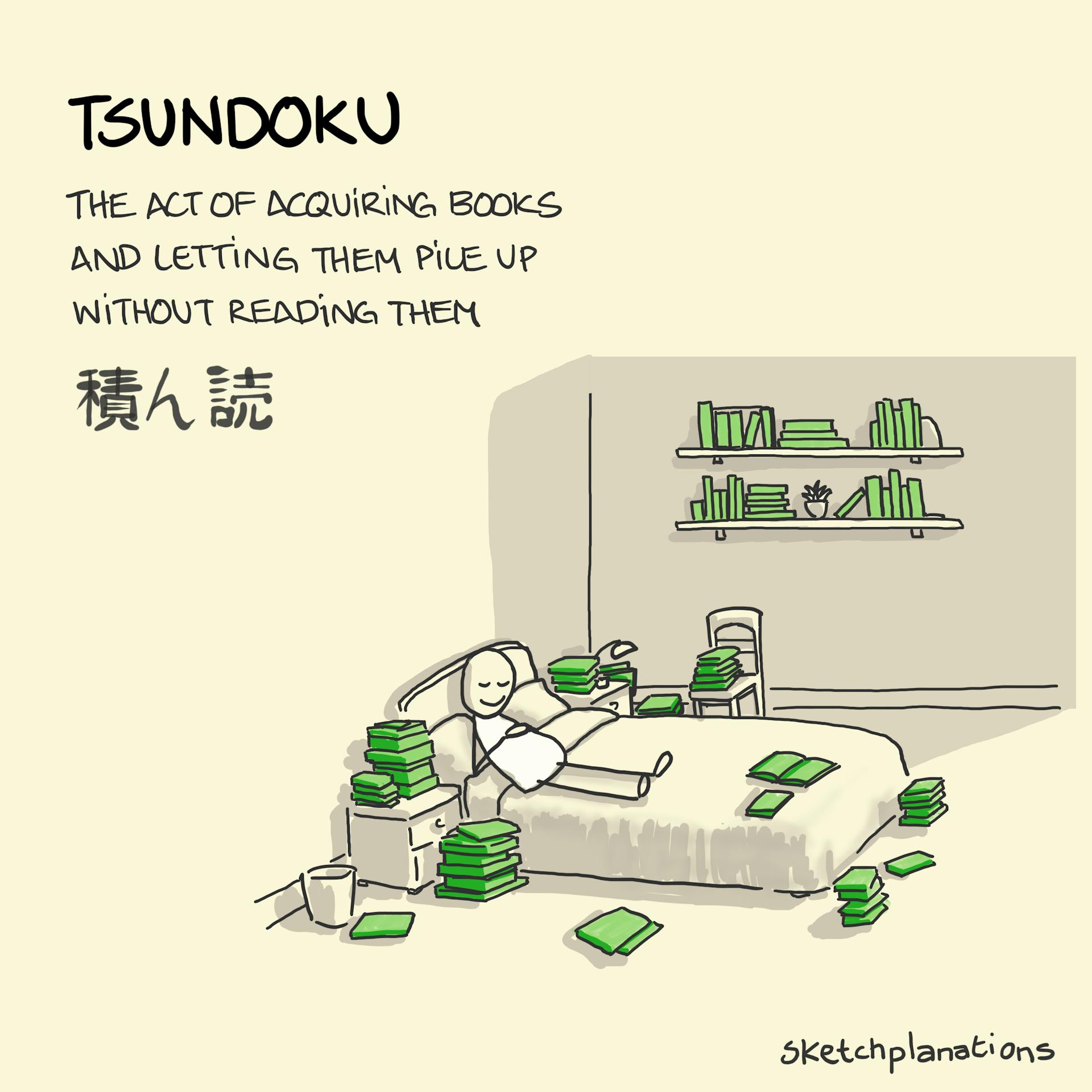
I recently discovered a beautiful Japanese term that perfectly describes this stage of my journey: Tsundoku (積ん読). It refers to the act of acquiring reading materials and letting them pile up without necessarily reading them all. For me, it isn’t just about the “unread” pile; it’s an extension of that original scrapbooking impulse—the desire to gather and surround myself with ideas that inspire growth.

The Digital Pivot

Today, my “scissors and glue” have been replaced by the digital “Pin.” My collection of articles and interests has migrated to Pinterest boards, allowing me to curate ideas with a speed my ninth-grade self couldn’t have imagined.

Looking back, those “part-time hobbies” were never just filler. Whether it’s a physical scrapbook, a shelf of books, or a digital board, the act of collecting is really an act of self-discovery. It’s about identifying what speaks to you and keeping it close.

So, if you’re still trying to define your hobby, don’t worry about whether it sounds “official” enough for an essay. Look at what you do when the world leaves you to your own devices. That—whatever it is—is where your story begins.

Additional Refs:
Winston Churchill used to lay 200 bricks per day to keep his mind busy when feeling down. Depression hates a moving target.
https://x.com/george__mack/status/2051334328303669498

What was your “exam pad cricket”? Did you have a hobby that didn’t quite fit the standard essay template? Let me know in the comments!

*This blog post has been refined using Gemini.

Purpose Dis(solved): The Illusion of the Gloved Hand

We’ve all seen it. You walk into a busy tiffin center or a local cafe, and you feel a momentary sense of relief. The server is wearing bright blue or clear plastic gloves. “Ah,” you think, “they care about hygiene here.”

Then, the illusion shatters.

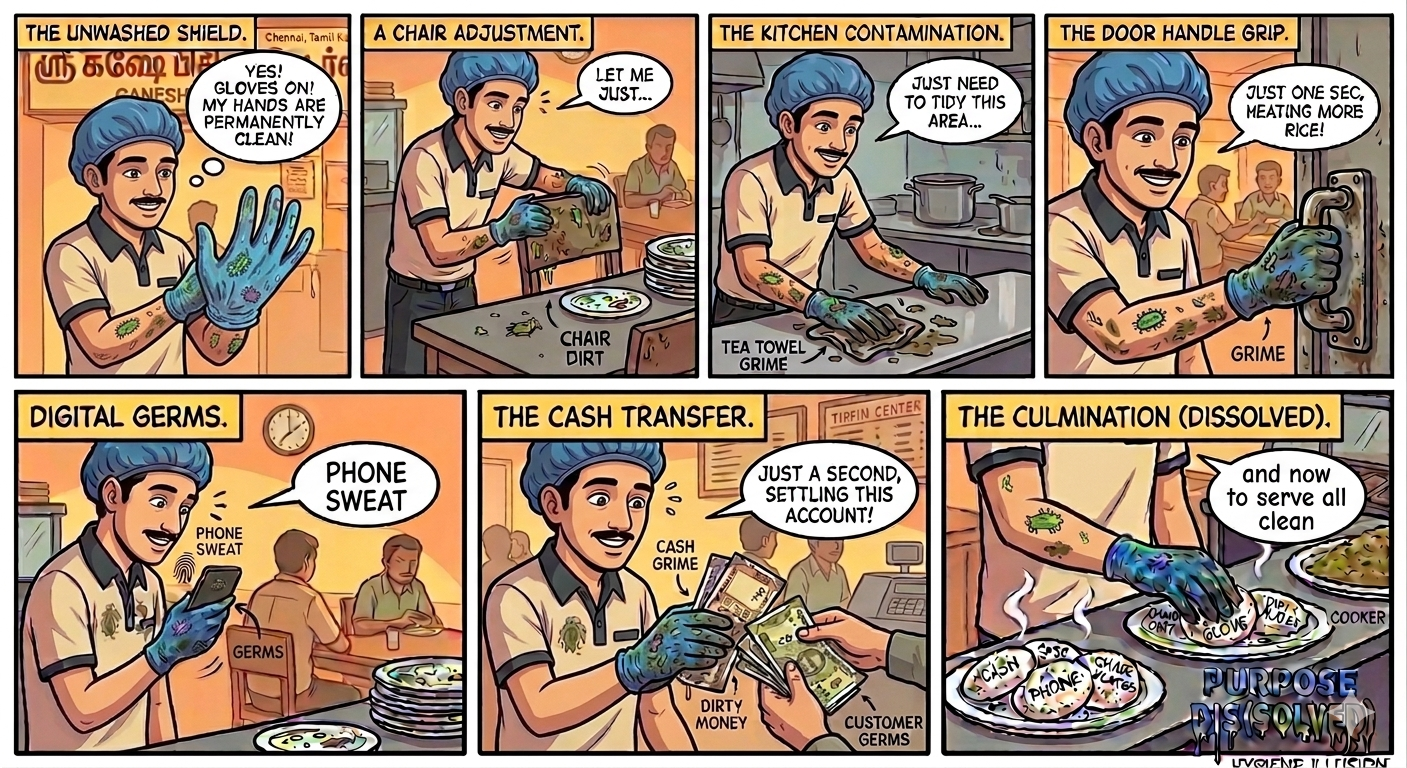
With the gloves on, the server wipes a grime-streaked counter with a damp, dirty tea towel. They accept a sweaty currency note from a customer. A notification pings—they tap away at a smartphone screen. They might even adjust their face mask, pull a chair for a guest, or grab a water bottle by the cap. Finally, they reach out and pluck two steaming idlis from the steamer to place them on your plate.

Purpose dissolved. The purpose of hygiene and why a glove is worn, has been forgotten.

The Hand Glove Illusion. Graphics generated using Gemini.

The “Magic Shield” Fallacy

The primary issue is a fundamental lack of understanding of what a glove is for. Many staff members treat gloves like a magical barrier that keeps their hands clean, rather than a tool to keep the food safe.

  • The Reality: Bacteria don’t care if they are hitching a ride on human skin or latex.
  • The Irony: A person with bare hands is more likely to feel the “stickiness” of dirt and wash their hands. A person in gloves feels “permanently clean,” leading to a dangerous lapse in sensory awareness.

The Invisible Path of Contamination

In the food industry, “Hygiene Theater” creates a trail of germs across every surface:

  1. The Multi-Tasking Towel: Using gloves to handle a “tea towel”—which is often a breeding ground for bacteria—and then returning to food service.
  2. The Currency Exchange: Currency notes are arguably one of the dirtiest objects in circulation. Using a gloved hand to handle cash and then immediately touching “ready-to-eat” food is a direct bypass of all safety protocols.
  3. The Digital Contaminant: Phones are high-touch surfaces covered in germs. Checking a message mid-service “dissolves” the hygiene of the glove instantly.
  4. The Infrastructure Trap: Every time a gloved hand touches a door handle, a POS terminal, a refrigerator grip, or a customer’s chair, it collects a new layer of contaminants.

Reclaiming the Purpose

If the glove doesn’t change when the task changes, the glove is the problem, not the solution. Proper hygiene isn’t about wearing the gear; it’s about understanding the flow of contamination.

The Golden Rule for Food Safety:

“A glove is only as clean as the last thing it touched.”

If a server touches a phone, a currency note, or a cleaning rag, those gloves are now “dirty.” They must be discarded, the hands underneath must be washed, and a new pair must be donned.

Another Practical Hack: The “Dominant Hand” Strategy

If we want to stop the cycle of cross-contamination, we have to work with human nature. Perhaps the answer isn’t more gear, but better design.

The Proposal: Glove the Non-Dominant Hand.

Since most servers are right-handed, their right hand is instinctively used for “utility tasks”—counting cash, opening doors, or handling tea towels. By keeping the right hand bare, the server retains their sense of touch and remains aware of when their hand is actually “dirty.”

Meanwhile, the left hand is gloved and reserved exclusively for touching food or clean plates.

Why this works:

  • Intuitive Separation: It’s easier to remember “Left for Food, Right for Everything Else” than to remember to change gloves twenty times a shift.
  • Tactile Feedback: The moment the bare right hand touches a greasy surface, the brain receives a “dirty” signal. That instinct to wash is lost when the hand is encased in plastic.
  • Reduced Waste: This method uses half the number of gloves while providing significantly higher actual safety.

Final Thoughts

Hygiene isn’t a costume. If your staff is wearing gloves but still touching everything in sight, you aren’t protecting your customers—you’re just performing “Hygiene Theater.” Let’s trade the “Glove Habit” for “Hand Awareness.” Whether it’s through the dominant hand strategy or frequent, visible handwashing, let’s ensure the purpose of food safety is no longer dissolved, but strictly upheld.

I’d love to hear from you: What is the most “purpose-dissolving” thing you’ve seen a gloved server do while preparing your food? Do you think the One-Hand Rule would work in our busy local tiffin centers, or is there a better way to stay safe? Drop your stories and thoughts in the comments!

Note from the Author: This post isn’t about pointing fingers at the hardworking individuals who feed us every day. We have immense respect for the long hours and dedication of restaurant staff. Instead, this is a look at how a lack of specific hygiene training can turn a good intention into a safety risk. Let’s move from “hygiene theater” to true food safety, together.

PS: The credit for the title “Purpose Dis(solved)” goes to my former colleague, Mr. Dhanasekar. He originally used the phrase on his blog, Testing Ideas, years ago. I felt the wordplay perfectly captured the “dissolving” hygiene standards I witnessed here.

*This blog post was refined using Gemini.

To Tip or Not to Tip? A Labour Day thought in support of fair wages

A sign I found in a hospital lift. A quiet but powerful statement about professional labor.

On this Labour Day, as we celebrate the rights and dignity of workers across the globe, I found myself reflecting on a simple, powerful sign I saw in a hospital lift: “NO TIPS.”

This sign doesn’t just represent the hospital policy; it represents an entire culture’s approach to labor. It implies that the staff are professionals whose livelihoods are already secured by their employer. It is a perfect “Labour Day” reminder to reflect on a global habit that causes anxiety for many: Tipping culture.

During a recent training on cross-cultural sensitivity, I encountered a fascinating contrast. In the United States, college students often take up part-time service jobs and rely almost entirely on tips to pay for their tuition and housing. Conversely, in India—where parents typically cover college and hostel fees—hotel waiters are usually full-time employees who receive a steady wage and complimentary meals. This realization brought me back to a fundamental question: Why is the customer responsible for the employee’s livelihood?

The “Postman” Logic

Consider your local postman, often delivering mail through harsh weather and long hours. When we receive a letter, we don’t feel a moral obligation to tip them. Similarly, when we board a flight, we don’t tip the pilot. Why? Because we recognize that their employers—the organizations profiting from their labor—are responsible for their livelihood. Yet, in the hospitality industry, particularly in the West, this logic is flipped. The ‘tip’ has shifted from being a reward for exceptional effort to a mandatory subsidy for underpaid staff. Why should a server be the only professional denied a guaranteed wage and forced to depend on the whim of a customer?

Why “Forced Tipping” Fails the Worker

While tipping is often framed as a “choice,” the current system actually puts the worker at a disadvantage:

  • Income Instability: A worker’s ability to pay rent shouldn’t depend on how many people walked through the door on a rainy Tuesday.
  • The Burden of “Gratitude”: It forces service staff to “perform” for their pay, creating an unhealthy power dynamic between the customer and the server.
  • A Lack of Transparency: If a meal costs $20, but I am socially obligated to pay $25 to ensure the staff can eat, then the menu price is a lie.

Many countries around the world operate successfully without a tipping culture. In these societies, the cost of labor is built into the price of the product. The result?

  1. Workers have predictable incomes.
  2. Employers take full responsibility for their payroll.
  3. Customers enjoy their experience without doing mental math at the end of the night.

The Way Forward

Supporting “no-tipping” isn’t about being ungenerous; it is about advocating for a more professional and equitable workplace. An employee’s wages should be a contractual guarantee, not a gamble based on a customer’s mood.

This Labour Day, let’s advocate for a world where “service with a smile” is a sign of a well-treated professional, not a survival tactic. It is time we stop tipping the balance and start paying the wage.

Should the employer pay fair wage, or should the customer tip?
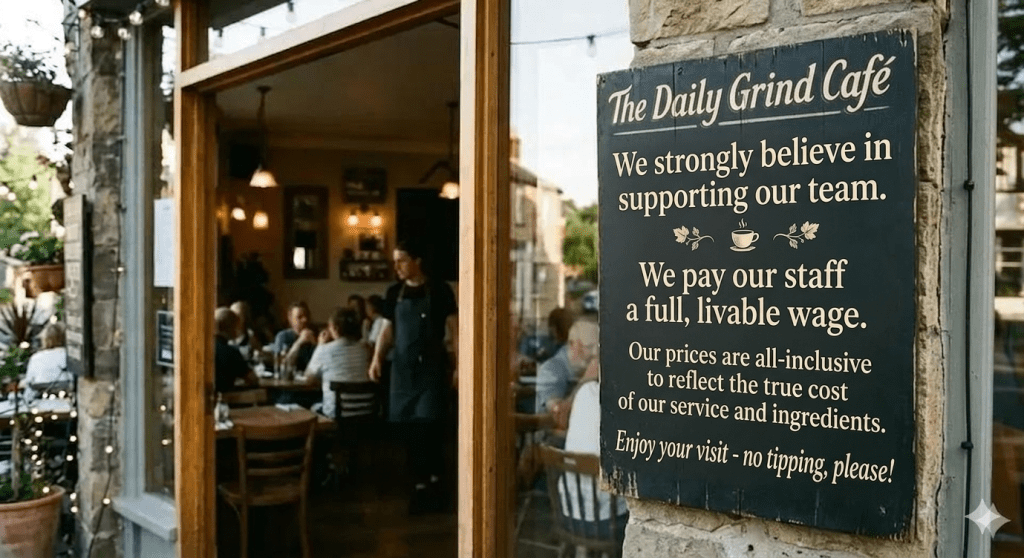
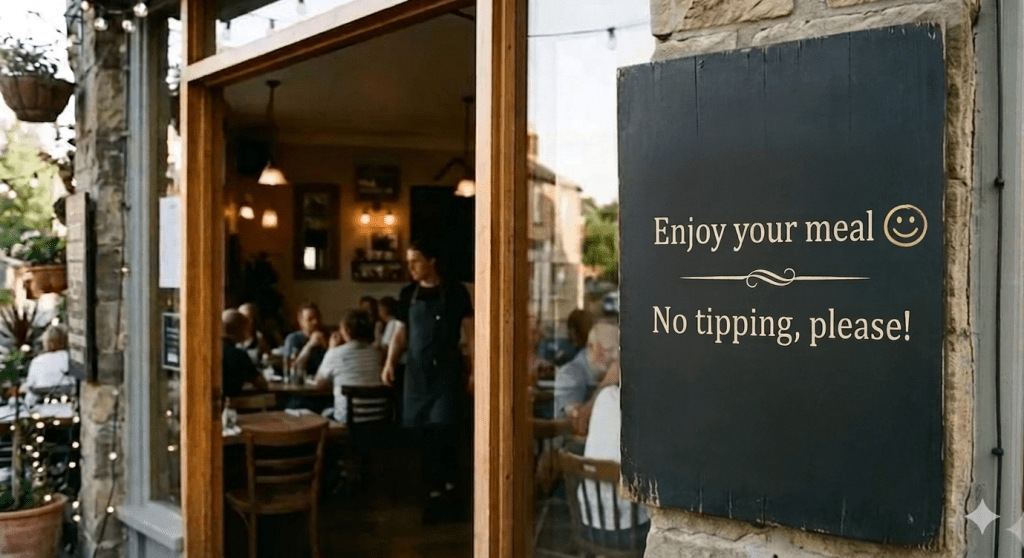
What if the restaurants displayed a sign like the one below?
What are your thoughts? Please share in the comments. Thank you 🙂

* The above images generated using Gemini. This blog post has been refined using Gemini.