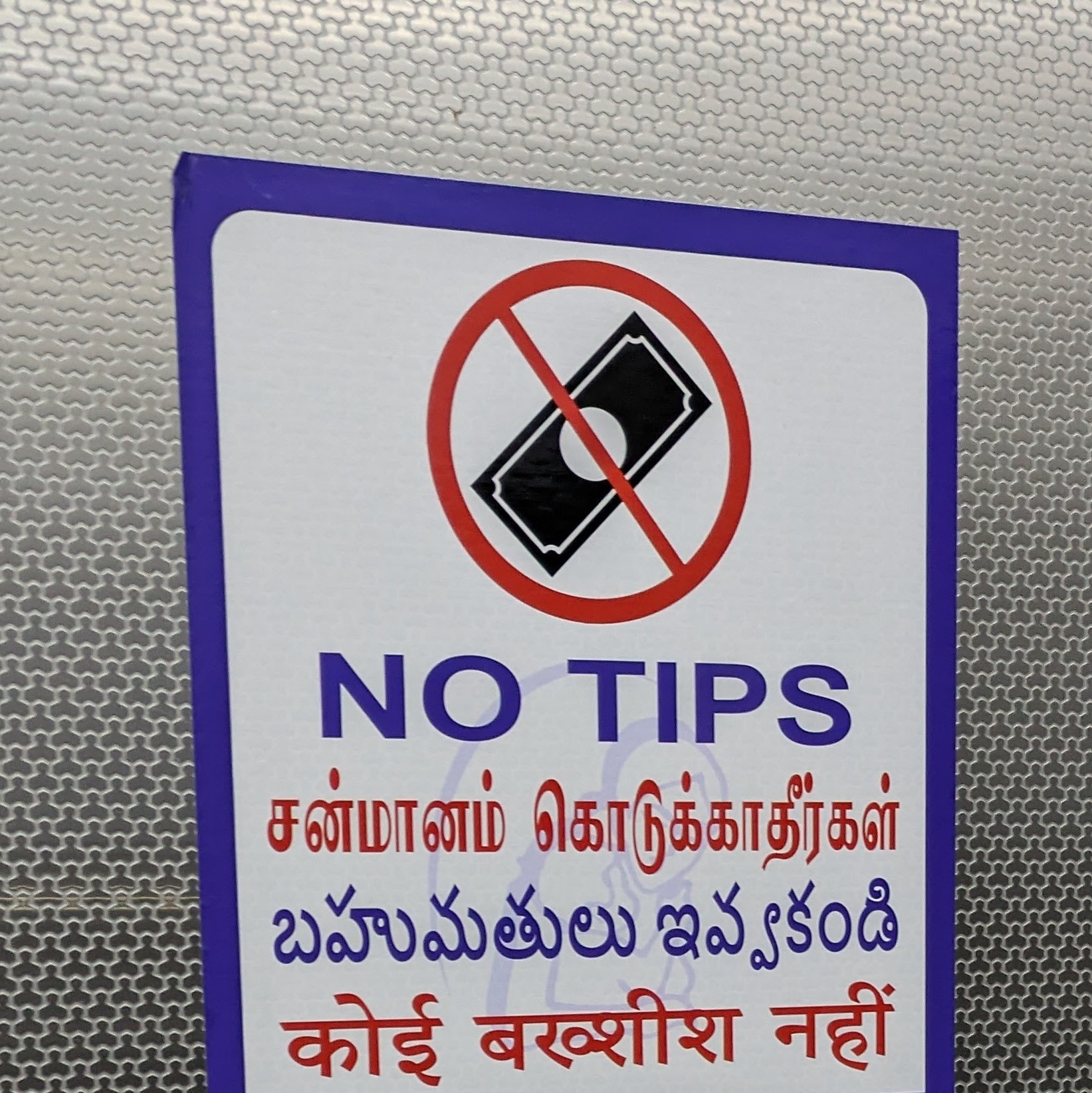
On this Labour Day, as we celebrate the rights and dignity of workers across the globe, I found myself reflecting on a simple, powerful sign I saw in a hospital lift: “NO TIPS.”
This sign doesn’t just represent the hospital policy; it represents an entire culture’s approach to labor. It implies that the staff are professionals whose livelihoods are already secured by their employer. It is a perfect “Labour Day” reminder to reflect on a global habit that causes anxiety for many: Tipping culture.
During a recent training on cross-cultural sensitivity, I encountered a fascinating contrast. In the United States, college students often take up part-time service jobs and rely almost entirely on tips to pay for their tuition and housing. Conversely, in India—where parents typically cover college and hostel fees—hotel waiters are usually full-time employees who receive a steady wage and complimentary meals. This realization brought me back to a fundamental question: Why is the customer responsible for the employee’s livelihood?“
The “Postman” Logic
Consider your local postman, often delivering mail through harsh weather and long hours. When we receive a letter, we don’t feel a moral obligation to tip them. Similarly, when we board a flight, we don’t tip the pilot. Why? Because we recognize that their employers—the organizations profiting from their labor—are responsible for their livelihood. Yet, in the hospitality industry, particularly in the West, this logic is flipped. The ‘tip’ has shifted from being a reward for exceptional effort to a mandatory subsidy for underpaid staff. Why should a server be the only professional denied a guaranteed wage and forced to depend on the whim of a customer?
Why “Forced Tipping” Fails the Worker
While tipping is often framed as a “choice,” the current system actually puts the worker at a disadvantage:
- Income Instability: A worker’s ability to pay rent shouldn’t depend on how many people walked through the door on a rainy Tuesday.
- The Burden of “Gratitude”: It forces service staff to “perform” for their pay, creating an unhealthy power dynamic between the customer and the server.
- A Lack of Transparency: If a meal costs $20, but I am socially obligated to pay $25 to ensure the staff can eat, then the menu price is a lie.
Many countries around the world operate successfully without a tipping culture. In these societies, the cost of labor is built into the price of the product. The result?
- Workers have predictable incomes.
- Employers take full responsibility for their payroll.
- Customers enjoy their experience without doing mental math at the end of the night.
The Way Forward
Supporting “no-tipping” isn’t about being ungenerous; it is about advocating for a more professional and equitable workplace. An employee’s wages should be a contractual guarantee, not a gamble based on a customer’s mood.
This Labour Day, let’s advocate for a world where “service with a smile” is a sign of a well-treated professional, not a survival tactic. It is time we stop tipping the balance and start paying the wage.
Should the employer pay fair wage, or should the customer tip?
What if the restaurants displayed a sign like the one below?
What are your thoughts? Please share in the comments. Thank you 🙂
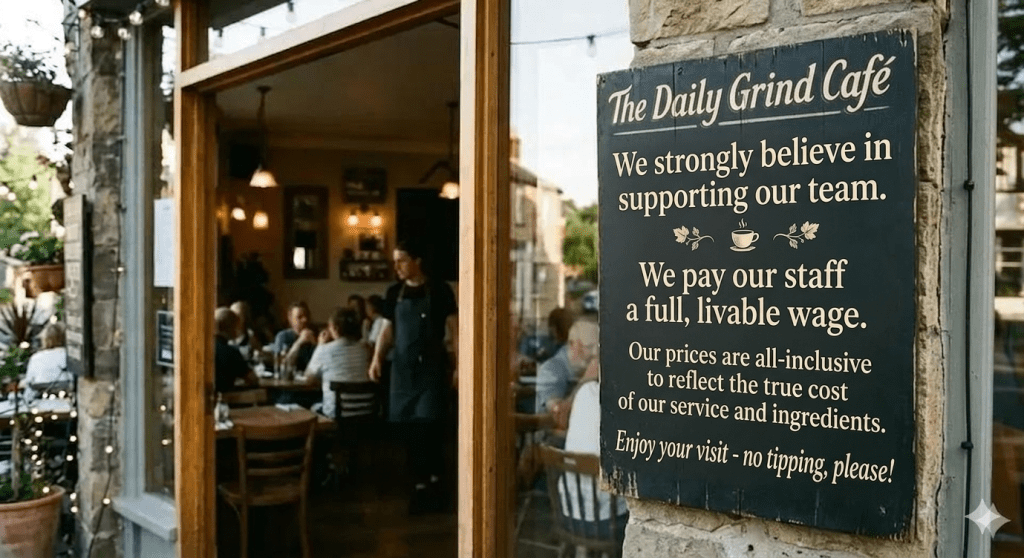

* The above images generated using Gemini. This blog post has been refined using Gemini.
 Attitude is Everything
We tip in Canada primarily because it is a social norm influenced by American culture, though it is not legally mandatory, omitting a tip for sit-down service is widely considered socially unacceptable. If you do not tip, the server probably knows your origin.
Understanding why the custom persists—even though Canada’s labour laws differ significantly from the United States—comes down to a mix of history, economics, and evolving technology.
1. Cultural Proximity to the United States
Because Canada shares a border, media, and massive tourism ties with the U.S., American consumer habits heavily dictate Canadian social expectations. The U.S. has a low federal ‘tipped minimum wage,’ which legally requires American customers to subsidize a server’s income. Canada adopted the exact same restaurant and service etiquette out of cultural habit, despite having a vastly different wage structure.
2. Historical Wage Gaps
Historically, several Canadian provinces (such as Ontario and British Columbia) utilized a two-tiered system featuring a lower ‘liquor server minimum wage’. Customers tipped because they knew their servers were legally being paid less than standard minimum wage.
3. High Cost of Living
While Canadian servers make general minimum wage, minimum wage in major Canadian metropolitan areas (like Toronto and Vancouver) is not considered a living wage. Skyrocketing housing costs and inflation mean that many service workers heavily rely on tips to pay rent and buy groceries. Consumers often continue to tip out of direct empathy for the person serving them.
4. The “Tip Out” Restaurant Model
In most Canadian restaurants, servers do not keep 100% of their tips. They are required to “tip out” a fixed percentage of their total sales (usually 3% to 8%) to the kitchen staff, hostesses, and bartenders. [
5. Digital Prompts and “Tip Creep”
In recent years, the explosion of digital point-of-sale (POS) terminals has institutionalized tipping. These payment screens prompt customers for a gratuity before completing a transaction—even at fast-food counters, liquor stores, and bakeries where tipping was historically never expected. This has manufactured an environment of social guilt and pressure, causing many Canadians to tip purely because a screen asked them to.
Baseline Tipping Standards in Canada
If you are navigating Canadian service culture, the current baseline expectations include: