Placeholder – Publishing the blog shortly. Please excuse.
Category Archives: Ideas
The Reviews You Can Really Trust
Online reviews have become the go-to resource for everything—from buying gadgets and booking hotels to choosing training courses or restaurants. But are these reviews always trustworthy? In a digital world flooded with ratings and testimonials, many of us have discovered the hard way that not all five-star reviews are created equal. This post explores how incentives, outdated information, and persuasive advertising often skew online ratings—and why the opinions of people you know can be far more reliable.
Case Study 1: The Paid Review Trap
When Nivetha decided to restart her career, she turned to online reviews and picked a two-day classroom training. The fee was steep, but the 4.8/5 rating convinced her it was worth the investment. The training promised value but delivered something she could have learnt through Wikipedia or for free online. Disappointed, she realized the classes were not worth the money she had paid for. What puzzled her most was the glowing online ratings. The answer arrived the next day—she received an email: “Give us a 5-star review, and you’ll get a ₹500 voucher.” The incentive was tempting, but Nivetha questioned the ethics: were the stellar ratings genuine, or had they been bought?
What went wrong?
It’s easy for a person to be swayed by a small incentive. The reward for 5-star ratings had distorted the online reviews and also misleads future customers, making them unreliable and undermining the credibility of feedback.
Case Study 2: When Awards Can’t Be Trusted
Ria was driving on the highway when she noticed something peculiar: multiple billboards for different car brands, each proudly claiming the “Car of the Year” award. She knew various publications and organizations give out their own awards, but it still made her wonder—how can they all be “the best”? A few weeks later, she found a clue. An email from a marketing firm offered her company an award in a specific category, but only if they paid a fee that could be “clubbed as part of the marketing budget.” This practice, often called “pay-to-play,” instantly made her realize that the accolades she’d seen on those billboards might not have been earned at all. A practice that misleads consumers into believing a company or product has been genuinely recognized for its excellence.
Case Study 3: The Friend Factor
Vishnu’s experience buying his first car was another lesson. An emotional milestone, he did his research online and was drawn in by relentless ads touting a particular model’s 5-star safety rating. He was ready to buy it until a lunch conversation with colleagues changed his mind. Babu, who already owned that model of the car, confessed he was unsatisfied with the quality of interior parts and the engine and the positive online publicity the car had received was a job done well by the marketing team. He advised Vishnu to consult Gopi, a car enthusiast whose recommendations were based on real-life experience. Gopi’s thoughtful advice helped Vishnu find the right car for his needs.
Your friends’ honest opinion trumps a thousand 5-star reviews.
Case Study 4: Advertising and Authenticity
Manish ran into similar trouble when he searched online for office chair & desk to setup his home office, during the Covid lockdown. Soon, he was bombarded with polished online ads and enthusiastic testimonials. Manish purchased the chair and desk, only to discover a few weeks later that they were poorly made and falling apart. A few days later, in the office lunch table, another colleague, Subha was asking for opinions to buy an office chair and mentioned the ads she saw from same company Manish had purchased. Manish was fuming because he fell for a wonderfully crafted advertisement and strongly suggested not to purchase that chair. Hearing this, another colleague recommended a chair he was using for years, and was of good quality and affordable. Subha made her purchase based on recommendation from a trusted friend and found it good. Manish & Subha now trust & ask suggestions from friends, colleagues, or through alumni WhatsApp groups before buying something or eating out, rather than relying on online reviews.
What went wrong?
Persuasive advertisements & suspicious testimonials lured Manish into buying a poor quality product.
Case Study 5: Old Reviews and New Problems
Arthy’s attempt to treat her guests at a local restaurant, based on positive reviews online, ended in disappointment. When they went, she was upset that neither the food nor the ambience lived upto the hype the reviews had promised. Talking to her friend later, she learned the restaurant had changed management years earlier and quality had dropped since. She also noticed how the restaurant staff placed a small card with QR code, politely asking her to leave a 5-star review.
What went wrong?
Outdated reviews misled Arthy and the restaurant’s aggressive solicitation of high ratings further distorted the truth.
Case Study 6: The Malicious Competitor
Shan, the owner of a popular cafe, is facing a problem many small business owners dread: fake negative reviews. A jealous competitor has orchestrated a campaign to sabotage his reputation. The competitor has enlisted friends and acquaintances to write scathing reviews on various online platforms, even though they have never set foot in Shan’s cafe. These reviews are not based on any real experience; they are a calculated and malicious attempt to drive down his star rating and mislead potential customers. This case highlights how online review systems can be exploited not only by unethical businesses but also by malicious competitors who weaponize fake reviews to undermine a rival’s success.
Case Study 7: The Vacation Membership Trap
Karthik was sold on a dream: a lifetime of luxury family holidays at prestigious resorts. Lured by glossy advertisements showing serene resorts and happy families and a high-pressure sales presentation, he invested several lakhs into a long-term holiday membership. He was imagining effortless annual getaways, but the reality was a nightmare. Every time Karthik actually had vacation days, the app showed “Zero Availability” for his desired resorts. The beautiful rooms he saw in the ads existed, but they were out of his reach when he actually needed them. To his frustration, he noticed the same “fully booked” rooms were often available for the general public on websites like Booking.com or Agoda—but at a premium price. He soon realized he was part of an “Inventory Gap”—where the number of members far exceeds the number of available rooms. The financial drain didn’t stop at the initial fee. Karthik was hit with a mandatory “Annual Subscription Fee” that increased every year. He had to pay this fee even in years when he didn’t use the membership at all. When he finally managed to book a remote resort, he found himself in a “Food Trap”—since the resort was far from town, his family had to pay five-star prices for every meal, often doubling the cost of the “free” holiday. Now, he’s trying hard to transfer his membership, realizing that a beautifully marketed lifestyle is useless if you can’t actually use it, when you need it.
What went wrong? Karthik fell for glossy advertisement that sold a “dream,” without checking the real-world booking experiences of long-term members He traded the simple flexibility of a hotel booking for a rigid, one-sided contract. Between the “subject to availability” fine print, the hidden burden of rising annual fees, and the difficulty of transferring a membership, he realized that a beautifully marketed lifestyle is no luxury at all or indeed a burden if it dictates exactly when and where you can breathe.
Whether it’s a 5-star rating bought with a gift voucher, a testimonial from an anonymous user, or an award paid for by a company, the goal is the same: to create a perception of quality that might not exist in reality. Nivetha, Ria, Vishnu and Manish learned that a manufactured reputation, built on awards or paid endorsements, is no substitute for genuine quality. The best way to know if a product is truly excellent is to rely on the trusted, real-world experiences of people you know.
User Reviews – which began as a system designed to build trust and attract more visitors has now become unreliable, compromised by vested interests and manipulative practices.
How Might We Make Online Reviews Trustworthy?
Implement a “Re-Review” Nudge: What if, after posting a review, users received a gentle nudge a day later—asking if their review was genuine or incentivized, encouraging them to rethink or edit if necessary.
Ask Better Questions: A one-time visitor to a restaurant might give a good review, but a repeat customer is a sign of true satisfaction. Asking a question like, “Will you come back again?” could better gauge a customer is really in love with the food or service. Some relevant options like “Just came to explore” or “Came here for the Instagram worthy ambience” can help filter out one-off, potentially incentivized reviews.
Question Incentivized Reviews: Look critically at testimonials rewarded by discounts or vouchers, and be wary of ratings that seem unusually positive.
Check Review Dates: Verify that feedback is recent and relevant to avoid being misled by outdated comments.
Rely on Your Network: The most trustworthy reviews come from people you know. Your friends, colleagues, neighbors, alumni groups and trusted communities are far more reliable sources of information than a faceless online rating. They have no incentive to lie and can offer personalized advice based on their own experiences. The next time you’re tempted by five-star ratings, reach out to someone you trust – someone with real skin in the game.
Share Honest Feedback: When we write reviews, let’s pledge to be honest & transparent about our experience and help others make informed decisions.
Have you ever been misled by fake reviews? Share your experience in the comments below, and let us know what could have helped you make a better choice. Thank you 🙂
The reviews you can really trust, come from the people you know.
*Thanks to Pari, Ravi, Ajeeth & Vidhya for reviewing the draft of this post & for the early feedback.
*This blog post was refined using Gemini & ChatGPT
Tidbits:
– 15 Red Flags You’re About to Eat at a Bad Restaurant
– How the book, ‘Skin in the Game’ changed how I understood risk and success
My Learning from ‘We are LimITless’ – phase 2
Who is Elvis?
The ones who shine a bit brighter, the ones who are maverick, the ones with lots of energy and charisma.
Felt good to be part of a program “We are LimITless.” The phase-2 of the culture journey focused on building a culture of collaboration by expanding your network. Why do we need to expand our network?
Collaborating effectively and working well in a matrixed organisation is crucial to achieve collective goals and progress. When we only reach out to people we know, for advice & support, we are limiting ourselves to same team, same routine and missing out on the diversity of opinion & perspectives, thereby slowing down on innovation process. By expanding our networks within the company, we increase our exposure to fresh perspectives, new ideas, opportunities and insights, build new skills and grow our self-confidence.
Volunteered to be a culture influencer, running a few experiments with support of org’s toolkit. In one of the experiments, we nudged & reiterated the teams to try Diversity Collision.
A few more experiments were, networking at leisure, pair and share, scheduled networking, sense checking with someone before presentation or sending a mail, discover hidden value about a colleague, happy-to-help, mentor-mentee and crowdsourcing.
Below are a wealth of resources that will help you network better and collaborate. In case you do not have subscriptions to the respective publishers, you might be allowed to read 3-5 articles free, per month.
Please click & expand for a wealth of resources & references:
- Connecting with others is a vital source of happiness — cos can create simple ways to achieve this and build sustainability
- 4 Simple Ways to Make Yourself Really Happy in 10 Minutes or Less, Backed by Harvard Research
- Get Better at Networking: Our Favorite Reads
- A Beginner’s Guide to Networking
- How Leaders Can Build Connection in a Disconnected Workplace
- How to Ask For What You Want (And Get It)
- 5 Networking Tips for Introverts (and Anyone Else)
- How to Make Small Talk with Anyone from Anywhere
- How to talk to strangers
- Amber Cabral: 3 steps to better connect with your fellow humans | TED Talk
- The 4 Best Openers: How to Break the Ice With Absolutely Anyone, Anywhere
- Beyond ‘How Are You?’: The Art of Asking Powerful Questions | by Phil Roberts
- Why talking to strangers is good for you
- Mastering the Art of the Request
- Your Guide to Working on Global Teams
- Millennial Managers Can Change Company Culture for the Better
Experiments with Diversity Collision
A few years back, at the Construkt fest, I witnessed an induced networking called “Construkt Collision.” The hall was filled with people, standing. When the conductor of the event says, “Change,” every 1 min, we say “Hi” to the person around us, briefly introduce ourselves and also get to know the other person, exchange business cards, until we hear the next “Change,” after which, we move and meet someone new. It was interesting.
During the “Power of Diversity” week celebration at office, wanted to try something similar, help people meet diverse colleagues they haven’t interacted with and we came up with “Diversity Collision.”
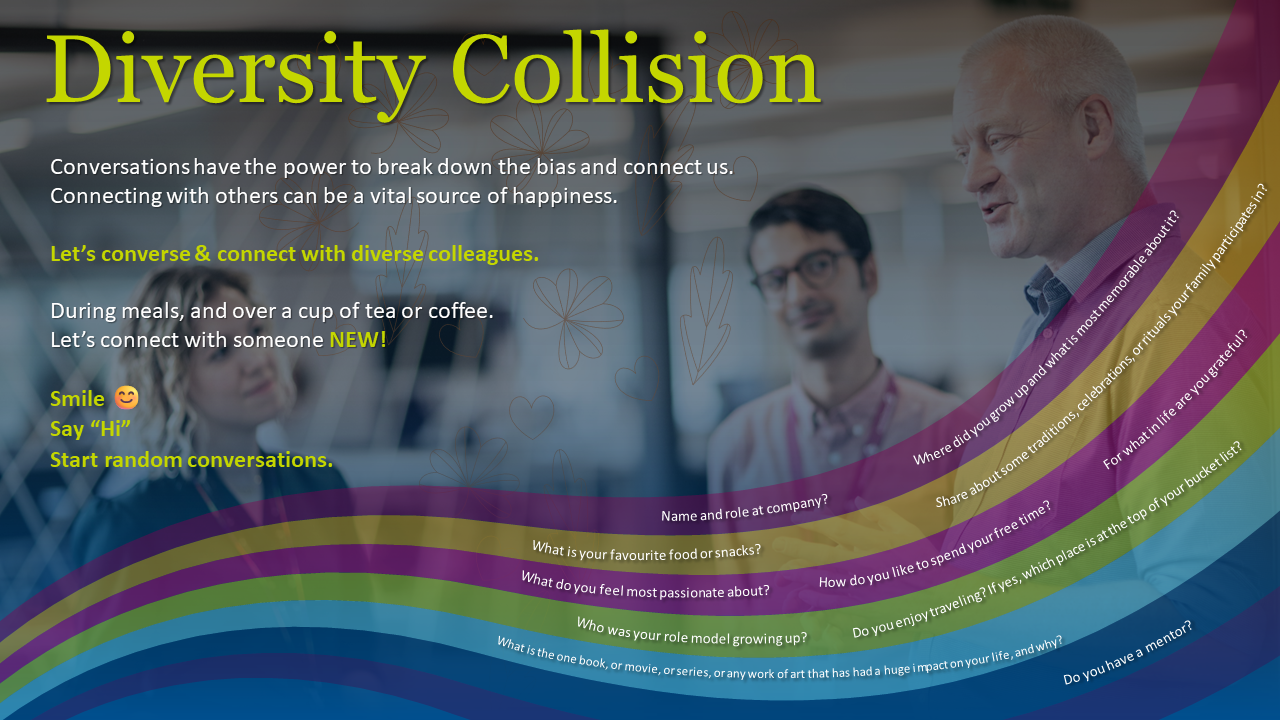
I felt we were not able to achieve active participation in this collision probably because colleagues were shy to reach out to people they do not know or have never interacted with. To overcome this, in one of the offsite gathering, we requested the host to announce and nudge participants to sit alongside someone they have never interacted with and when breaking for lunch, to share the lunch table with someone new and get to know them better. Slight force or nudge helped to break the inertia/shyness 🙂
In hindsight, I thought, we also could have also tried placing a bingo sheet on colleagues desks and asked them to meet, interact briefly and get signatures or names of people, under questions/options like:
- Someone born in specific month
- Someone wearing a particular colour shirt
- Someone from another state/country than yours…etc.
How might we enable better UPI adoption at petrol bunks?
- Jay drives to the petrol bunk and requests petrol refill of Rs. 1000 to his car.
- The attender refills and asks the mode of payment.
- Jay says UPI, scans a QR pasted near the pump pillar and sends money.
- The attender interrupts and annoyingly asks why he sent the money through that QR. The attender then said Jay needs to scan the QR from a card board he was holding onto his hand, which had a QR printed in A5 sheet and pasted.
Looks like the petrol bunk has different modes of UPI payment. This is apart from cash and card payments.
- Some QR payments are processed through the petroleum companies payment gateway
- Some QR payments are processed through the petrol bunks bank account
- Some QR payments go directly to the petrol bunk owners bank account
The QRs were, either pasted on the dispenser or printed and held on hand or printed to plastic holders supplied by payment aggregators or generated through the POS machine. There is some confusion and delay in processing the payment. The next vehicle waiting is honking.
How might we enable faster & easier UPI payments at petrol bunks?
I could think of a user feedback from the office tea stall:
“Do you feel, opening the app at tea stall, adding the amount and then entering the PIN, a painful process? The user says, he is used to it daily and it feels like a ritual. While he asks the tea vendor, 1 ginger tea, the user is parallelly scanning the QR code and much before he gets the tea, he finishes the payment and waits for the tea.”
Similarly, if the petrol bunks can display QR codes for UPI payments, prominently, (Ex. Red circled space in the dispenser image below) the drivers can intimate the quantity or the amount of fuel (Ex. 10 litres or for Rs. 1000) to be refilled and while it is getting refilled, they can scan the QR code and make payment. Each pump or dispenser can have unique QR code so that it is easy for each servicing attender to generate his end of day accounts and make settlements.

Also, to improve trust and efficiency, apart from the innovative soundbox the UPI app has provided, we can think of a low energy consuming display like Kindle readers, that can be placed near the petrol dispenser and display the amount received from the customer or the vehicle no.
The UPI app can allow users to create a label of his vehicle type and vehicle number.
Ex. Maruti Swift: IQ 01 AM 3499
The label can be tagged and displayed alongside each refuel payment acknowledgement for easier visibility and acknowledgement, thereby improving trust and increasing the speed of payment.
If the user has leased the car through his office, she/he might like to have receipts for all the spends on fuel and receipts for driver’s salary. How might we enable the petrol bunks to share digitally generated receipts back to the user after refueling?
*”Petrol Bunk” is the most widely used term in India, for a fuel station. Different terminologies used across the world are: Gas Station, Petrol Station, Fuel Station, Filling Station, Petrol Pump…etc.
Sidewalks, Health & Peace of Mind
I am a software tester, finding flaws in products. I am also passionate about user experience & design and find it exciting to simplify & improve the experience of products we use. One such thing I wanted to simplify & make it better accessible is the side walks. Something that’s part of our public space.
Like many, I’ve tried to de-stress by going for a walk, only to be forced off the sidewalk and into the street. Our sidewalks are often unusable—either encroached or poorly designed. The intersection of my experiences in testing, design and walking, made me view these sidewalks not just as civic problem, but as a design & behaviour problem. I began to capture pictures of various footpath patterns I encountered, trying to understand what makes some pathways easily walkable and others a nightmare. How might we reclaim these vital public spaces? How might we build better & pedestrian friendly sidewalks? The solution might be right beneath our feet. Let’s design our way to a better walk.
Think about the Nudge Theory, the Nobel Prize-winning concept that shows how subtle cues can guide our behavior. If we put a sign to switch off lights before leaving the room, we are most likely to do so. What if we could apply this same principle to our public spaces?
In his book, The Tipping Point, Malcolm Gladwell argues that for an idea, trend or behaviour to spread, the Power of Context is crucial. He shows how small changes in our environment can trigger significant behavioral shifts. The environment itself becomes the nudge.
My idea is simple, yet I believe it holds the potential for significant impact: a new standard for footpath design based on these behavioral insights. What if we started using indicative colors on our sidewalks? Imagine clear, universal visual markers painted along the edges of our sidewalks, sending a subtle, non-intrusive message to vendors, to vehicle owners, and to pedestrians themselves: “This is the pedestrian zone. Please respect it.” We’re not just painting lines; we’re changing the context. We are nudging people not to encroach, not drive vehicles on the sidewalks and guiding pedestrians to walk on the designated path. A small modification to our public space can potentially create a positive change in how we use it.
As a first step, let’s understand some examples that hinder pedestrians from using the sidewalks.
Pedestrians prefer to walk on even surfaces. Unevenly built sidewalks like shown in the examples below, where houses and shops add kurb ramps/driveway ramps, forces pedestrians to get down and walk on the even road. Pedestrians also avoid sidewalks that are too high to easily step on.


Illustration of better sidewalk with side markings. (Image generated with the help of Gemini AI. Learning to refine the prompt to get better output. )
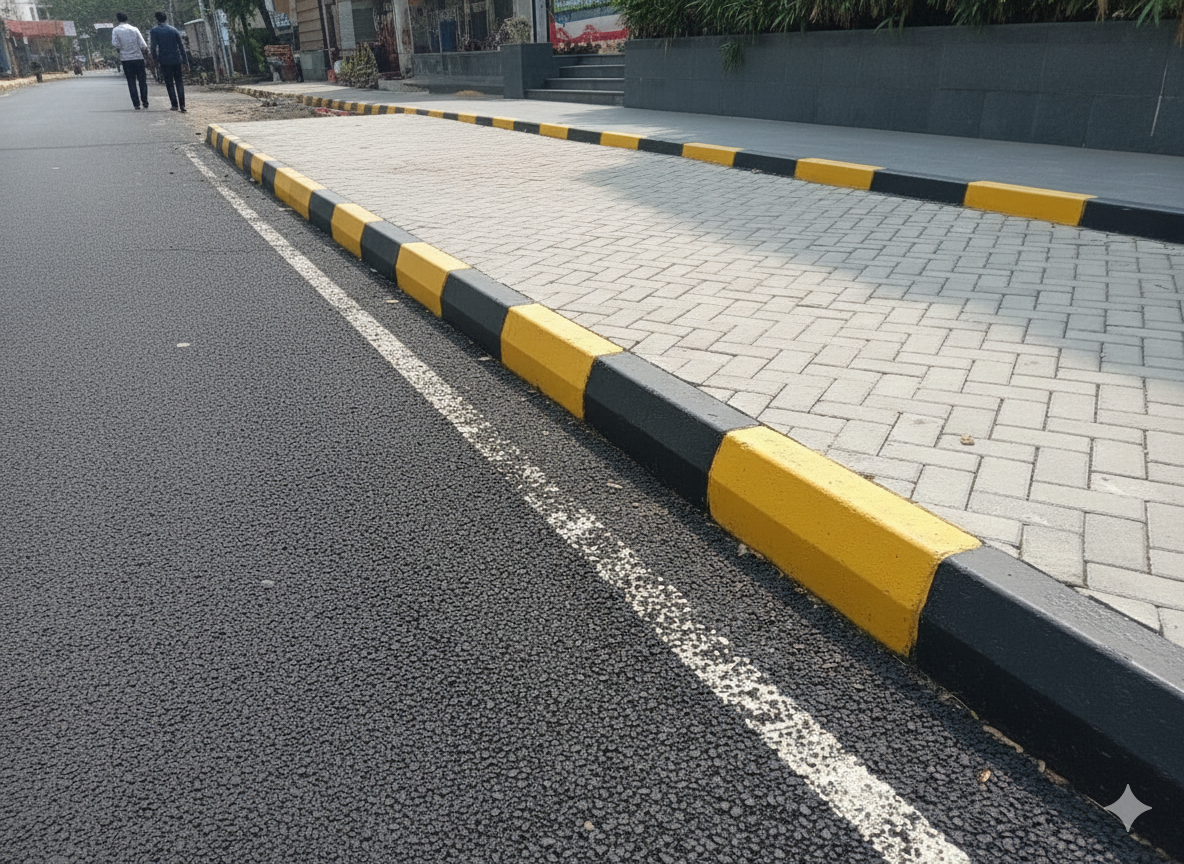

Curb ramps/driveway ramps shall be built like illustrated below. (Image generated with the help of Gemini AI.)


Also, pedestrians find it easy to walk when the starting point and end point of the sidewalks are built like a ramp rather than like a step.
*The article is being drafted. Apologies for publishing a not fully drafted post. Just published today as it is a day of significance for me.
Additional reading: How a broken wall led me explore the modern management principle, Therblig?
How a broken wall led me explore the modern management principle, Therblig?
During the 2010 rainy season, a 3 feet portion of my house compound wall broke. (The wall was built using stone blocks, red sand and plastered on top with cement, in 1970 period i.e. approx. 40 years back, by my grandfather.) We hired a local mason and requested to rebuild the damaged portion, in the same way, reusing the stone blocks so that it looks even with the rest of the wall. The mason, along with a helper, took 4 days to place the uneven stone blocks, fill the gaps in between carefully, with smaller sized stones and plaster it. In another 2 years, an even larger portion of the compound wall too fell during the rainy season. The wall was about 40 ft in length. Once again, called the same mason and requested him to rebuild the damaged wall using the fallen down stone blocks. He said, it would take weeks to rebuild with same stone blocks and labourers with him are all aged people who cannot carry such blocks. He said, demolishing the entire wall quickly using a JCB and rebuilding using hallow block bricks would only take 2-3 days, cost much less and look even across. We agreed and rebuilt the entire eastern side of our house compound wall using hallow block bricks.


12 years later, i.e. in 2022-2023, I glanced on an article through Medium or Linkedin, explaining modern scientific management and referring to Frank Bunker Gilbreth’s Bricklaying Ergonomics. I was quickly able recollect what our mason said while we were rebuilding the damaged wall and corelate this with how evenly sized and lesser weight hallow block bricks helped build the wall quicker, without compromising the purpose of the compound wall.
A few months later in 2023, when I had to shift my house, one of the many aspects, I had to decide the house, was based on the furniture we had with us and one of the decision point was the size of bedroom, kitchen & living room. Every house we saw had different room dimensions, making it difficult to make a decision faster. Post shifting to the new house, we had another difficulty. The window curtains and velcro based mosquito nets we had used in the previous house was not fitting here. I was then recollecting Gilbreth’s Bricklaying Ergonomics and a thought striked!
How Might We Create Standards in Home Construction?
- What if real estate builders and regulators like RERA came up with standard room dimensions? Something similar to T-shirt sizes.
For example,- S-Small (Kids Bedroom) – 10’ x 10’
- M-Medium/Regular – 12’ x 14’
- L-Large (Master Bedroom) – 14’ x 16’
- Wardrobes could be mass produced, keeping in mind the room dimensions, which in turn could be cost effective and easy for the buyer to decide, while buying a house.
- What if builders and carpenters came up with standard door dimensions? Doors with defined standard dimensions can be mass produced and hence will be cost effective. When a need arises to replace, we can just tell the door size and buy one, which can also be fixed much quicker than custom made ones.
For example,- S-Small (Bathroom door)
- M-Medium/Regular (Bedroom door)
- L-Large (Main entrance door)
- What if builders and carpenters came up with standard window dimensions? Same like doors, windows with defined standard dimensions could be mass produced.
- There can be various combinations of room dimensions, based on where the room door faces, where the windows are, where the wardrobes are and to which side the bathroom is built. However, based on experience a standard room will fit a wardrobe for 2 people, a king sized bed with space for side tables on either side, some space for a study table and some space to walk around.
- The size of bedroom and kitchen could be standardised and the size of living room could be adjusted as per the left over available space.
If I were to build an apartment complex for the middle class, how would I design?
- I ll build a 3 bedroom+study+kitchen+living room(hall)+utility+foyer. Why___
- Walking track___
- Social balcony at each floor___
- Having a study room, with a proper study table and chair lets us focus, concentrate and ultimately improves learner outcome. What if every house is built with a study room?
- Having guests at home and socialising, improves ones happiness. What if every house has a guest room?
If I were to build a studio apartments for the lower income people, how would I design?
- Foyer___
- Utility___
- Study___
- I would use simple and easy to maintain objects.
- Stairs – ideal width & inclination?
- *Will update my thoughts
I have observed that, in villages, lands are sold with price per acre, whereas in cities lands are sold with price per sqft or price per ground (40ft*60ft=2400sqft.) What if all housing plots formed as 40*60ft sizes so that it is even and construction can be planned accordingly.
“The most important, and indeed the truly unique, contribution of management in the 20th century was the fifty-fold increase in the productivity of the manual worker in manufacturing.”—Peter Drucker
PS: Another example I could think of is my Diwali dress stitching. When I was young, it was a tradition to buy / stitch a new dress. Like us almost a maximum percentage of people stitched new dresses during Diwali. we had to buy the cloth a month in advance, visit the tailor shop, take measurements and then wait for weeks to get the newly stitched dress, to be worn on Diwali. Fast forwarding, I have never stitched a dress for more than a decade and buy readymade ones, which comes marked with sizes like S, M, L, XL, XXL…etc for T-shirts and shirt sizes like 36, 38, 40…etc, specific to India. I visited a garment factory in Tirupur, from where lots of garments are bulk manufactured and exported to many countries and saw how cloths in hundreds are laser cut and sent to tailoring sections, which speeds up the mass production process.
*Will refine this post with some more thoughts
Hackathon Idea: Asa – fly at ease
Today’s newspaper carried a full page advertisement on The Gen AI Hackathon. Also, glanced similar ads on X a few days back. The deadline is today. The problem statements are interesting to solve. Due to personal obligations, and time constraints I wasn’t able to plan and prepare detailed solutions. On this Gandhi Jayanthi holiday, spent time on this simple chatbot solution: Asa.
Done is better than Perfect. Publishing a solution to the below problem statement.
“Indian is the 7th largest country. Can you make it #1 for flight experience.”
I expanded on my earlier idea on Air Safety Awareness, by picking one use case with two personas:
Subbu & Eswari are retired couples visiting their son in New York, US. Their ticket from Chennai to New York via connecting flight at London, has been booked in advance by their son . How might the airlines guide them to fly at ease.
Recommending them to install an app might not work out as many travellers don’t want to install one more app. How might we utilize WhatsApp or RCS messages to help them fly at ease.
Since the problem statement was shared by Akasa, came up with the chatbot Asa. (name suggested by Gemini) Since the Akasa logo is called the “Rising A,” contemplated on some names like “The Guiding A,” “Fly at Ease,” “A-hostess” but settled with Asa, because when the chatbot interacts with the passengers on WhatsApp, “Hi, I’m Asa…” sounds easy. Referred to branding guidelines from AkasaAir: Sunrise Orange: FF6300 & Passionate Purple: 5C0FD9. Gemini suggested that the font used in the logo might be a custom one. “AS Circular” or custom “Poppins.”
*n.b: Referring to the name Akasa and its branding guidelines, as the problem statement I picked has been shared by Akasa. No intention to infringe on Akasa’s brand identity in any way.
Let’s delve into Asa‘s role:
- The airline collects the mobile no. of passengers, while booking the ticket.
- Asa sends the first Hello to Subbu & Eswari, immediately after the ticket is booked.
- Asa migh have created a WhatsApp group between Subbu & Eswari and started the conversation. However, many people have the tendency to use the groups to forward casual messages, videos and photos and the actual guiding conversation from Asa might get lost in between other unimportant forwards. So, Asa will stick to messaging individuals 🙂
- Asa sends a reminder 2 weeks before the flight.
- Asa sends a reminder 1 day before the flight.
- Asa sends guiding instructions on the day of departure.

- The users updates a list of items or photo of items in the bag and checks if anything is prohibited.
- The user shares the dimension of the carry on luggage and checks if it will fit in the storage cabin.
- Asa lets users to enter the language of choice and send voice based responses.
Why this matters to the airlines?
An exceptional customer experience goes beyond service – it’s about trust, communication, and support at every step of the flyer journey. Being supportive and providing easy access to information can transform the flyer experience, build trust, increase loyalty, besides saving hours of wasted time.
Please click & expand for a wealth of resources & references
How might we simplify air safety awareness?
I was reading the below news and was able to correlate to the check-in experiences my colleagues had shared. A few were first time travellers and a few seasoned travellers. Summarised the problems with a few personas below:
Over 1,200 hours wasted daily confiscating cigarette lighters, perfume sprays, power banks
Meenu, an IT executive, who took her first international trip a few years back said, she was very anxious while preparing for her trip. She had reached out to her friend Kiru, who had experience of travelling to a few countries. Meenu had saved the below instructions shared on WhatsApp, by her friend:
********************
*Check-in*
- Get into airport, find your airlines counter from signboard.
- Get in to the respective queue (Business/Economy & Web check-in/Counter check-in.)
- Drop the check-in bag. It will be weighed. Should be under weight of the limit. Collect your boarding pass. Make sure you collect back your passport after verification.
- Collect the Immigration form. It will be distributed by your airline staff in front of the counter (mostly when you are entering in the counter or you might need to collect it in front of the immigration location.)
- You will be pointed to the immigration area.
*Immigration*
- Fill the immigration form. Its good to have a pen always with you.
- Get into the immigration queue. One at a time in the immigration counter even if you are going as a family except kids who can join mom/dad.
- You will be interviewed and photographed and will be the exit approval from India.
- Note: Have your travel documents in a file or folder handy as you need to produce respective ones as they ask for verification. Sometimes your office ID card too.
- Collect your passport & boarding pass back.
- You will be pointed to security check counter.
*Security check*
- Separate counters for each gender.
- Get into appropriate counter. Take out the items to be scanned individually- laptop, tablet, phone, jacket, belt, watch, shoes & toiletry (depends on the airport). Basically no steel. Empty your pockets. You will be provided with trays to place these items. Place these trays and your bags on the running belt to scan and give your passport & boarding pass to the staff at this place.
- Note: Your carry-on bags should not have any pointed materials like knife, scissor so on. No lighters. No water. No liquids more than 150ml of each.
- Get into the scanner.
- If you are beeped, then you will be inspected separately again.
- Else, collect all you stuff. Re-pack and wear back your shoes and you are free now to find your gate.
*Getting to Gate*
- Check your boarding pass to see gate number.
- Watch out for sign board and walk to your respective gate.
- Note: When you are in transit and taking connecting flight, periodically check the flight information board to confirm there is no flight time or gate change.
- Once you reach your gate, confirm once with the screen over there that your destination and flight number is correct and you are at the right place to board.
- Be here, max by 45 mins early to your flight timing. Eg: Flight time: 8.45AM, Boarding time: 8.15AM, You should be at gate: 8.00AM.
*Shopping*
- If you have enough time for boarding, you can roam around or chill out or do some shopping.
- If done, get back to your gate and rest until your boarding starts.
*Boarding*
- Get into the boarding queue as per instructions provided by the airline staff over there.
- Your boarding pass will be scanned and torn apart. You will carry your part of it.
- Walk into the flight belt. Keep your pass in hand as there will be staffs to assist you and they will ask for it.
- Note your seat number from the pass.
- Step into the aircraft. Air hostess will greet you, acknowledge and get in. Sometimes they will ask your seat number to route you to the right pathway.
- Find your seat and get settled. Drop your bag in the cabin.
- Take things which you wanted with you like tablet, book to read or MP3 player or neck pillow…etc.
- Put your gadgets in airplane mode or switch it off.
- Now, you are set to fly.
********************
Leka, a leisure traveller who had flown abroad a few times, said she once took a Swiss keychain which had her house keys. The security officer who screened her bag adviced she can put that in her checked in baggage, as it is not allowed in the cabin luggage since the keychain had small knife, screwdriver…etc. But she was anxious to go and see if the baggage was still there in the check-in counter. So she just removed the keys alone and discarded the Swiss keychain at the security desk itself.
Mani, a first time air traveller, works for finance company, and was asked to attend a training in another city. The ticket was booked and shared by his office travel desk. The ticket had mentioned, baggage of 15 kgs allowed. Mani was not clear from the ticket if he can take a check-in baggage or is it only cabin baggage that is allowed? What is the ideal size of cabin baggage? Will they allow small trolley as cabin luggage…etc. He also made his family member wait at airport till he boarded the flight, just in case he needs some support. Mani said he didn’t have weighing scale at home and felt if there was a weighing scale outside the airport entrance, he can give back excess items to his family and avoid the hassle due to overweight baggage.
Muthu, a senior citizen was travelling to another city by flight for the first time. He was initially confused if he should carry a printed ticket or he can just show the ticket from mobile. Later, he also struggled to navigate the airport security procedures. His son was constantly guiding him on phone, till he boarded the plane and once again after he landed. What if there was voice based instructions on phone, travellers can listen to and navigate the airport security check without feeling stressed? The passenger was not clear on when and how to purchase from duty free. Can purchases from duty free be carried into cabin even if it is change of multiple flights? Can he purchase gold from a foreign country and what documents he needs and how much tax will be charged for that? The passenger had heard stories of lost luggage and panicked when his luggage was not in sight for long in the luggage belt.
Suggested Solutions
The above examples show that the travellers, who were predominantly first time travellers, didn’t have sufficient information or awareness on air travel safety.
While reading “The Design of Everyday Things” by Don Norman, I learnt how the author had analysed accidents and inferred whether kitchen stove or nuclear power plant, automobile or aircraft, thermostat or computer, the same problems were present. In all cases, design faults led to human error.
How Might We design effective interventions to nudge passengers adhere to safety?
- What if the ticket clearly states or airline company designs effective advance nudges through phone messages/notifications, that would help travellers be aware of travel safety, prepare well in advance and which in turn can increase the passengers’ probability of adherence to safety?
- What is allowed in hand baggage?
- What is banned in hand baggage?
- What is allowed in checked-in baggage?
- What is banned in checked-in baggage?
- What if regulatory agencies like The International Civil Aviation Organization (ICAO), country specific regulators like The Directorate General of Civil Aviation (DGCA), The Transportation Security Administration (TSA), The International Air Transport Association (IATA) and the airline companies designs and maintains a common webpage with detailed guides like the one above Meenu had received, which can then be shared as links or QR codes in the tickets/boarding pass?
- What if the emailed tickets have 3 links/QR codes viz. ICAO safety guidelines, DGCA safety guidelines and Airline Company/Aircraft specific safety guidelines or to make it simpler for passengers, 1 common page with all safety guidelines?
- What if airports have safety rules and relevant QR codes displayed at prominent places, that would nudge passengers and make it easier for them to follow the rules?
- What if there is a common FAQ (Frequently Asked Questions) section for all air travellers, which they can search and look for specific answers, in case they are not sure of the process?
- What if there is a repository of unruly passenger behaviours and what actions were taken or be taken in case of such behaviours, so that passengers are aware and behave politely?
- What if the passengers are clearly aware of what to do and what not to do inside the aircraft?
- What if the passengers have clear information on what to do in case of missing luggage?
- What if the passengers are clearly aware of how to properly discard wastes inside the aircraft so that each aircraft can save some time in cleaning, which compounds to a huge time saved for all aircrafts and trips?
- What if there are weighing scales placed outside airports’ entry gates? Many first time travellers have family or friends accompanying them to airport. In case their baggage is overweight, they can give back not so important things and avoid the hassle of overweight baggage charges.
- What if the ticket mentions the size/volume of cabin baggage as the luggage cabins might differ in sizes based on the aircraft types. Ex. Length, Width & Height, so that the users can plan and pack accordingly.
Besides, the users tend to follow rules better if they are also given the reason/why. How Might We explain why the users are required to follow certain rules?
- Ex. The reason why seats are told to be kept upright and tray tables have to be closed while take-off/landing is to allow the passengers to move out of their seats in case of an emergency evacuation. In the case of an emergency evacuation, if the seats are reclined or if the tray tables are kept open, it would hinder the movement of the passengers to the aisle and escape the aircraft, hence wasting valuable time during the evacuation process. – Source: Quora.
- Ex. The reason window shades are required to be kept open is to get a visual of the outside environment, especially engines. In case a fire breaks out in any of the engines, the passengers can notify the flight attendants, who will, in turn, bring it to the pilot’s attention and the required emergency procedure can be followed. – Source: Quora.
Implementing some of these and enabling passengers with proper information, can reduce anxiety, increase satisfaction, and foster a positive relationship with air passengers, besides saving valuable time.
References & a wealth of resources:
Over 1,200 hours wasted daily confiscating cigarette lighters, perfume sprays, power banks
What Can I Bring? All | Transportation Security Administration
New Study: The Top 3 Mistakes That Are Slowing You Down at Airport Security
13 Things That Totally Annoy TSA Agents
15 Things Smart Travelers Always Do Before a Flight
I’ve Been to 30 Countries and These Are the Travel Mistakes I’ll Never Make Again
10 things airport passengers should stop wasting money on, according to a former flight attendant
PS: For the past one month, talking to friends and writing has been therapy for me.
HBR: To Cope with Stress, Try Learning Something New
Readers, please leave a note on the difficulties you had faced during air travel and what could have improved your situation? Thank you.
Hackathon Submission: YHaB
The Persona & Problem Statement
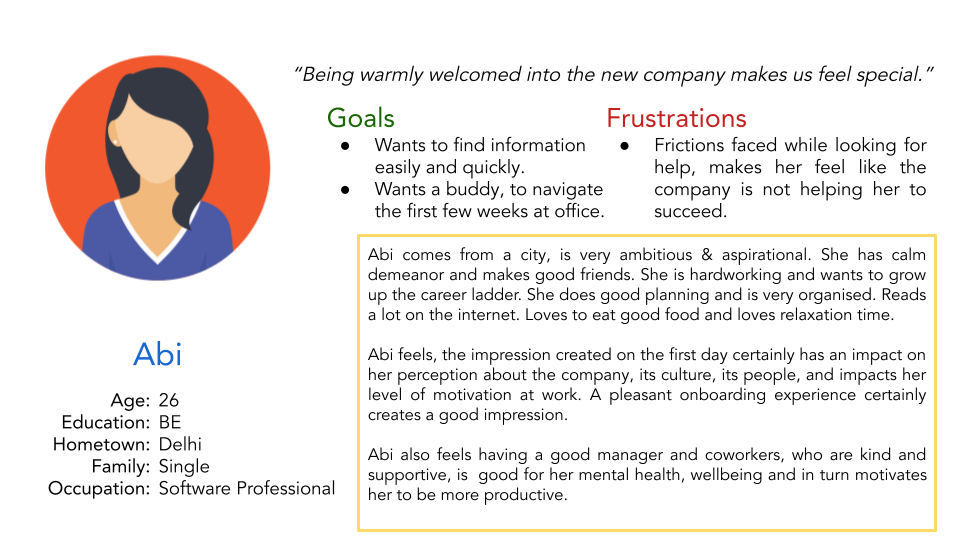
Abi joined a new company and took part in the new joiner’s induction program. The next day, she went to an HR executive for a query on insurance. The HR executive responded rudely, asking “What were you doing during the induction.” Abi was taken aback and felt this is not in line with creating a psychologically safe work environment and the “Great Place to Work” philosophy the company is advocating.
A few months down the line, when Abi wanted to book tickets for a few team members to attend a conference, she booked using a travel website instead of Concur, which is the company prescribed way for the employees to plan travel. Abi did this inadvertently, firstly because no one told her during induction, there is a system called Concur. Next, she didn’t have the mindset to check with someone from operations/HR team due to a poor first impression. Not using Concur, led to compliance issues, warnings and in turn had cascading negative effects on her career, resulting in low level of confidence, and being withdrawn from participating in office events. This had an overall impact on Abi’s morale and in turn on company’s business.
Suggested Solution
You Have a Buddy (YHaB) – A chatbot to handle employee onboarding & offboarding. This doesn’t mean, we eliminate physical onboarding sessions. This is to aid new employees beyond the induction sessions, with multi departmental support.
Poor onboarding can leave employees with lower confidence in their new roles, and worsened levels of engagement. Creating a great onboarding experience can make lives at work easy for employees, motivate them to perform well, set new hires for success and in turn greater employee retention.
From experience, we have seen checklists on Workday, to see if all onboarding tasks are complete. However, people rarely see to those. When new employees are handed over the laptop, they should have the onboarding chatbot pinned to their task bar. The chatbot should have notifications/flashing capabilities like how MS Teams flashes when a new message arrives. When the employees open the chatbot, he should get a welcome message with videos on the company, its history, various operations…etc. The employees should be presented with the list of various points of contact. The chatbot should answer questions like:
- What are my roles and responsibilities?
- How can I book a cab?
- How can I apply leave?
- Please share me the holiday lists for this year
- Who is my manager/HRBP?
- How to contact facilities team?
- How to get my laptop repaired?
- How to add a new software to my laptop?
- What are the leave policies?
- What are the various company policies?
- What are the compliance policies I should be aware of?
- What are the emergency contacts?
- What is the organisation structure?
- What does each function in the organisation do?
- Where to find my Form 16?
- What are the reimbursements I can avail?
- What is GCO? What do they do?
- Do I have a mentor at AZ?
- What are the mandatory learnings I should complete?
- Where can I see my mandatory learnings/assignments?
- What are my goals and objectives for the year?
- What is the company scorecard?
- What are the tools I should be knowing? Ex. Jira, Confluence, Workday, ServiceNow, Workplace, Degreed, SabaCloud…etc.
- What are a few examples of breach of compliance?
- What is POSH?
- The checklist before offboarding
*Above listed are a few sample questions.
Once onboarded, the chatbot should nudge the new employees on daily basis for the next 30 or 60 days prompting them to complete the mandatory trainings and guide them to plan their day.
Ex: When the employee logs in the morning, the chatbot should present a note saying,
“Good morning 😊 Let me guide you to plan your day. You have these mandatory trainings to be completed. Pick one to complete today.
Also, what is one big thing you want to focus today?”
When it comes to learning something that is in a document with option “Read & Sign”, people predominantly open and sign it without fully understanding what is in it. Not to blame the employees. This is partly because of the way such trainings are designed, which overwhelms. Probably a good way to make trainings meaningful should be to share snippets of information, at regular intervals, that is easy to grasp.
As a way for new employees to remember certain things, the chatbot can ask question from what they learnt, nudging to type the answers.
Ex: Chat bot asking, questions like “What is your understanding of leave policies at AZ?”
In toto, the virtual buddy should help new employees understand the company culture, know how to be compliant, ask for clarifications, and help establish workplace connections within the team, stakeholders, and the company, which in turn can enhance the overall employee experience.
Business Outcomes & Strategic Alignment
The chatbot can capture metrics on daily basis, from individuals, by populating some questions like:
- How was your day?
- Were you feeling stuck somewhere?
- What could have been done better today to improve your mood?
A weekly report can be generated to measure the level of satisfaction of new joiners and take measure to address their concerns.
The suggested solution, when implemented, can help new joiners with a pleasant onboarding experience, plan their career ahead at AZ, which in turn can lead to improved work satisfaction and greater retention of employees. This also aligns with company’s strategic goals of Run IT Brilliantly, Digitize Our World & being a Great Place to Work. Extensions of this chatbot solution could be to help clarify queries of patients onboarded onto studies, vendor onboarded to provide some service…etc.
Sustainability
Clear communication, and easy availability of information reduces the time wasted in navigating a matrixed organisation to find clarifications and improves overall productivity. Wanted to use the below example to corelate:
Over 1,200 hours wasted daily confiscating cigarette lighters, perfume sprays, power banks – BusinessToday
Please click & expand for a wealth of resources & references
- Question Answering – Language Understanding – Microsoft Azure
- FAQ Plus App Template
- Onboarding Can Make or Break a New Hire’s Experience
- Why People Quit Their Jobs
- Turn Departing Employees into Loyal Alumni
- The Morning Nudge & Evening Mood
- Over 1,200 hours wasted daily confiscating cigarette lighters, perfume sprays, power banks – BusinessToday
PS:
- Submitted this during a hackathon organised by my business unit in 2022 and resubmitted in an IT org wide hackathon in 2023. We were not the winners, but are glad to be in the top 10 entries amongst the 70 submissions.
- Thanks to new grads Banishree, Asaf, Sai Krupa & Sandra, who joined the company recently, for being part of the team and sharing the inputs on their employee onboarding process.
- Long back, when I was looking for a personal finance app, I stumbled upon YNAB (You Need A Budget) and that inspired the title for this idea: YHaB (You Have a Buddy)
Suggestions to curb OTP related monetary frauds

One-Time Passwords (OTP) are used by banks to authenticate user login & authorize transactions, by ecommerce companies to confirm delivery, by UIDAI, for Aadhaar based verification, by stock brokers to confirm trades, by taxi aggregators to confirm trips and so many other similar use cases.
There are numerous news articles which state, people are being scammed by obtaining their OTP, losing their hard earned money, and as a result of the loss, suffering serious health issues. Scamsters are well trained to talk in a way that sounds very genuine and earn the trust of their prey.
Currently most of the OTPs are in the format of a 4 digit numeric value. What if we have a unique alphanumeric format of OTP that prefixes some meaningful words like “BANK”, for transactions that would debit money from a user’s account. A format that clearly distinguishes and denotes that it is a money related transaction and one that could be easily understood by common people, so that they become aware money will go out or debited from the account when they key in the OTP.
Below are a few examples for OTP that could be standardized for money related transactions:
- BANK1234
- BANK123456
- BNK1234
- PAY1234
- SEND1234
- DEBIT1234
- M1234 (M denotes Money)
If there are technical difficulties in having alpha-numeric OTP, then we can think of something like prefixing the OTP with 2 or 3 zeros, which can symbolically denote a transaction that would debit money from the user’s account once the OTP is keyed in.
- 0001234
If the central agencies can arrive at a format, the same can be standardized for all money related transactions across all banks. The public can then be educated so that they are able to identify/differentiate an OTP for monetary transactions and not share the same with anyone. Also, we can keep educating the public that they do not need any OTP to receive money.
Addendum:
Of late I also read news on how people get cheated when they search for customer care numbers online and end up calling some dubious numbers. The crooks on call convince innocent people to install screen sharing apps, generate OTP and carryout banking transactions using the OTP they can view while the screen is shared.
Suggestion: Android currently shows tiny green dots called privacy indicators while the phone’s camera or mic is on. In a similar way, the user should be clearly indicated while his screen is shared and on top of this, to prevent misuse during screen sharing or screen mirroring, the Android Operating System should suppress or not allow anyone to open/access notifications, messages, email, banking apps or similar sensitive apps, while the screen is being shared.
With respect to the customer care numbers being altered, on Google maps or search results page, one resolution could be RBI (Reserve Bank of India) maintain a page with the customer care numbers and email ids of all banking and financial entities, similar to how it is done here. When someone searches e.g. “SBI customer care no.” on Google, Google can prioritize the search result by showing the official page from RBI both on search results as well as the side pane that shows details from Google maps, along with a note advising the public to refer the contact details shared by RBI or on the banks official website.
Also, we receive lots of spam messages on the phone with shortened URL/link. Leave aside spam messages, a user received a message for an item ordered online, from a local ecommerce firm, with an OTP to share to delivery person and a link to track shipment. The user was highly suspicious to click the link or share the OTP as it was from an unknow courier service. It would be safer if the users are able to preview the full URL before the browser actually opens it. Also, we should make it difficult for innocent users to download malware or apps by the click of a link shared by scamsters. Like privacy indicators, the user should be notified when something is being downloaded in the background or on click of any link, and also notify the location/folder where was it actually downloaded. An even better option would be when user clicks any malicious links from mobile, block any background installation without user entering the device security code. A differentiated OTP would have made the user feel at ease and a mechanism to block/check if any malware was downloaded by a link click, would make users feel safe.
We also receive QR codes from scammers, which people scan and end up losing money. It would be safer if some safety checks can be integrated within the camera application, which when used to scan QR codes, alerts the user if they were sent with malicious intent.
News references:
RBI Press Release
RBI warns against fraud calls, messages, emails and OTP scams | Mint
How to avoid OTP fraud
Avoid payment transfer scams – Google Pay Help
India: number of OTP frauds recorded by leading state 2021 | Statista
Rise of OTP based Frauds
SBI OTP fraud alert! Lender says know how to make online system work | How-to
SBI Customers Alert! This OTP fraud can be dangerous; here’s how to avoid it
KYC, OTP and PIN theft, the biggest trends in financial cyber-crime: Report
Mumbai: Woman claims did not share OTP with cyber-fraudster but lost Rs 3.63 lakh | Cities News,The Indian Express
Punjab CM Amarinder Singh’s wife reveals ATM pin & OTP to fake bank manager, loses Rs 23 lakh – The Economic Times
Beware of these 4 frauds while making payments via UPI amid lockdown – The Economic Times
SMS Spoofing: How scammers are using this technique to steal money from your account – Times of India
Two OTP frauds reported every day in city | Mega Media News English
Cyber Crime: New form of OTP theft on rise, many techies victims
Walk-in fraud: How this gang steals money via OTP – Times of India
Tips to Avoid OTP Fraud – Bajaj Finserv
Tips to keep your OTP safe from online fraud
Beware of fake customer care numbers you find on Google | Mint
WhatsApp users lose over Rs 54 crore to a new scam, here is what happened – India Today
Illegal desi call centres behind $10 billion loss to Americans in 2022 | India News
Fake delivery executives scam with OTPs: Here’s how to prevent falling prey | Mint
Mumbai woman tweets train ticket details online, loses Rs 64,000: here is what happened
Flat owners lick wounds as fake army officers invade bank accounts – Times of India
NRI techie duped of Rs 10 lakh by fraudsters in Chennai
Fraud calls are a real threat to many sectors – The Economic Times
BFSI, telecom most impersonated by scamsters for customer care frauds, says CloudSEK report – The Economic Times
In Chennai, scammer swindles techie out of Rs 9.5 lakh
Beware! Scammers sending fraud messages to HDFC customers, do not click on the link – India Today
Sim boxes new tool in scammers’ arsenal – Times of India
They thought loved ones were calling for help. It was an AI scam
Scammers steal Rs 1 crore from 81 users who were making UPI payment in Mumbai, how to stay safe – India Today
What could improve my twitter experience?
I glanced on this tweet and thought of sharing my little suggestions.
The people I follow tweet on multiple topics. However, not all the tweets are relevant to my interests. If I can have an option to either follow all tweets from an account or tweets on specific topics from an account, it would make my experience better.
In the twitter Bio or below the Bio, people can be given an option to add approximately, 5 -6 topics of interest.
Ex: Design, Startups, Health, Football, National Politics, Local News…etc.
Or something like, Tweets on #design, #startups, #health, #football, #nationalpolitics, #localnews…etc.
While Tweeting, users should be presented with their topics of interest, as tappable buttons to quickly select the tweet’s topic. Once the user selects the relevant topic from the available options, the selected topic should be added to the tweet as #tag. Ex: #design, #startups, #health, #football, #nationalpolitics, #localnews…etc
Also, when I open Twitter, I wish to have quick filters in the form of #tags or tabs, above the feed, to view tweets on the topics of my interests.
I retweet a lot of tweets from others, many of which are part of my learning, and I wanted to refer to those retweets later. If there is an option to easily search and filter all my retweets, based on the account and topic, it would be great.
I also wish to see the profiles differentiated based on if they are individuals, companies, magazines, news papers, political parties…etc. and then would like to have search filters to view tweets based on these types.
Thanking you in anticipation 🙂
PS: I predominantly use Twitter on desktop.
A better Google Photos app
When people were having film roll cameras, they took it out during special occasions, clicked a few pictures, developed them and put them into albums, which were later cherished as memories. With the advent of mobile photography, we click too many photos and sometimes we also miss enjoying the moment.
We went on a family trip for two days, along with our cousins. In those two days, we took nearly 600 photos. In a dessert shop that had Instagram worthy background, we clicked 37 pictures. For a portrait shot inside a tea estate, we clicked 15 pics of the same person, where I just needed one photo with a good facial expression and great background.
To capture a portrait picture when my friend was best dressed for a marriage, we clicked 25 photos with 3 different backgrounds. To get the best shot, my friend posed for photos with different styles like having free hair or plaited hair, wearing spectacles or without spectacles, smiling widely or without a smile, and with the face looking at the camera or looking sideways.
Of late, the albums are filled with too many photos, mostly because we click around 3 to 10 pictures in the same spot, so as to get the best shot and also because our cameras do not have film rolls like the old analog cameras, we don’t care how much ever we click.
A few months down the line, I might not appreciate having too many photos per album. I prefer minimal photos per occasion, somewhere between 10-50 photos per album. So after each occasion like picnics or wedding functions, I sit and diligently delete most duplicate or unwanted photos. Deleting these photos is a very boring task! But I still do it, to keep my albums clean. As I deleted the photos, I made notes of what I deleted, so that I can share with Google requesting them to use their AI prowess, image recognition capabilities and come up with algorithms that would help users declutter the photos.
How did I shrink the size of my albums and retain the good looking photos, the ones in which people are smiling, facial expressions are positive and the background is nice? By deleting the not so good photos. Here is what I did:
- Toggle between successive shots, look for if all the people in the pic are seeing the camera, are they smiling, decide on which one is better to retain and delete the other one.
- Between multiple photos of the same frame, I retained the one that looked lively. For me, being lively means smiling. Laughing means it is livelier.
- Compared between smiles that are wide with the ones that are gentle and retained, the one looked lively.
- Deleted photos if there are non welcome objects seen in the photo, like scattered clothes, unused chairs in the background…etc.
- Deleted photos in which people were seen talking and hence the facial expression was not good.
- Deleted photos in which people were trying to make children smile or make them look at the camera by uttering some jokes or using some gestures.
- Deleted photos in which the face was obstructed due to hand movement or some other objects.
- Deleted photos in which people were seen with eyes fully or partially closed.
- Deleted photos in which people were not smiling, seen frowning or staring rudely.
- Deleted photos if someone’s eyes or face is looking elsewhere.
- Deleted photos in which people were looking downward or the head was too up and faces were not clearly visible.
- Is the frame of the photo good? Has someone gone out of frame? Delete if someone is only partially covered in the frame than the one in which they are visible fully.
- Deleted photos with too much or too low lightning.
- Deleted photos if there is a glare on the face
- Deleted photos with poor shadow disturbing the frame.
- Deleted photos with hand or lip movements or if a part of the body part is blurred due to movement while taking the photo.
- Deleted if the person was giving some instructions or talking while taking the shot and the lip movements were not looking good.
- Deleted photos in which someone has photobombed.
- Deleted photo in which the baby was seen crying.
- Deleted photos if they were holding some props which are not fully visible. Ex. My daughter picked some strawberries from a farm and wanted those to be visible in the photo.
- Had multiple pics of the baby eating strawberries. Retained the one that had a lively expression.
- Deleted pictures where the costumes might have misaligned.
- If I have to cover a background with some name on the board or letters, deleted the ones where the names were partially cut
- Deleted photos that were taken from behind and were not looking great.
- For photos taken in front of monuments, compared with poses where the person was sitting, with the ones where they were standing and deleted the one that was not looking good.
- Took photos of a strawberry farm with family members and without family members in the frame. Retained the pic with family members. Might be it were a monument, I would have retained a pic that doesn’t have anyone else other than the monument in the frame.
- If everyone is asked to pose in a certain way, are all doing the same? Ex. Pouting, thumbs up, laughing, smiling. Does the pose look natural?
- I was choosing between photos with half frame and full frame, photos with feet visible and if they are looking good or ugly.
A few patterns I noticed:
- For pictures of people with good natural landscapes in the background, landscape mode looked better than portrait mode.
- Portrait picture with half frame, full frame and longshot. Full frame looked good. Long shots in portrait mode did not look good.
- Portrait shots with people standing far behind don’t look good.
- When there are more than 3 people in the frame, a photo in landscape mode looks good.
- In a spot, compared to a selfie, a photo taken by someone else looked good.
- When a pic was taken on hills with the photographer standing on highland and the person being photographed standing slightly below, then a photo with faceup looked better than a photo with face down. Similarly, when a pic was taken on hills with the photographer standing on lowland and the person being photographed standing slightly higher, then a photo with chin down looked better than a photo with chin up.
Let there be a Nudge: At the end of the day, if the photos app can show suggestions and provide tools to compare and delete duplicate and not so good looking photos, it would be great. The tool can prompt the reasons as to why a photo can be deleted. Ex. Someone looking away, blurred hand, foreign particles in the background, someone photobombed …etc.
Nudges can also be applied to delete not so useful videos, forwarded memes, good morning messages…etc.
Medical Archives: I regularly take photos of medical prescriptions and test report sheets, so that I can refer to them later. It would be great if there is a separate medical archives folder. When the labs send me the reports as pdf, in email, I can save it to Google Drive. However, if I get a physical copy of the reports, I click pictures of it, which would be in Google Photos. It would be helpful if there is an integration between Google Photos and Google Drive and I can have a common medical archives folder that can be accessed from both these apps seamlessly.
Casual Pics: When my wife had a new haircut, we took multiple pics to see if it looks good for her. I don’t intend to keep these photos for long. Also, there are lots of photos we take casually, while on a car ride or in a local train, but will not be a special long term memory and these photos can be classified as casual photos and have some option like delete these casual photos after 6 months or 2 years …etc.
Apart from albums, it would also be nice to have categories for photos, like family, friends, vacations, sports, work, medical documents, professional mode photos, other documents …etc.
Let the process of organizing and managing photos be simple and delightful and the memories cherishable. Also, clearing the clutter contributes to a sustainable earth, in a small way.
PS: Professional photographers will be able to add more ideas, to shortlist the best photos.
Thanks to Ravi for reviewing the draft of this post 🙂
Addendum:
I have enabled partner sharing on Google Photos. I click multiple photos and delete the not so good ones later. However, the photos I delete, only gets deleted on my account and not on my partner’s account. I would appreciate if there is an option to set sync settings for partner sharing, like sync with partner’s account immediately, after an hour, after 24 hours or after a week, so that I can delete the not so good photos and later only the good left over photos gets synced. Else, when I delete, the partner account could be notified highlighting the photos that were deleted and prompting if the partner would also like to delete or is ok to retain the photos.
I was casually capturing the building landscapes at my office and felt that the left most photo with the full building visible, looked better than the middle one, which looked better than the right most photo


Addendum – Oct 2023
The Morning Nudge & Evening Mood
A good plan makes a great day. Digital world presents us with plenty of choices and distractions. We struggle to organize our day, leading to missed deadlines, not keeping up with commitments, and as a result, loss of trust. Failing to plan also leads to working overtime, missing personal and family time which in turn leads to stress and anxiety. Also, people spend a considerable amount of time on various administrative tasks, which when delegated, simplified, or automated, frees up time for important tasks or initiatives.
Nudge theory is a Nobel prize winning concept in behavioural economics, that proposes positive reinforcement and indirect suggestions, to influence the behaviour.
A decluttered and organized life enhances wellbeing and improves productivity. Nudging people plan their day, optimize the schedules, and focus better, increases productivity, and helps manage work-life balance.
Below are the pictures of my desk board at home and the notebook I use to take notes, to-dos and plan my day.


Ways for Improvement
- Nudge people make daily, weekly plans, disconnect distractions and focus.
- Nudge people make progress, one task at a time, one day at a time.
- Nudge people develop better habits and monitor.
- “The biggest influence in life is habits. To get better results, develop better habits.” ~ Vala Afshar
Visual Boards & Notebooks: From my experience, visual boards, notebooks, and reminders are nudges which are right in front of my sight and have aided me in making my day organized, accomplishing tasks and being productive.
I also have a few pages in the back of my notebook, to note down the distractions and analyse once in a while on how to eliminate them during office hours.
The hack that helps me prioritize the important tasks to start first: Just imagine power will go off in the next 2 hours. What is the one important thing you wanted to complete before that, which, when not completed can lead to missed deadlines or an escalation? The chatbot can use such hacks to help people prioritize better.
Focus Mode – Disconnect distractions, Timebox & Deep work: While I learnt exploratory testing, we used a methodology called Session Based Test Management (SBTM). A similar thing in business parlance would be timeboxing. You take a task, fix 1 hour, and commit to be focused only on that task for the next 1 hour. You just do deep work or do nothing during that time. If the chatbot can nudge people to timebox, eliminate distractions like pausing email & chat notification and commit to deep work, it will help focus better and finish tasks with ease.
Routine Tasks: Nudge users to complete routine tasks like booking cabs in advance, filling timesheets by end of every week or month, submitting expenses and tax documents before deadline, deleting old mails once in a week and decluttering.
Habits are a superpower. What habit do you want to develop and monitor?
Ex: Did you read for 15 mins today?
Reflection: Nudge people to spend 5 mins daily evening, reflecting how the day was? And, to have a quick glance at the next day’s calendar.
Gamify: A gamified approach can create an inherent motivation.
Ex: When the user consistently achieves his plans for all days of the week, present him with a “Hurray! You earned a 5-star badge.” Else, gently say “Oops! you missed the plans for this day. No issues. Let’s rise tomorrow.”
Suggested Solution
An ideal solution would be a Microsoft Teams or Google Workspace based chatbot that acts as a virtual assistant and nudges people to plan, focus and relax.
Why a chatbot? At the office, we have goals and learning plans in various applications. We take notes physically in a notebook or keep it digitally as documents or in emails. We have emails to respond, meetings on calendar and minutes of meetings in email. We also have routine tasks like booking cabs in advance, filling timesheets by the end of every week or month, submitting expenses and tax documents before the deadline…etc. Like this there is lots of information scattered between many apps and we forget to check them all leading to missed tasks or deadlines. However, we check the chat window multiple times in a day, which has become a habit for many and hence having an AI enabled chatbot on MS Teams or Google Workspace, can assist in planning the day better, making smarter decisions and nudging users to act on the important.
The chatbot should nudge users,
- To track their long-term goals and daily plans
- To make commitments and set deadlines
- To act on pending tasks by sending reminders
- To create a habit of learning with 15 mins daily learning plan
- To take regular breaks.
- To delete mails and declutter the mailbox.
- To glance at the next day’s calendar before logging off for the day.
And by the end of the day assist in gauging the mood of the user
- Happy 😊
- What made me happy today?
- Worried ☹
- What worries me?
- What distracted me today from achieving my plans?
While nudging users, we should make the users feel confident that their privacy will not be violated, and their activities are not tracked by anyone else other than the user and be mindful that high frequency notifications can also be overwhelming. The Nudge should be framed in a way that motivates and enables rather than pressurising.
Benefits
A good plan makes a great day.
- When you can anticipate the needs of your day, you can prioritise what is important.
- Organised day helps manage time smartly and increases productivity.
- Crazy schedule feels overwhelming. An organized day reduces the stress.
- Helps us evaluate the progress.
- Striking off completed tasks is satisfying.
- We can have a clear mind and feel positive.
- We get time to relax.
- Increased work-life balance.
- We feel a sense of accomplishment and can have a better sleep at night.
The individual nudges, when multiplied by the total number of employees in the organisation, can create value at scale.
PS: Submitted this internally, when my company solicited ideas to implement AI/Chatbot/NLP based services across various functions, so as to become smarter/faster/leaner/better.
Would be nice if a similar self service chatbot can also be implemented by phone based chat applications, to help individuals better manage their day.
Addendum: I read that Wednesdays are the most stressful days of the week. I prefer to have Deep Work Wednesdays with no meetings of any type & Learning Fridays, which would helps us think, plan, learn or share something new professionally or personally.
Please click & expand for a wealth of resources & references
Sustainable Meetings
In continuation of my earlier post on how billions of dollars are lost every year due to unproductive meetings, I would like to share my suggestions for having sustainable online meetings.
Ref: How to run meetings effectively
Lots of work related meetings are happening online leading to meeting fatigue. With the online meeting service providers having a record option for meetings, people tend to record meetings with the assumption that people can refer to the recordings in future. However, any meeting recorded for playback occupies a lot more digital space than it would, had it been saved as a transcript or as simple meeting notes. I understand from general reading that people rarely view the recordings later. These recordings sit on servers and occupy lots of space and energy. When we calculate the amount of meeting recordings for an entire company or across the world, it would be massive, and the energy spent to maintain those recordings would also be massive.
We can tend to reduce the number of meetings. If a meeting must happen, then we can think of options to take notes or transcribe the discussion points rather than recording the entire meeting.
For a learning or educational meeting, a recorded video would be useful as people understand better through demonstrations, visuals, and illustrations. However, meetings recorded for future references can be transcribed using Artificial Intelligence / Natural Language Processing and the recordings replaced with just text. Texts are also easily searchable.
Nudge 1: Firstly, when a meeting is set up, prompt the meeting organiser with simple questions like,
- What is the purpose of this meeting?
- Does this meeting have a clear agenda?
- Can the purpose be solved with quick ad-hoc discussions or chats rather than a meeting?
Nudge 2: Next, when the planned meeting happens and when the meeting organiser clicks on record button, prompt him with questions like,
- Keeping in mind our sustainability goals, is it necessary to record this meeting?
- Will anyone ever watch this recording later?
- How long do you wish to retain this recording?
- Is this meeting recorded just for future reference or is this an educational session?
- Will taking notes suffice rather than recording?
Nudge 3: When there is 5 mins left before the meeting ends, nudge the participants to summarise the meeting points. Show the transcript of the meeting and enable the participants to remove the noise and retain only the important points. Enable collaboration of the meeting notes so that participants can mark if their actions are done.
Nudge 4: An Effective Meeting = Agenda + Action Items + Responsible Individual + Timeline. Nudge the participants to see if all the agenda items are discussed and based on the discussion, add the responsible individuals to actions identified, along with the deadline to act on it and an option to notify either 1 day or 15 mins before the deadline ends.
Suggested Solution
- As a meeting happens, enable a sidebar and using Natural Language Processing, capture the meeting transcript.
- Enable the participants to edit the transcript, removing the unnecessary noise and keeping only the important points from the meeting.
- Enable the organiser to do a quick check if the agenda items are discussed.
- Enable the organiser to list down the action items, assign responsible individuals and set deadlines.
- Enable the organiser to trigger alerts before the deadline approaches. Ex: 1 day or 15 mins before the deadline.
Benefits
- Any meeting involves time and money and simplifying it saves time and money.
- Not recording a meeting is an opportunity to save storage space and contribute towards sustainability.
- When we calculate the amount of meeting recordings for the entire company and across the world, it would be massive, and the energy spent to maintain those recordings would also be massive.
- Transcripts are easily searchable. Acts as quick reference. Important points from an hour long meeting can be quickly glanced and grasped probably in 5 mins.
- Employees feel overwhelmed due to too much meeting time online and hence lesser meetings and no recordings, reduces stress and improves wellbeing.
- Assigning actions with timelines, nudges participants to keep up with commitments.
- Helps follow up on the action items.
- No confusion as responsibilities can be clearly assigned.
Reading has been described as an active activity while watching videos has been described as a passive activity. Watching videos does not put the cognitive senses into any use close to how reading puts it.
Ref: Reading vs watching videos. What science says?
Let’s strive to have fewer meetings. And if a meeting needs to happen, let’s strive not to record and instead take notes of important actions, responsible individuals and the timeline.
Impact – Addendum – Nov 2023
- Generate a meeting summary
- Get started with Copilot in Microsoft Teams meetings
- Microsoft Teams Premium: Cut costs and add AI-powered productivity
- Teams is now able to extract text, suggest tasks & assign them to the right/responsible people automatically. Meeting recaps and real time transcriptions are saving billions of minutes for professionals.

TED Talks I liked

A few years back, when I was preparing to give an internal company talk, my then boss suggested, I listen to a few TED Talks and improve my presentation skills. I had never heard about TED Talks before that. Over time, I developed a habit of watching at least one TED Talk per week and enjoy watching these talks and taking notes for personal reference. Based on my interest, the content, the enthusiasm of the speaker and the presentation styles, I have created my watch list and am delighted to share it here.
The Danger of a Single Story – Chimamanda Ngozi Adichie
What Makes a Good Life. Lessons from the Longest Study on Happiness – Robert Waldinger
The Danger of Science Denial – Michael Specter
Why You Should Make Useless Things – Simone Giertz
The Happy Secret to Better Work – Shawn Achor
Your Body Language May Shape Who You Are – Amy Cuddy
Inside the Mind of a Master Procrastinator – Tim Urban
Less Stuff, More Happiness – Graham Hill
How to Get Your Brain to Focus – Chris Bailey
The Best Stats You’ve Ever Seen – Hans Rosling
The History of Our World in 18 Minutes – David Christian
The Power of Introverts – Susan Cain
How Great Leaders Inspire Action – Simon Sinek
How a Single Voice in Your Head Can Save Your Life – Sabina Nawaz
How to Speak So That People Want To Listen – Julian Treasure
The Puzzle of Motivation – Dan Pink
How to Make Stress Your Friend – Kelly McGonigal
Where Joy Hides and How to Find It – Ingrid Fetell Lee
How I Made Friends With Reality – Emily Levine
A kinder, gentler philosophy of success – Alain de Botton
Why We All Need to Practice Emotional First Aid – Guy Winch
There’s More to Life Than Being Happy – Emily Esfahani Smith
The Art of Saying No – Kenny Nguyen
My Stroke of Insight – Jill Bolte Taylor
Strange Answers to the Psychopath Test – Jon Ronson
How to Be Happy Every Day: It Will Change the World – Jacqueline Way
How to Achieve Your Most Ambitious Goals – Stephen Duneier
My Journey in Design – John Maeda
Happiness and its surprises – Nancy Etcoff
What Really Motivates People to be Honest in Business – Alexander Wagner
PS: Browse the Playlists on TED
TED encourages sharing the talks, under Creative Commons license. Please refer TED Talks Usage Policy
Addendum:
The Single Biggest Reason Why Start-ups Succeed – Bill Gross
How to run meetings effectively
I have been reading on how to run meetings effectively and be considerate of others time. Here is a compilation from what I learnt. Studies indicate that we spend anywhere from 35%–55% of our time, and sometimes much more, in meetings. Of the approximately 11 million meetings that take place every day in the US, a third are unproductive. It comes at a cost. An estimated $37 billion is lost every year to unproductive meetings, in the US alone.
Successful executives like Jeff Bezos, Elon Musk, and Steve Jobs developed their own techniques to combat bad meetings and here’s how Steve Jobs did it:
- At Apple, any meeting should have a clear agenda. (Also, it is good to be clear of the venue and the time)
- He kept meetings as small as possible. To Steve Jobs, the core idea of an effective meeting is for it not to be crowded.
- He made sure someone was responsible for each item on the agenda. He called that person, Directly Responsible Individual or DRI. The DRI would own the task, facilitate discussion around the agenda item and often manage post-meeting actions about it. (Research shows that clearly and publicly attaching a name to a task fosters accountability. This, in turn, increases follow-through)
- Conclude agenda topics with actions or next steps. Each action item will have a DRI and the deadline or time to complete.
Virgin Group founder Richard Branson insists everyone stands in meetings. If you’re standing, you’re not going to chitchat for too long, and you’re not going to have long, drawn-out conversations.
Agile teams have standup meetings, timeboxed between 5 to 15 mins, with participants standing up to remind people to keep the meeting short and to-the-point and usually take place at the same time and place every working day, with the simple 3 point agenda:
- What I did yesterday?
- What will I do today?
- Am I facing any challenges in accomplishing my sprint goals?
Now, let’s see how to create the Perfect Meeting Agenda. Consider creating it as a set of questions to be addressed:
- Instead of a topic titled “Budget Problems,” consider a question such as, “How will we reduce our spending by 100K by the end of the fiscal year”?
- Instead of a topic titled, “Customer Process Improvement,” consider a question like, “What are the key ways of improving overall response time to customers by 25%?”
- Instead of a topic titled “Leader Succession,” try changing it to “Where are we vulnerable from a leadership turnover perspective and how might we address these vulnerabilities?”
- Instead of a topic titled “Continuing Our Strategic Planning,” try changing it to what exactly will be worked on in the meeting such as, “What is the key market threat we need to be aware of, how could it affect us, and what can we do about it?”
- Instead of a topic titled, “Miscellaneous Updates,” try changing it to “What key pieces of information do each of you have to share or need from one another?”
A question-and-answer approach makes it easier to determine your invitation list, for one: it’s the people essential to answering the questions. This approach also better informs when to actually end a meeting — when the questions have been answered to satisfaction.
- Design questions that are specific and challenging.
- Collaborate to identify questions that truly matter.
- Privilege the most important questions first.
- Execute on the agenda.
And remember: if you can’t think of any questions to be answered in a meeting, that may be your sign that a meeting is simply not needed. Give back the gift of time to would-be attendees. They will thank you.
Let’s also see a few Meeting Mistakes:
- You don’t have a strong agenda.
- You invite too many people. Amazon’s Jeff Bezos follows the Two Pizza Rule: No meeting should have more people than can be fed with a pair of pepperoni pies. This not only allows for quicker decisions, it also lets teams test their ideas without the interference of groupthink
- You don’t have a facilitator.
- You don’t establish and follow ground rules.
- Not starting a meeting on time. A whopping 37% of meetings start late, mostly because someone attending it was late
- You listen to the loudmouth, rather than the expert.
- You use your phone.
- You drink too much coffee or eat during the meeting.
- You indulge in small talk. (Leave the small talk for the water cooler.)
Term of the post: meetingitis – An excessive tendency to hold unnecessary meetings.
To summarise:
Effective Meeting = Agenda + Action Items + Responsible Individual + Timeline
Addendum: During a Lean Coffee meeting at office, we discussed on how to stop small talks during meetings and save time.
- Start the meeting on time and not wait for latecomers.
- The organizer can strictly stick to the meeting agenda.
- The meeting rooms shall have printed notices saying “Please keep the casual conversations at water cooler points or at cafeteria” and also some stats on the time and money wasted by unnecessary meetings, so that the participants are conscious.
- If the agenda items are discussed, close the meeting and give participants their valuable time back.
Please click & expand for a wealth of resources & references
- 3 Ways Steve Jobs Made Meetings Insanely Productive – And Often Terrifying
- 12 tricks Steve Jobs, Jeff Bezos, and other famous execs used to run meetings
- Manage your Team Meeting like Steve Jobs Did
- These 12 Meeting Mistakes Cost Companies $37 Billion A Year In Lost Productivity
- Let’s Have Better Meetings!
- 12 Ways to Stop Wasting Time in Meetings
- How to stop wasting your time — and everyone else’s — in meetings
- How to Run a Meeting
- 9 Ways To Make Your Meetings Matter
- Do You Really Need To Hold That Meeting
Note taking – a productivity hack
A pen and a notebook have been a great productivity tool for me. I take notes and ToDos. I write down deadlines and important dates. When a ToDo item is Done, I strike it off, so as to keep track of what is pending. For taking notes, I prefer to use a spiral sketchbook that is turned over by the side rather than a notepad that is turned over at the top. Why note taking has been a crucial skill for me as a tester. I take notes,
- About an application under test
- During requirement discussions
- During testing, making notes of issues
- For test idea generation
- To keep track of the queries
- To keep track of the issues
- To keep track of the deliverables, deadlines and it’s status
- To remember important points during calls and conferences
- To note down ideas or suggestions …etc.
The benefits of note taking:
- “Note taking isn’t just about recording information. Effective note taking is thinking on paper.” – Nicole Liem Yang of Show Me the Notes
- Not only do good notes help us recall facts and ideas, there’s good evidence that the act of writing things down helps many of us to remember them better.
- By jotting down what you need to remember later, you can then turn your focus on what you’re hearing or reading. You will have room to ask follow up questions or clarifications
- Notes help us to prioritize the important.
- Notes help to eliminate the communication gap.
We have smartphones and laptops. Then why use notebooks?
- You have a significantly higher chance of achieving your goals if you write them down. This is likely why vision boards or lean visual controls have become popular.
- We can always have that handy and in sight, thus reminding us of our priorities.
A few tips on note taking:
- Keep it short. Yet, it should be clear so that you understand when you refer to it next time.
- Don’t write down every single word.
- Focus on important points.
- Use abbreviations or short-hand writing.
- Forget spelling and grammar.
Here are a few note taking methods
- Cornell Style of Note Taking
- The Outlining Method
- Mind Mapping
One of the greatest note-takers was Leonardo Da Vinci, whose notes (Codex Leicester) were bought by Bill Gates for over $30 million and are exhibited today to the public.
References:
https://en.wikipedia.org/wiki/Note-taking
Taking Notes: The Secret to Getting Better Results in Life
Note-taking as a Skill for Testers
https://www.lifehack.org/articles/featured/advice-for-students-taking-notes-that-work.html
How to telecommute / work from home effectively?
What is telecommuting?
Telecommuting, also called working from home, remote work, telework, or teleworking, is a work arrangement in which employees do not commute or travel to a central place of work, such as an office building, warehouse or store and work from home, coffee shop or a place of their choice. Below listed are a few points to help you telecommute / work from home effectively:
- Take pride in your work.
- Start early – you can get a lot done with a fresh mind.
- At the home office, no one’s watching. You are responsible for what you do.
- Communicate expectations with anyone who will be at home with you so that they don’t distract/disturb you.
- Pretend like you are going to office. Don’t stay in the nightdress/pyjamas. Structure your day like you would do in office. This helps you to be focused and productive.
- Choose a dedicated workspace – Setting your work space apart from your home space allows you to better delineate the two, and lets your brain know when it needs to be in work mode or home mode.
- Set goals for the day, create a To-Do list and commit to doing things. Using a simple notepad and pen works better. Write down and strike off as you finish a task.
- Set deadlines for tasks.
- Work in Sprints – to allow yourself dedicated time to a task at hand, work in sprints of no more than an hour at a time before you take a break. This way, your main task gets your entire focus for the allotted time, and then you can take a break for a few minutes to recharge.
- Save calls for the afternoon.
- Use technology smartly, to stay connected. (Ex. Skype, Slack, Hangout, Microsoft Teams)
- Communicate Deliberately. Remote workers have to be better at communication than their office brethren.
- Communicate well and often. Check in with co-workers and the boss several times a day.
- Find the team’s golden hour – it makes sense to find the time when the majority of the team is available, so that you can schedule daily standup or all-hands meetings or other important events during that time.
- Be virtually present in meetings.
- Every 1 hour, take short and clear breaks. Get up and get outside to the balcony, for a while. Coffee breaks and lunch allow for some respite and time away from the desk and screen.
- Follow the 20/20/20 rule – look away from the screen, every 20 mins, to something 20 feet away, for 20 secs.
- Don’t go to non-work appointments in the middle of the day.
- Make it harder for yourself to mess around on social media and TV. Resist the impulse.
- Resist the urge to snack often.
- Set office hours. Pick a definitive start and finishing time each day.
- Have a shutdown ritual – this could be anything, from writing up what you did during the day and planning what you want to achieve tomorrow.
- Do not forget to update the status for the day with the team and the manager.
- Follow a routine – waking up, exercise, breakfast, logging in to work, lunch, logging out of work, evening family time, dinner, sleep. Routines help you to be organised.
- As a manager,
- Be proactive. Reach out to your team members regularly to set clear goals and expectations, offer support and assistance, and show you care about them as people, not just employees
- Provide the right tools for the employees
- Communicate clearly
- Set clear expectations
- Track progress
- Be transparent
- Remember to stay healthy,
- Exercise regularly
- Clean home creates a positive environment and helps focus.
- Drink plenty of water
- Eat healthy
- Maintain proper hygiene
- Get some fresh air, take a few deep breaths
- Maintain a good posture
- Take short breaks, quick walks, and do a few stretches
- Put aside your devices at night
- Have enough sleep at night and feel sufficiently rested
Every remote worker can have their own version of this list that helps them work to their full potential and be 100% productive for their team.
PS: I had compiled and shared this with my team 2 years back, when we had to work from home for a few days. Sorry that I do not remember the exact links or the sites, to provide reference here. Re-sharing it now for the benefit of all those who are privileged to have an option of working from home.
Enhancing the Messages app for a better User Experience
One morning around 6.30 am, my phone beeped upon receiving an SMS. Usually, I get my office cab details in SMS around the same time every day and thought it might be the same. When I took the phone to check the message, I was shocked to see that someone abroad had used my credit card to transact around 900 GBP. My sleep went off in the shock and I immediately dialled my bank to notify that the transaction was not done by me.
Of late, we have started receiving lots of spam and marketing messages/SMS on mobile. We receive transaction alerts from banks as SMS. It happens, we fail to notice these alerts as they get buried with the rest of the other spam messages in the Inbox. In case, any unauthorised transaction has been made and if we fail to notice the banking alert SMS, it could prove costly.
With Android rolling out RCS (Rich Communication Services) messages, I thought I can share a suggestion to organise the messages in a better way so that we don’t miss out any messages that are important. Besides, too many spam messages are annoying, which keeps me away from opening the messages app and there certainly should be an option to filter these spam messages. Google has implemented tabbed messages in Gmail and thought why not we have a similar option for the messages too with four tabs. The first tab can be for Important alert messages like bank alerts, ATM withdrawal alerts, credit card spending, OTPs, stock market trade details, online wallet transfers and purchase receipts …etc. The second tab can be for the messages From Contacts. All other messages which might not be important and might not be spam too can be in the third tab, Updates. The marketing and spam messages in the fourth tab, Spam.
Below are a few layout suggestions to organise and display the messages. They are the candidates to experiment and understand which serves the users best and which the users love. The layout can have grid, list and tab views to display the messages. This UI presentation makes the messages to be organized and well presented. More importantly, it helps in noticing important messages and making decisions quickly, which is missing today in the messaging app. The time to act upon a required message will be less here when compared to the current message inbox. Apart from the layouts suggested, it would also be helpful if the user has feature to sort unread messages, follow-up messages and add reminders to the messages. All these improvements can eventually make the experience of using the messaging app much better.

(Designed using Marvel)
(Designed using Marvel)
(Designed using Marvel)
References:
A Plan for Spam – http://paulgraham.com/spam.html
Better Bayesian Filtering – http://paulgraham.com/better.html
Filters that Fight Back – http://paulgraham.com/ffb.html
Mobile UX Design: List View and Grid View – https://uxplanet.org/mobile-ux-design-list-view-and-grid-view-8f129b56fd5b
Web Layout Best Practices: 12 Timeless UI Patterns Analyzed – https://www.uxpin.com/studio/blog/web-layout-best-practices-12-timeless-ui-patterns-explained
Thanks to Pari & Ravi for reviewing the draft and the feedback 🙂
Addendum:
These days, after shopping at stores, very few people save the physical receipts, which would be used in case of exchanges, warranty or for any other tracking purpose. It would be of great help if the messages app also has options to categorize and store receipts, that are sent as messages after billing through POS machines. Additionally, these receipts can also be useful to redeem loyalty points. Gradually, shops can eliminate the necessity to issue physical copy of receipts. If the Messages app can summarize all the spends for a month or year that would be an added delight, which would help us manage budgets.
Also, I m interested to have Google pay integration with Messages. If I receive my monthly notification for credit card payment or phone bills, I should be allowed to pay directly from the Messages app.
 Attitude is Everything