Placeholder – Publishing the blog shortly. Please excuse.
Author Archives: Ashok Prabhu
The Reviews You Can Really Trust
Online reviews have become the go-to resource for everything—from buying gadgets and booking hotels to choosing training courses or restaurants. But are these reviews always trustworthy? In a digital world flooded with ratings and testimonials, many of us have discovered the hard way that not all five-star reviews are created equal. This post explores how incentives, outdated information, and persuasive advertising often skew online ratings—and why the opinions of people you know can be far more reliable.
Case Study 1: The Paid Review Trap
When Nivetha decided to restart her career, she turned to online reviews and picked a two-day classroom training. The fee was steep, but the 4.8/5 rating convinced her it was worth the investment. The training promised value but delivered something she could have learnt through Wikipedia or for free online. Disappointed, she realized the classes were not worth the money she had paid for. What puzzled her most was the glowing online ratings. The answer arrived the next day—she received an email: “Give us a 5-star review, and you’ll get a ₹500 voucher.” The incentive was tempting, but Nivetha questioned the ethics: were the stellar ratings genuine, or had they been bought?
What went wrong?
It’s easy for a person to be swayed by a small incentive. The reward for 5-star ratings had distorted the online reviews and also misleads future customers, making them unreliable and undermining the credibility of feedback.
Case Study 2: When Awards Can’t Be Trusted
Ria was driving on the highway when she noticed something peculiar: multiple billboards for different car brands, each proudly claiming the “Car of the Year” award. She knew various publications and organizations give out their own awards, but it still made her wonder—how can they all be “the best”? A few weeks later, she found a clue. An email from a marketing firm offered her company an award in a specific category, but only if they paid a fee that could be “clubbed as part of the marketing budget.” This practice, often called “pay-to-play,” instantly made her realize that the accolades she’d seen on those billboards might not have been earned at all. A practice that misleads consumers into believing a company or product has been genuinely recognized for its excellence.
Case Study 3: The Friend Factor
Vishnu’s experience buying his first car was another lesson. An emotional milestone, he did his research online and was drawn in by relentless ads touting a particular model’s 5-star safety rating. He was ready to buy it until a lunch conversation with colleagues changed his mind. Babu, who already owned that model of the car, confessed he was unsatisfied with the quality of interior parts and the engine and the positive online publicity the car had received was a job done well by the marketing team. He advised Vishnu to consult Gopi, a car enthusiast whose recommendations were based on real-life experience. Gopi’s thoughtful advice helped Vishnu find the right car for his needs.
Your friends’ honest opinion trumps a thousand 5-star reviews.
Case Study 4: Advertising and Authenticity
Manish ran into similar trouble when he searched online for office chair & desk to setup his home office, during the Covid lockdown. Soon, he was bombarded with polished online ads and enthusiastic testimonials. Manish purchased the chair and desk, only to discover a few weeks later that they were poorly made and falling apart. A few days later, in the office lunch table, another colleague, Subha was asking for opinions to buy an office chair and mentioned the ads she saw from same company Manish had purchased. Manish was fuming because he fell for a wonderfully crafted advertisement and strongly suggested not to purchase that chair. Hearing this, another colleague recommended a chair he was using for years, and was of good quality and affordable. Subha made her purchase based on recommendation from a trusted friend and found it good. Manish & Subha now trust & ask suggestions from friends, colleagues, or through alumni WhatsApp groups before buying something or eating out, rather than relying on online reviews.
What went wrong?
Persuasive advertisements & suspicious testimonials lured Manish into buying a poor quality product.
Case Study 5: Old Reviews and New Problems
Arthy’s attempt to treat her guests at a local restaurant, based on positive reviews online, ended in disappointment. When they went, she was upset that neither the food nor the ambience lived upto the hype the reviews had promised. Talking to her friend later, she learned the restaurant had changed management years earlier and quality had dropped since. She also noticed how the restaurant staff placed a small card with QR code, politely asking her to leave a 5-star review.
What went wrong?
Outdated reviews misled Arthy and the restaurant’s aggressive solicitation of high ratings further distorted the truth.
Case Study 6: The Malicious Competitor
Shan, the owner of a popular cafe, is facing a problem many small business owners dread: fake negative reviews. A jealous competitor has orchestrated a campaign to sabotage his reputation. The competitor has enlisted friends and acquaintances to write scathing reviews on various online platforms, even though they have never set foot in Shan’s cafe. These reviews are not based on any real experience; they are a calculated and malicious attempt to drive down his star rating and mislead potential customers. This case highlights how online review systems can be exploited not only by unethical businesses but also by malicious competitors who weaponize fake reviews to undermine a rival’s success.
Case Study 7: The Vacation Membership Trap
Karthik was sold on a dream: a lifetime of luxury family holidays at prestigious resorts. Lured by glossy advertisements showing serene resorts and happy families and a high-pressure sales presentation, he invested several lakhs into a long-term holiday membership. He was imagining effortless annual getaways, but the reality was a nightmare. Every time Karthik actually had vacation days, the app showed “Zero Availability” for his desired resorts. The beautiful rooms he saw in the ads existed, but they were out of his reach when he actually needed them. To his frustration, he noticed the same “fully booked” rooms were often available for the general public on websites like Booking.com or Agoda—but at a premium price. He soon realized he was part of an “Inventory Gap”—where the number of members far exceeds the number of available rooms. The financial drain didn’t stop at the initial fee. Karthik was hit with a mandatory “Annual Subscription Fee” that increased every year. He had to pay this fee even in years when he didn’t use the membership at all. When he finally managed to book a remote resort, he found himself in a “Food Trap”—since the resort was far from town, his family had to pay five-star prices for every meal, often doubling the cost of the “free” holiday. Now, he’s trying hard to transfer his membership, realizing that a beautifully marketed lifestyle is useless if you can’t actually use it, when you need it.
What went wrong? Karthik fell for glossy advertisement that sold a “dream,” without checking the real-world booking experiences of long-term members He traded the simple flexibility of a hotel booking for a rigid, one-sided contract. Between the “subject to availability” fine print, the hidden burden of rising annual fees, and the difficulty of transferring a membership, he realized that a beautifully marketed lifestyle is no luxury at all or indeed a burden if it dictates exactly when and where you can breathe.
Whether it’s a 5-star rating bought with a gift voucher, a testimonial from an anonymous user, or an award paid for by a company, the goal is the same: to create a perception of quality that might not exist in reality. Nivetha, Ria, Vishnu and Manish learned that a manufactured reputation, built on awards or paid endorsements, is no substitute for genuine quality. The best way to know if a product is truly excellent is to rely on the trusted, real-world experiences of people you know.
User Reviews – which began as a system designed to build trust and attract more visitors has now become unreliable, compromised by vested interests and manipulative practices.
How Might We Make Online Reviews Trustworthy?
Implement a “Re-Review” Nudge: What if, after posting a review, users received a gentle nudge a day later—asking if their review was genuine or incentivized, encouraging them to rethink or edit if necessary.
Ask Better Questions: A one-time visitor to a restaurant might give a good review, but a repeat customer is a sign of true satisfaction. Asking a question like, “Will you come back again?” could better gauge a customer is really in love with the food or service. Some relevant options like “Just came to explore” or “Came here for the Instagram worthy ambience” can help filter out one-off, potentially incentivized reviews.
Question Incentivized Reviews: Look critically at testimonials rewarded by discounts or vouchers, and be wary of ratings that seem unusually positive.
Check Review Dates: Verify that feedback is recent and relevant to avoid being misled by outdated comments.
Rely on Your Network: The most trustworthy reviews come from people you know. Your friends, colleagues, neighbors, alumni groups and trusted communities are far more reliable sources of information than a faceless online rating. They have no incentive to lie and can offer personalized advice based on their own experiences. The next time you’re tempted by five-star ratings, reach out to someone you trust – someone with real skin in the game.
Share Honest Feedback: When we write reviews, let’s pledge to be honest & transparent about our experience and help others make informed decisions.
Have you ever been misled by fake reviews? Share your experience in the comments below, and let us know what could have helped you make a better choice. Thank you 🙂
The reviews you can really trust, come from the people you know.
*Thanks to Pari, Ravi, Ajeeth & Vidhya for reviewing the draft of this post & for the early feedback.
*This blog post was refined using Gemini & ChatGPT
Tidbits:
– 15 Red Flags You’re About to Eat at a Bad Restaurant
– How the book, ‘Skin in the Game’ changed how I understood risk and success
My Learning on Prompt Engineering
Remember when calculators first showed up? Accountants worried they’d be replaced. Instead, these tools simply made them faster and more accurate. This story repeats itself: from the Industrial Revolution to the Internet, new tech doesn’t replace human skill—it amplifies it.
Just like the printing press or the internet, Generative AI is now here to democratize and boost human ingenuity. For example, designers gain the freedom to iterate new concepts at remarkable speed, while researchers can distill vast datasets in seconds and focus their talents on discovery.
Generative AI creates new content—text, stories, images, music, and more—by learning from massive amounts of data. It only needs an input, or what we call a ‘prompt,’ to get started. Think of it like this: If you show an AI thousands of photos of cats and guitars, it learns the patterns. When you prompt it to “draw a cat playing a guitar,” it creates a new image.
A Large Language Model (LLM) or AI Model is the core computer program, trained on vast data to recognize patterns and perform tasks. Think of the AI model as the engine, and the AI tool as the car. The engine provides the power; the car (like Gemini or ChatGPT) gives you the interface and controls to apply that power.
How do they work? They’re brilliant guessers. LLMs look at a sentence like, “After it rained, the street was…” and, based on statistics and all the data they’ve seen, they predict the most likely next word. This predictive ability lets them answer complex questions, write a story, or develop an entire ad campaign.

The AI Landscape: A Quick Look at the Major Players
| AI Tool | Company | Models (Examples) | Purpose |
|---|---|---|---|
| ChatGPT | OpenAI | GPT-4o, GPT-4, GPT-3.5 | General-purpose AI for complex tasks, conversation, and content creation (text, code, image, and audio). |
| Google Gemini | Google DeepMind | Gemini (Ultra, Pro, Nano), PaLM, BERT | Highly capable multimodal AI, designed for complex reasoning and information retrieval across text, images, audio, and video. |
| Microsoft Copilot | Microsoft | GPT-4o, GPT-5 (planned), DALL-E 3 | To boost productivity by integrating advanced conversational AI into Microsoft 365, Windows, and Bing for task automation and content generation (text and images). |
| Claude | Anthropic | Claude 3 Opus, Claude 3 Sonnet, Claude 3 Haiku | A suite of safe, reliable, and high-performance LLMs tiered for different needs, from complex reasoning (Opus) to instant responsiveness (Haiku), all with vision capabilities. |
| DALL-E 3 | OpenAI | DALL-E 3, CLIP (Contrastive Language–Image Pre-training) | Text-to-Image Generation: To create highly detailed, accurate, and coherent images from natural language text prompts. |
A Prompt is simply the input—the text, question, or instruction—you give an AI tool. For example, typing, “Tell me a joke about cats” is a prompt.
Modalities are the different formats AI can use: text, images, video, audio, or code. When you use several formats at once, that’s multimodal prompting. For instance, you could upload a picture of a chart and ask the AI to explain the data in simple terms.
As AI becomes central to our work, one skill is becoming essential: prompt engineering. If you’ve ever struggled to get the precise result you wanted from an AI, the secret lies in writing better prompts. Put simply: The quality of the output depends on the quality of the input.
The Foundation: Clarity and Purpose
The first step to a better prompt is giving the AI a clear purpose. Clarify what you want the AI to do and why. For example, instead of just “Generate a headline,” a better prompt is “Generate an SEO friendly headline with keywords xyz, to increase traffic.”
Provide Context
– Time frame (when?)
– Location (where?)
– Industry or field (what sector?)
– Target audience (for whom? Ex: The answer is for a 6 year old or a report for aboard member )
Details Matter – The Power of Specificity: Think of prompts like giving directions. The difference between “go to the store” and “take the first right, walk two blocks to the grocery store” is huge, right? The same applies to AI prompts. The more specific context you provide, the better results will be.
Let’s look at how adding context transforms a simple prompt:
Vague Prompt: “Tell me about weather trends.”
Clear Prompt: “Analyze weather trends in the Pacific Northwest for 2025.”
Notice how the second prompt includes three key details: What (weather trends), Where (Pacific Northwest), When (2025)
Vague Prompt: “Give me marketing strategies.”
Clear Prompt: “Suggest social media marketing strategies for a small wellness brand targeting millennials in Canada for Q1 2025.”
Vague Prompt: How was DNA discovered?
Clear Prompt: “You’re a science expert developing a new curriculum at a local college. Tell me in a couple of engaging paragraphs how DNA was discovered and what kind of impact it had on the world. Write it in a way that people unfamiliar with science would understand. You have gotten feedback from students that they found this course dry and unintelligible before, so you want to make sure that the explanation grabs the students’ attention and makes a good first impression.“
Vague Prompt: Write a code to calculate the Fibonacci sequence
Clear Prompt: “Write a TypeScript function to efficiently calculate the Fibonacci sequence. Comment the code liberally to explain what each piece does and why it’s written that way.”
Vague Prompt: Summarise the meeting notes.
Clear Prompt: “Summarise the meeting notes in a single paragraph. Then write a markdown list of the speakers and each of their key points. finally, list the next steps or action items suggested by the speakers, if any.”
The Sweet Spot – Specificity Without Overload: Adding context isn’t just about making prompts longer; it’s about making them smarter. For example, when asking about market trends:
Vague Prompt: “What are the market trends?”
Clear Prompt: “What are the emerging market trends for sustainable consumer goods in Europe for 2025, focusing on plastic-free packaging?”
Avoiding Mistakes: Be careful not to overload your prompts. Too many unnecessary details can confuse the AI. For instance, when asking about customer service, this would be an overwhelming prompt:
“Provide customer service tips for a small, family-owned, three-employee, downtown-located, recently-painted-blue bookstore that sells mainly mystery novels and has a cat named Whiskers.”
Instead, stick to adding most necessary details to get something like this:
“Suggest customer service strategies for a small independent bookstore targeting mystery readers.”
A word of caution: sometimes an AI will make up facts or generate false information, which we call hallucination. Since AI can sound very confident even when it’s wrong, we use a strategy called Human-in-the-Loop (HITL). This just means a human (you!) must always review, fact-check, and edit the AI’s output.
Start simple. Evaluate the response. Iterate by adding relevant details until you get the expected output. Let’s look at a few techniques to make this possible.
Prompting Techniques
1. T-C-R-E-I
The TCREI framework (Task–Context–References–Evaluate–Iterate) is a powerful 5-step process that guides you from a basic idea to a polished result. It adds a critical focus on reviewing and improving the AI’s first draft. Here’s a mnemonic to remember the framework: Thoughtfully Create Really Excellent Inputs.
- Task: The specific job you want the AI to do. Always include a Persona (who the AI should be) and a Format (how the output should look).
- Ex: “Act as a history professor (Persona). Summarize the causes of World War I (Task) in a bulleted list (Format).”
- Context: All the relevant background details and constraints. This tells the AI the “why,” “who,” and “where” of the request.
- Ex: “The summary must be easy enough for an 8th-grade student to understand and should focus only on the political factors.”
- References: Providing examples, data, or source text. This is like giving the AI a blueprint to follow, ensuring the output is accurate or matches a specific style.
- “Base your summary only on the provided text from ‘The Great War: A New History’ and do not use outside sources.”
- Evaluate: Review the AI’s output. Check for accuracy, tone, and whether it met all the Task and Context requirements.
- (This step is done by the human user after the AI responds.)
- Iterate: If the first response wasn’t perfect, refine your original prompt and try again. This is key to unlocking better results!
- “The first response was too formal. Please rewrite the summary using simpler vocabulary and a more encouraging tone.”
TCREI in Practice: “What’s a good birthday gift idea?”
Here’s how T-C-R-E-I transforms a simple question into a perfect prompt:
- Task: “Act as a personal shopper (Persona). Suggest three unique gift ideas (Task) in a simple table format (Format).”
- Context: “The gift is for a 29-year-old woman who recently switched from snowboarding to skiing. My budget is $30.”
- References: “In the past, she loved the ‘Smartwool ski socks’ and the ‘ski slope mug’ I gave her.”
- Evaluate: (The AI suggests a specialized ski wax, a pair of lightweight goggles, and a gift card.) I realize the goggles are too expensive for my budget.
- Iterate: “The second suggestion for goggles is over budget. Please replace it with a recommendation for a low-cost item, like a book or a snack, that a skier would appreciate.”
The final two steps, Evaluate and Iterate, are the secret weapon of an experienced prompter. They acknowledge that the first answer is often just the starting point!
2. Shot-Based Prompting
Shot-based prompting is a quick way to get specific results by giving the AI examples, or “shots,” right inside your prompt. It’s the AI equivalent of “show, don’t just tell.” This technique is best for quick tasks where you need the AI to follow a specific style, format, or pattern without giving it a lot of extra background information.
Zero-Shot Prompting: No examples are provided. You just ask the question or issue the command., and the model responds based on general knowledge and patterns learned during training.
Best suited for simple translations, factual questions, or basic text summaries.
- Sample Prompts:
- “Translate ‘Hello, how are you?’ into Spanish.”
- “Summarize the following paragraph:”
- “What is the capital of Japan?”
One-shot prompting: One example is provided before the actual task. This helps the AI understand the format or style of the expected response.
Best suited for setting a specific tone, dictating a precise output format (like a table or a tag), or teaching a simple transformation rule.
- Sample Prompts:
- “Translate ‘Good morning’ into French: ‘Bonjour’. Now translate ‘Hello, how are you?’ into French.”
- “Tag the part of speech in this sentence: “Dogs bark loudly.”
Example: “The cat sleeps.”
The: Determiner
cat: Noun
sleeps: Verb
Sentence: “Dogs bark loudly.”” - “Change the following sentence to sound more formal tone.
Casual: What’s up with your project?
Formal: What is the current status of your project?
Now, change this sentence:
Casual: Can you get me that thing?
Likely Formal Output: “Could you please retrieve that item for me?””
Few-shot prompting: Two or more examples are provided. This technique is used to teach the AI a more complex, specialized, or subtle pattern that a single example might miss.
Best suited for complex classification, code generation, learning a very specific writing style (like the “dark fantasy” example), or training it on a unique structure.
- Sample Prompts:
- “Classify intent:
Can you join the call at 10 AM tomorrow?’ — Intent: meeting request
‘Here are the minutes from last week’s call.’ — Intent: information sharing
‘Could you send over the latest sales figures by Wednesday?’ — Intent: action required
Now classify intent:
‘Please approve the attached proposal before Friday.’” - “Convert the following English sentences into SQL queries for a products table.
Example 1:
English: Select all products.
SQL: SELECT * FROM products;
Example 2:
English: Get the product named ‘Laptop’.
SQL: SELECT * FROM products WHERE name = ‘Laptop’;
Example 3:
English: Find products with a price greater than 500.
SQL: SELECT * FROM products WHERE price > 500;
Now, convert this sentence:
English: List all products with a category of ‘Electronics’.
SQL:”
Likely Output: “SELECT * FROM products WHERE category = ‘Electronics’;” - “Write short, dark fantasy descriptions for the following items, in a style similar to the examples.
Example 1:
Item: A tarnished silver locket.
Description: A locket that whispers forgotten sorrows, its surface worn thin by centuries of bitter tears and lingering regrets.
Example 2:
Item: A crooked wooden staff.
Description: This staff is not merely wood, but the petrified spine of a long-dead tree-spirit, its gnarled knots pulsing with a faint, malevolent energy.
Item: A single, black feather.
Description:
* AI’s Task: The AI learns the pattern of writing with a dark, evocative, and slightly sinister tone from the two examples. It then applies that specific style to the new item.
* Likely Output: “Plucked from the wing of a fallen seraph, this feather feels cold to the touch, and its edges hum with the silent scream of shattered grace.”
- “Classify intent:
3. C-R-E-A-T-E
The CREATE framework is a simple way to remember all the necessary components for a powerful, high-quality prompt. It’s an easy-to-use checklist that structures your request to ensure the AI gives you exactly what you need, tailored to the right situation and tone.
- Context: The background or situation. Why are you asking this? This ensures the response is relevant to a specific scenario.
- Ex: “We are preparing for a Q3 board meeting.”
- Role: The persona the AI should adopt. This guides the model’s tone, vocabulary, and perspective.
- Ex: “Act as a financial analyst.”
- Emotion: The feeling the output should convey. This makes the response sound appropriate for the audience.
- Ex: “”Use a professional but optimistic tone.”
- Action: The specific task the AI needs to perform, like explaining, creating, summarizing, etc.
- Ex: “Summarize the last five years of sales data.”
- Tweak: Instructions for refining or adjusting the output.
- Ex: “Keep the summary under 200 words, using bullet points.”
- Example: Providing sample inputs or desired outputs. This guides the AI and reduces ambiguity.
- Ex: “Start with a headline like: ‘Five Years of Steady Growth.'”
CREATE in Practice: “Write me a summary of our company’s sales.”
“Act as a financial analyst writing a summary for a Q3 board meeting. Use a professional but optimistic tone. Summarize the last five years of sales data in under 200 words, using bullet points. Start with a headline like: ‘Five Years of Steady Growth.'”
4. R-T-F
The RTF framework is one of the simplest and most powerful ways to structure your prompts. It’s a three-step checklist that ensures the AI knows who it is, what it needs to do, and how the final answer should look.
- Role: The Persona. Who should the AI pretend to be?
- Ex: “Act as a seasoned travel blogger.”
- Task: The Goal. What exactly do you want the AI to achieve?
- Ex: “Create a list of five must-see hidden gems in Rome.”
- Format: The Structure: How should the final output be presented?
- Ex: “Present the list as a markdown table with columns for ‘Name,’ ‘Location,’ and ‘Best Time to Visit.'”
RTF in Practice: “Give me risks for a hospital renovation.”
“You are an experienced construction risk manager specializing in facility renovation. Your task is to identify potential risks in this project to transform a designated wing into a functional outpatient clinic, considering construction delays, budget overruns, patient safety, and uninterrupted hospital operations. Create a risk register with the projects potential risks, in a table format.”
5. Chain of Thought
Chain-of-Thought (CoT) prompting is a technique that forces the AI to show its work. Instead of just giving you the final answer, you instruct the AI to break down the problem into a series of logical steps, just like you would on a test.
This technique is essential for complex problems because it makes the AI’s reasoning transparent and drastically improves the accuracy of the final result. If the answer is wrong, you can easily trace the mistake back to the incorrect step.

How to Use CoT Prompting
To activate this powerful feature, simply add a key phrase to your prompt:
- “Explain your reasoning step by step.”
- “Go step by step.”
- “Before the final answer, show your thinking.”
CoT in Action: Two Problem Types
Mathematical/Analytical Reasoning.
Prompt: “A baker makes 25 loaves of bread. He sells 15 loaves in the morning. In the afternoon, he bakes another 10 loaves. How many loaves of bread does he have now? Please show your reasoning step by step before giving the answer.“
AI’s Transparent Reasoning:
* 1 Start: The baker starts with 25 loaves.
* 2 Morning Sale: He sells 15 loaves, so he has 25 – 15 = 10 loaves left.
* 3 Afternoon Baking: He bakes 10 more loaves, so he now has 10 + 10 = 20 loaves.
* 4 Final Answer: He has 20 loaves of bread now.
This step-by-step process ensures the model correctly accounts for each action (selling and baking) and arrives at the right numerical answer.
Creative Problem-Solving
Prompt: How would you plan a surprise birthday party for a friend who loves hiking and minimalist design? Use the chain-of-thought reasoning and provide a final plan.
AI’s Strategic Thought Process:
* Step 1: Identify the key constraints: a surprise party, a friend who loves hiking, and a minimalist design aesthetic.
* Step 2: Brainstorm ideas that combine these elements. A surprise party in a traditional venue might not fit the hiking theme. A hiking trip would fit the theme but might be hard to make a surprise. A good compromise would be a surprise party at a scenic, outdoor location, like a state park or a mountain lodge, that doesn’t require a strenuous hike.
* Step 3: For the minimalist design, focus on clean lines, natural materials, and a limited color palette. Avoid clutter and excessive decorations. The party could feature simple, elegant table settings and arrangements of wildflowers or greenery.
* Step 4: The surprise element needs careful planning. A decoy activity could be a “short walk” to the location where the party is set up.
* Final Plan: Plan a surprise party at a rented cabin or a state park pavilion with scenic views. The theme will be “natural and minimalist,” with simple decor and a focus on the beautiful outdoor setting. The surprise will be revealed when the friend arrives at the “hiking destination.”
6. Tree of Thought
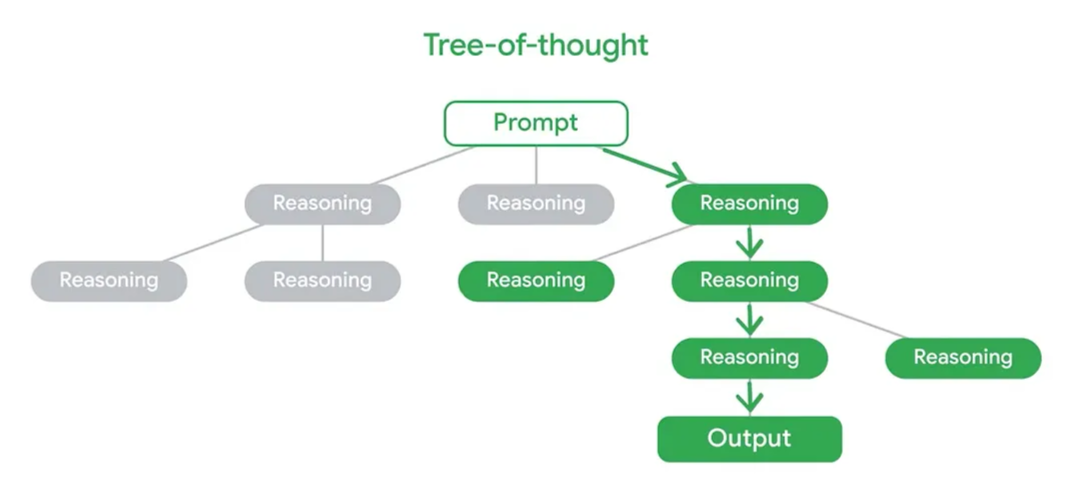
Tree of Thought (ToT) is an advanced technique that takes Chain-of-Thought (CoT) reasoning one step further. While CoT encourages the AI to find one logical path to an answer, ToT asks the AI to explore multiple, branching paths of reasoning before committing to the best solution. This process mirrors how humans often solve complex problems by considering multiple angles before committing to a final strategy.
ToT Prompt: “Develop a strategic marketing plan for a new language learning app called ‘Lingua-Flow.’ First, generate three distinct marketing strategies (e.g., social media focus, partnership focus, content marketing focus). Second, evaluate each strategy by analyzing its potential reach, cost-effectiveness, and time-to-impact. Finally, select the single best strategy and provide a detailed execution plan for the first 90 days.”
The Missing Cookies Mystery
Prompt: You are a detective solving a simple mystery. I need you to use a Tree of Thought (ToT) approach to find the culprit(s).
The Mystery:
Mom baked 10 cookies. There are only 6 left. Exactly 4 cookies are missing.
The Suspects:
– The Dog
– The Big Brother
– The Little Sister
The Clues:
– Clue 1: The cookie jar is on a high shelf that is too high for the dog to reach.
– Clue 2: The Big Brother has crumbs on his shirt. He claims he only ate 2 cookies.
– Clue 3: The Little Sister has chocolate on her face. She claims it’s from a chocolate bar.
Your Task (Follow these steps to build your “thought tree”):
Step 1: Initial Hypotheses.
Generate a list of three distinct “Thoughts” or hypotheses to explain where the 4 cookies went. Each thought should focus on a single suspect.
Step 2: Evaluation and Pruning.
For each of your initial hypotheses, evaluate it using the provided clues. State whether the hypothesis is valid or invalid based on the evidence. If a hypothesis is invalid, explain why and “prune” it (meaning, discard it from consideration).
Step 3: Synthesis and Final Conclusion.
Look at all the hypotheses that were NOT pruned. Can you combine them to create a single, logical explanation that accounts for all 4 missing cookies and fits all the clues? State your final conclusion clearly.
7. Prompt Chaining
While Chain of Thought guides a model to think step-by-step within a single prompt, Prompt Chaining uses a series of independent prompts where the output from one prompt becomes the input or context for the next prompt. Connecting prompts is like connecting links in a chain—which is why this process is called prompt chaining. Prompt chaining guides a generative AI tool through a series of interconnected prompts, adding new layers of context or tasks each step of the way. Eventually, those linked prompts help the tools solve complex problems one step at a time, just like putting together a puzzle.
Prompt: “Generate three options for a one sentence summary of the attached novel manuscript. The summary should be similar in voice and tone to the manuscript but more catchy and engaging.”
“Now, create a tagline that is a combination of the previous three options, with a special focus on the exciting plot twists and mystery of the book. Find the catchiest and most impactful combination. The tagline should be concise and leave the reader hooked and wanting to read.”
“Create a five sentence summary of the entire manuscript below that expands on the one sentence summary.”
“Generate a six-week promotional plan for a book tour, including what locations I should visit and what channels I should utilize to promote each stop on the tour.”
Based on the promotion plan, generate a visually energetic poster that can be shared on social media. The poster should contain the book title, tagline, author name, book tour venue & date.
The strength of Prompt Chaining is that it prevents the AI from getting overwhelmed by a single, massive request. You handle the complexity by acting as the project manager, assigning one clear task at a time and adding context with the previous results.
8. Meta Prompting
Meta Prompting is the practice of asking the AI to write or improve a prompt for you. Instead of manually struggling to craft the perfect, detailed request, you give the AI a high-level instruction (a “meta-prompt”) and let it generate the final, effective prompt.
In short, meta-prompt is a prompt that writes an effective prompt.
Examples of a Meta Prompt:
Scenario: You are a creative writing teacher and you want your students to write a short story. You need to generate a unique prompt for each student to prevent plagiarism and encourage creativity. Manually creating 30 different prompts is time-consuming and difficult.
“You are a prompt generator for a creative writing class. Your task is to create a single, specific prompt for a student to write a short story. The generated prompt must follow these rules:
* Start with a clear command: Use a phrase like ‘Write a short story about…’
* Establish a character: The main character must have a unique profession or a surprising past.
* Define the setting: The story must take place in an unusual or unexpected location.
* Introduce a specific conflict or challenge: This should be a clear problem that the character must solve.
* Specify a tone: The tone must be either ‘humorous’ or ‘melancholic’.
* The final output should be only the generated prompt itself, without any introductory text or explanation.”
Response (The Generated Prompt):
“Write a short story about an retired deep-sea salvager who has taken a job as a lighthouse keeper on a remote, landlocked mountain peak. One night, a mysterious, glowing object falls from the sky and lands just beyond his reach. The salvager must figure out what the object is and how to retrieve it, all while dealing with his own feelings of isolation and regret. The story’s tone should be melancholic.”
Meta prompting also works with images (a multimodal input). If you want a logo to match the feel of a specific painting, you can upload the painting and use this meta-prompt:
“Generate a prompt I can use to create the perfect logo for my dog food company that evokes the style of the attached image. The prompt should specify the color palette, texture, and historical era suggested by the artwork.”
9. Iterative Role Playing
Iterative Role-Playing is a powerful technique where you engage in a dynamic, back-and-forth conversation with the AI, often by switching roles between prompts.
Instead of submitting one massive prompt, you and the AI collaborate on a single project by taking on different personas (like a CEO and an Analyst, or a Student and a Teacher). This method allows you to progressively refine the output, correct flaws, and build complex documents, much like a dialogue with a human team member.
Example: Creating a Business Plan
Instead of asking for a complete business plan in one go, you can use iterative role-playing to build it section by section.
* Prompt 1 (You as CEO, AI as Business Analyst): “You are a business analyst. I am the CEO of a new tech startup. Our product is an AI-powered personal finance app. Draft an executive summary for our business plan, highlighting our mission and value proposition.”
* Prompt 2 (You as CEO, AI as Marketing Strategist): “That’s a good start. Now, switch roles. You are a marketing strategist. I need a detailed marketing plan section. Focus on social media and influencer partnerships. Provide specific campaign ideas.”
* Prompt 3 (You as Financial Director, AI as Accountant): “The marketing plan looks solid. Let’s move to the financials. You are now an accountant. I need a projected profit and loss statement for the first three years. Assume a conservative growth rate of 15% annually.”
Example: “Act as a mock interviewer, interviewing me for the position of Python programmer. Ask me a behavioral question first, and then follow up with a technical question about object-oriented programming.”
You answer the interview questions & add a follow-up prompt
“Now, switch your role to an interviewer coach. Give me feedback on my answers and suggest how I could improve my technical explanation.”
10. Image Generation
Prompting for image generation is where your imagination truly comes alive! It’s the art of talking to an AI model to transform your wildest visual ideas into digital masterpieces. Think of it as being both the director and the artist—you describe the scene, and the AI paints it for you.
The more precise and descriptive your words, the closer the generated image will match your creative vision. It’s a combination of different elements like the subject, style, mood, color palette, composition, and any other distinctive features you want to include. Experimenting with different prompt structures unlocks a vast range of artistic possibilities, making image generation accessible and engaging for everyone.
The Anatomy of an Image Prompt
Here’s how to structure your prompts to get the best visual results:
- Subject: The main star of your image.
- Example: “A majestic dragon,” “a futuristic cityscape.”
- Style Modifiers: The artistic look or medium. This is crucial for setting the aesthetic.
- Examples: “Photorealistic,” “oil painting,” “digital art,” “concept art,” “3D render,” “cinematic lighting,” “in the style of Van Gogh.”
- Prompt Example: “A pyramid made of glass, rendered in Unity and tinted red.“
- Setting/Environment: Where your subject is located.
- Examples: “In a misty forest,” “on the surface of Mars,” “a bustling city street.”
- Atmosphere and Mood: The overall feeling you want the image to convey.
- Examples: “A peaceful morning,” “a dramatic, high-energy scene,” “a melancholic mood.”
- Additional Details: Specific elements like lighting, colors, or camera angles.
- Examples: “Dramatic lighting,” “soft sunlight,” “vibrant, warm colors,” “a close-up shot,” “aerial view.”
The Golden Rule: Iterate, Iterate, Iterate!
The key to successful image prompting is an iterative process. Start simple, see what the AI generates, and then add more details, keywords, and stylistic modifiers to refine the results until you get your perfect image.
Mastering Color Palettes
Controlling the color palette in your prompts is a powerful way to set the mood and visual tone of your image, rather than leaving it to chance.
- Specific Colors and Shades: Name the colors directly.
- Examples: “A vibrant red and gold sunset,” “a calm scene with shades of blue, teal, and soft white.”
- Color Schemes: Use art terms to guide the AI.
- Examples: “A monochromatic scene” (using one color, varying shades), “a complementary color scheme” (colors opposite on the color wheel, like blue and orange), “a pastel color palette” for a soft look, “earth tones,” or “neon colors.”
- Moods and Associations: Describe the feeling you want the colors to evoke.
- Examples: “Warm colors” (reds, oranges, yellows) for cozy or energetic, “cool colors” (blues, greens, purples) for calm or mysterious.
- Quality Boosters: These enhance the resolution and detail.
- Examples: “High resolution,” “2K,” “4K,” “sharp focus.”
- Prompt Example: A beautiful, majestic, incredible pyramid, 4K.
Guiding Composition
Composition is all about how elements are arranged within your image. By including composition notes, you can direct the AI to create a more dynamic, balanced, or artful scene.
- Rule of Thirds: Imagine a grid over the image; place subjects along lines or intersections for balance.
- Examples: “Subject off-center,” “main character positioned according to the rule of thirds.”
- Camera Angles and Shot Types: Direct the AI on how to frame the subject.
- Examples: “Close-up shot,” “wide-angle view,” “aerial view,” “from a low angle,” “fisheye lens view.”
- Perspective: Control the viewer’s point of view.
- Example: “A one-point perspective of a long road.”
- Framing: Use elements within the scene to frame your subject.
- Examples: “A character framed by a doorway,” “a landscape viewed through a window.”
- Symmetry and Asymmetry: For balance (“symmetrical composition”) or dynamism (“asymmetrical composition”).
Prompt: Generate close-up images of a pair of sleek silver headphones on a desk in a college dorm room. They should have musical notes floating around the headphones to show that they’re playing music.
Pro Tip: Want to hone your image-generation prompting skills? Try playing “Say What You See,” a fun web-based game where you describe images and compare your description to the original prompt used to create them!
11. Data Analysis & Visualisation
AI as an Analyst: Most data is noise until someone asks the right questions, draws insights and creates the right visualisation. That someone, can now be the Gen AI.
Start with the right questions. AI performs best when there is an intent.
- “What decisions am I trying to make?”
Ditch the jargons. Act like human
- Technical Prompt: “Calculate the compound annual growth rate (CAGR) by territory.”
- Intent-Driven Prompt: “Which regions have shown the most steady, predictable growth in the last three years?”
- Technical Prompt: “Create a pivot table showing churn rate by month for Q2.”
- Intent-Driven Prompt: “What caused customer churn to spike after April 2025? Show the top three factors.”
See it as a story instead of stats & pivot tables
- Technical Prompt: “Plot customer growth over the last six quarters.”
- Intent-Driven Prompt: “Show me the story of our customer growth over the last six quarters using a compelling graph, and explain the trend.”
Using AI as a Strategic Thinking Partner. Explore the unasked questions
- “What’s unusual in this dataset?”
- “Are there any non-obvious trends or anomalies that deserve my attention?”
- “Based on the 2024 sales data, suggest three strategic questions I should be asking the executive team next quarter.”
By using natural language and asking intent-driven questions, you shift your role from a data cruncher to a strategic leader, amplifying your expertise with the help of AI.
Prompt Engineering is the new literacy. A powerful means for productivity, innovation, and strategic thinking. Start simple, be specific, and never stop iterating.
Ready to start amplifying your work? Go try your first structured prompt!
Please click & expand for some sample prompts you can use to practice, learn & explore
- “Explain quantum computing like I’m 10 years old. Use a simple analogy.”
- “Explain blockchain vs. traditional databases using a simple analogy.”
- “I took these notes on Python loops. Explain the core concepts back to me like I’m a beginner.”
- “I believe remote work hurts team creativity. Argue AGAINST my view.”
- “I’m writing a blog post about sustainable fashion. Give me 10 unexpected angles.”
- “Rewrite this email to be 30% shorter and more direct. Keep it polite but urgent:”
- “Rewrite this paragraph for non-experts. Remove acronyms. Use everyday words: [Paste technical text]”
- “Act as a busy, skeptical HR manager. How would you react to this new employee wellness policy? What questions would you ask?”
- “How would Marie Curie approach solving climate change today? Describe her method in 3 steps.”
- “You are a poet who works in a whimsical style. Write me a 4-line poem about a cat.”
- “Provide a concise, bullet-point list of the benefits of our new product xyz.”
- Provide a summary in bullet point format of the following scientific [PDF document]. Highlight the 3 most important findings.
- Sort these on a timeline: Voice assistants, First chess computer, Self Driving cars, Turing Machine.
- Paste a picture of a scientist and ask the AI tool to identify who this is?
- Paste a picture of a scenary and ask the AI tool to describe the image?
- “Create a Ghibli image of a rabbit in the forest.”
- “You are a social media expert for an eco-friendly brand. Generate three post ideas for posting on social media.”
- “Generate a misty landscape with rolling hills and light rain in the impressionism style.”
- “Generate an image of a cityscape that blends the geometric shapes of cubism with the vibrant colors of pop art.”
- “Create an image of a glass of water on a table by the beach. There are lots of droplets on the outside of the glass. In the background you can see the turquoise water of the ocean. It’s a beautiful summer vacation scene.”
- Provide a summary in bullet point format of the following scientific [PDF document]. Highlight the 3 most important findings.
- “Summarize the following meeting transcript and create a meeting summary that includes the following items:
Agenda: A brief description of the meeting’s objective.
Date and Time: Clearly state when the meeting took place.
Attendees: List all participants.
Summary of Discussions: Highlight the main subjects discussed.
Action Items. Please put the action items into a table format, along with who is responsible and time to complete for each action item,
Follow-Up Meetings: If applicable, mention when the next meeting is scheduled.
Additional Information Needed: Outline any further information required to move forward
Key Insights/Takeaways: Summarize the most important points or decisions that are critical for stakeholders to be aware of.
Return your final response as well formatted word document.” - “I’m trying to learn Spanish to better communicate with my clients who live in Guatemala. Take on the persona of a skilled Spanish tutor and help me learn Spanish. I want you to teach me Spanish by delivering increasingly difficult lessons, crafting educational activities and scenarios, chatting with me in Spanish, and quizzing me. Correct my errors when I respond and call out areas of improvement. Provide feedback in English only. When I want to end the lesson, I’ll write “adios.” After we finish our conversation, provide me with a personalized list of vocabulary words, conjugations, and tips I should study to become a better Spanish speaker.”
- “Act as if you are Steve Jobs in a product review meeting. I’m presenting our online community platform. Give brutally honest feedback on design, focus, user experience, and innovation. Challenge what’s missing and what could be revolutionary, Then give clear, high-level directions.”
- You’re a movie critic that specializes in Italian film. Create a table that contains the greatest Italian films of the 1970s, and separate them into genres like thrillers, dramas, and comedies. Provide a 100-word summary of each movie as well as details about the production including director and release year.
- Travel-Destination Inspiration:
- “I have a budget of $2,000 for a week-long trip in October. I want somewhere with warm weather and great hiking. Suggest three destinations within a 6-hour flight of New York.”
- “Help me brainstorm a ‘bucket list’ trip for a solo traveler who loves street photography and spicy food.”
- “We are looking for a family-friendly destination in Europe that isn’t too crowded but has plenty of activities for a 5-year-old.”
- Travel-Itinerary Building:
- “Create a 4-day itinerary for Tokyo that focuses on hidden gems and local cafes rather than the main tourist spots. I’ll be staying in the Shibuya area.”
- “I’m visiting Paris for the first time. Can you build a 3-day schedule that balances the major landmarks with relaxing time in parks?”
- “Design a 10-day road trip route through the Scottish Highlands, including the best stops for scenic views and historic castles.”
- Travel-Budgeting & Logistics:
- “What is the average daily cost (excluding accommodation) for a couple visiting Lisbon? Break it down by meals, transportation, and museum entries.”
- “Compare the pros and cons of traveling by train vs. renting a car for a tour of Tuscany.”
- “Help me create a packing list for a 2-week trip to Iceland in December. Include essential gear for glacier hiking.”
- Travel-Food & Experiences:
- “Give me a list of 5 must-try local dishes in Mexico City and suggest one specific neighborhood known for having the best street stalls for each.”
- “I love Art Deco architecture. Which neighborhoods in Miami or Havana should I prioritize for a walking tour?”
- “Are there any cultural etiquette rules I should know before visiting a traditional Onsen in Japan?”
Please click & expand for a wealth of resources & the references
- Prompt Engineering Guide
- Prompting guide 101
- OpenAI Academy
- Prompt engineering overview – Claude Docs
- Anthropic’s Interactive Prompt Engineering Tutorial
- Introduction to Generative AI and LLMs (Part 1 of 18) – Microsoft Learn
- Stanford Institute for Human-Centered Artificial Intelligence
- All Things Generative AI
- OpenRouter
- There’s An AI For That
- Fireflies.ai
- NotebookLM
- Anthropic Claude
- Gemini
- Google AI Studio
- Colab
- Claude
- Microsoft Copilot
- ChatGPT
- Midjourney
- Stability AI Image Models
- Runway
- ElevenLabs
- DALL-E
- Canva Magic Design
- Adobe Firefly
- Phot.AI
- HeyGen
- Vibe coding: Emergent
- Study Together: https://x.com/omooretweets/status/1942644108750639502
- Stock research – https://x.com/JafarNajafov/status/1939997860768199076
- Game Theory – https://x.com/PromptLLM/status/1942228380486701437
- Financial Planning: https://x.com/alex_prompter/status/1946841854164508811
- Systems Thinking: https://x.com/PromptLLM/status/1944031671285608960
- JSON Prompting https://x.com/thisguyknowsai/status/1956269176391393699
- 15 Viral ChatGPT AI Prompts That You Must Try -ChatGPT Prompts That Actually Work – Mystic | ILLUMINATION
- 50 Design Styles Every Designer Should Know for Better Prompting – Himanshu Bhardwaj – Aug, 2025 – UX Planet
- PAIR Explorables
- What is a long context window? Google DeepMind engineers explain
- Prompt Engineering – Pinterest Board
- God of Prompt – X
- PromptLLM – X
- Neat Prompts – X
- Google Labs – X
- Master the Perfect ChatGPT Prompt Formula (in just 8 minutes) – YouTube
- AI Engineering – X
- LearnPrompt.org
- The 7 Deadly Sins of Prompting
- Layers of Prompting
- https://medium.com/@jordan_gibbs/behold-the-prompt-bible-is-here-27e739eeffcd
What next?
– Practice different prompting techniques. Playing and experimenting with prompts is the best way to figure out how to get what you want & learn what works for you.
– Create and maintain a prompt library. It’s a powerful way to capture most effective prompts, make them reusable and develop your gen AI prompting skills. Ref: Template
– Try different LLM models to identify your go-to model.
– Learn about AI Agents. Difference between Generative AI & Agentic AI.
– What is context engineering?
– Share you favourite prompting technique, model and tips in the comment section below. Thank you 🙂
The future belongs not to those who fear these new tools, but to those who learn to wield them creatively—and in doing so, shape what comes next for us all.
*This blog post was refined using Gemini.
My Learning on Decision Making
Do you get stuck on choices—big and small? Do you get paralyzed by too many options? Do you believe waiting for the perfect answer is safe, when in reality, indecision is actually the riskiest path? Let’s level up! Decision-making is not a mysterious art, but a learnable habit. Business consultants & corporates rely tools and frameworks. I gained simple wisdoms, from the below quotes 🙂
“If you stand in the middle of the road for too long, you may get hit from both sides.”
Inaction has a cost. Be Decisive. It isn’t about being reckless. It’s about moving forward, learning quickly, and adjusting as you go. Stop Overthinking, Start Doing.
“Perfectionism is the enemy of progress” – Winston Churchill
The biggest roadblock to a decision isn’t a lack of information; it’s the belief that you must have a flawless plan before you start. Polishing endlessly and aiming for perfection hinders progress and keeps great ideas and tasks trapped in your head. Aim for “good enough to test,” then improve. Think in versions: v1 gets you moving, v2 makes it better, v3 refines based on feedback. Be consistent. Make a little progress everyday. Done Is Better Than Perfect.
“Schedule the Big Rocks, Don’t Sort Gravel” – Franklin Covey

Teaches how to decide or prioritize, with a simple & clear analogy i.e. if you put the gravel (small tasks) into jar/day first, you will quickly fill it up, and you won’t have space for the big rocks (high-impact tasks or work that truly matters). Focus your limited time and energy on the truly important decisions and tasks like putting the big rocks in the jar first, and the little tasks or the gravel will fit around them.
“If you get on the wrong train, get off at the next station – the longer you stay, the more expensive the return trip will be.” – Japanese proverb
What if you make the “wrong” choice? A bad decision is only a failure if you refuse to change course. A quick Course Correction is cheaper than stubborn commitment to a mistake.
“Hamlet was wrong!” – Blink – Just do it!
Malcolm Gladwell, in his book Blink, suggests that, for many choices without catastrophic consequences, spontaneous decisions or gut judgments, backed by basic facts, are often as good as carefully planned ones. Are you stuck on analysis paralysis? Give a quick deadline, trust your instinct and ask yourself: What’s the smallest step I can take today to make some progress? Action creates clarity. Action creates momentum. Overthinking kills it. Stop Ruminating. Just Do It!
Thinking of complex frameworks? Simple tools can help you decide faster!
- Mindfulness/Meditation: Clears mental clutter and improves focus, which is the foundation of deep thought.
- Weighted pros/cons: List outcomes and tag impact as high/medium/low. Pick the highest‑impact option, not the longest list.
- 80/20 Analysis: Identify the vital few drivers that produce most outcomes. Focus effort there.
- Use data when the game is stable; use structured judgment when the game is changing. Choose, act, and adjust.
- Reversible vs. irreversible: If a decision is reversible, decide fast. If it’s hard to undo, slow down and gather one more piece of key information, then commit.
- Regret test: Ask, “Which choice will I regret not trying when I look back in a year?”
- 70% rule: If you have roughly 70% of the information and waiting won’t change much, decide now and learn the rest by doing.
- After‑action reviews: Post‑decision, ask: What did I expect? What happened? What will I do differently next time? Small reflections compound.
- The Two Perspectives Rule: For any proposal, write both the strongest case for and against it before deciding.
- Decision Trees: Map choices, probabilities, and payoffs. Useful for uncertainty and sequential decisions.
- The Decision Log: In a journal, record key decisions with context, options considered, rationale, risks, and outcomes. Review monthly to spot patterns in your misjudgments.
We saw that decision-making is a combination of experience, intuition, data & structure. Simple frameworks can help us with everyday and tactical decisions. Corporates & expert strategists rely on advanced frameworks like Game Theory. But what about the Big Life Decisions—the ones that changes your identity and are irreversible, where you can’t truly know how it will feel until after you’ve become that person. Somethings like, should you have a child or stay child-free? Should you relinquish your country’s citizenship for a new one? Should you sacrifice a decade to become a brain surgeon? These are what philosophers call “transformative experiences” — a concept explored in the thought experiment known as “The Vampire Problem.”
The problem states that for choices that fundamentally change who you are (your identity and values), you cannot rationally predict the outcome, because the person who experiences the outcome doesn’t exist yet! How can you know if your future “vampire self” will be happy? Explained with two helpful lenses: Gilbert vs. Paul
- Daniel Gilbert’s lens: When facing a big decision, like sacrificing the next 10 years of your life to become a brain surgeon, talk to people who have already done it. It makes a lot more sense for us to rely on other people’s lived experiences than to try to predict for ourselves.
- L.A. Paul’s lens: Some decisions are identity-changing and irreversible. No amount of shadowing, babysitting, or role-playing truly tells you what life will feel like on the other side. We must look beyond logic. The decision is not about rationally proving you’ll be happy; it’s about asking: Who do you want to become? Do I have the courage to choose the self I want to discover?
- Make the vampire problem practical: classify your decision
- Reversible decisions (you can undo): Decide fast, test small, adjust. Use “done over perfect.” Your future self can course-correct at the next station.
- Irreversible decisions (hard or impossible to undo): Slow down slightly, widen options, reality-test assumptions, and talk to many people. Then decide based on values, identity, and the person you hope to become.
Traps
- Confirmation bias: Only seeing evidence that supports your current belief.
- Counter with “disconfirming evidence” or run a Red Team Review.
- Availability bias: Overweighting recent, vivid, or easily recalled examples..
- Counter with historical base rates and broader statistical data.
- Anchoring: Over-relying on the first number or piece of information presented.
- Counter by generating multiple independent estimates.
- Overfitting: Overcomplicating analysis.
- Counter with simpler models and out-of-sample tests.
- Action bias: Doing something fast vs. the right thing.
- Counter with a short pause and a minimum viable analysis.
If you want to move from being an indecisive overthinker to a confident actor, start with the smallest decision today and commit to it.
Please click & expand to glance the books relevant to decision science:
Decisive: How to make better choices in life & work – Chip & Dan Health
- Provides a four-step process – W.R.A.P.
- Widen Your Options. Talk to people outside your circle who have solved a similar problem.
- Reality-Test Assumptions. Run small experiments, prototype, seek out and listen to critics and watch for early signs of failure.
- Attain Emotional Distance. Ask the “10/10/10” question: How will you feel about this decision 10 minutes from now? 10 months from now? 10 years from now? or “If a friend I respect faced this, what would I advise?” Zooming out reduces short-term emotional bias.
- Prepare to Be Wrong. Accept that you may fail. Figure out many “if-then” situations. Then make back-up plans for them. Once you’ve made your decision, keep a time when you can turn back and start again if you see early signs of failure.
- The Four Villains of Decision Making, described by Chip and Dan Heath in their book Decisive, are Narrow Framing, Confirmation Bias, Short-Term Emotion, and Overconfidence, all of which lead to poor choices by limiting options, distorting information, reacting emotionally, or being too sure of oneself, and can be countered by widening options, reality testing, gaining distance, and preparing to be wrong.
- Here’s a breakdown of each villain and how to fight them:
- Narrow Framing: Defining problems too narrowly, often as a simple “this or that” choice, instead of exploring multiple possibilities.
- How to fight it: Widen your frame by asking “What else could we do?” and considering “This and that,” not just “This or that”.
- Confirmation Bias: Seeking out information that supports what you already believe and ignoring evidence to the contrary.
- How to fight it: Reality-test your assumptions by looking for disconfirming evidence and seeking out people who disagree with you.
- Short-Term Emotion: Letting powerful, fleeting feelings (like anger or excitement) drive your decision.
- How to fight it: Create distance from the decision by sleeping on it or using the 10/10/10 rule (how you’ll feel in 10 minutes, 10 months, 10 years).
- Overconfidence: Believing you know more than you do about how the future will unfold.
Moneyball: The Art of Winning an Unfair Game – Michael Lewis
- Do we make better decisions based on data or is it ok to trust our hunch / gut feel.
- Data wins when the rules are stable. Moneyball showed how statistical evidence beat gut feel in baseball scouting. Baseball manager Billy Beane used the power of statistics to acquire young talent who were overlooked by the big clubs. The result? A winning team built on a fraction of the budget. In stable domains with lots of data—sports stats, marketing funnels, credit risk—data consistently outperforms hunches because the past is a strong guide to the future.
- Gut matters more when the environment is volatile. In fast-changing contexts, past performance is a weaker map. Hiring is a prime example: short interviews often foster overconfidence, and we mistake confidence for competence. Unstructured interviews let bias creep in. Here, intuition should not be the main filter—but it can help assess adaptability, values, and learning mindset, which are harder to quantify yet vital in uncertainty.
Blink: The Power of Thinking Without Thinking – Malcolm Gladwell
- Makes the case for speed and accuracy of rapid cognition and intuitive decision-making.
- Explores the idea of thin-slicing: the ability of our unconscious mind to find patterns in situations and make surprisingly accurate judgements with very little information.
- Spontaneous decisions are often as good as carefully planned ones.
- Best suited for those who tend towards analysis paralysis.
Thinking Fast & Slow – Daniel Kahneman
- Explores the two systems that drive how we think and make choices. System 1 (fast, intuitive & emotional) and System 2 (slow, deliberate & logical). Explains cognitive biases like confirmation bias and anchoring, that skew our judgement.
Mastering Game Theory: A Comprehensive Introduction to Strategic Decision Making – Ismail Saglam
- Offers a comprehensive exploration of both noncooperative (individual decision making, Nash equilibrium) and cooperative (coalition formation, payoff division) game theory.
- Equips with the tools to analyze strategic interactions, from sequential decision-making to the design of optimal economic mechanisms.
Please click & expand for a wealth of resources, tools & the references
- Decision Making – Untools
- Decision Making – Pinterest Board
- The Paradox of Choice
- The Vampire Problem: How to Make Big Choices When You Can’t See the Future
- Hick’s Law — Quick Decision Making
- Hick’s Law in UX
- https://www.instagram.com/p/DMh7jG3R72s
- https://www.instagram.com/p/DPgkSKaiU-5
- https://www.instagram.com/p/DPbjk7mjebS
- https://www.instagram.com/p/DPjIGyKEt-1
- https://www.instagram.com/p/DPHiF9MiRo5
- https://www.instagram.com/p/DRuFXx6EUGc
- https://www.instagram.com/p/DNYRjHsukHh
*This blog post was refined using Gemini & ChatGPT
My Learning on Thinking
As a young kid, when I encountered problems, my father nudged me to think what can be done. During early school days, teachers presented patterns and made us think what might come next. In Sainik School, the officers gave us situation assessment tests, to prepare for the SSB. As a software tester, I learnt thinking is a crucial skill. Strong thinking skills are learnable. Just like a muscle, your brain’s ability to reason, analyze, and strategize can be strengthened with consistent practice.
Why Deliberate Thinking Matters
Better thinking reduces mistakes, speeds up decision-making, improves collaboration, and uncovers opportunities others miss. It helps you:
- Identify the real problem, not just the symptoms.
- Ask sharper questions and find better answers.
- Make decisions that stand up to scrutiny.
- Anticipate second-order effects and trade-offs.
- Communicate clearly and persuade more effectively.
You can find my visual collection of mental models on my Pinterest Board, but let’s dive into the core details below.
1. Critical Thinking: The Skill of Sound Judgment
This is the ability to evaluate claims and evidence objectively and reach well-founded conclusions. It’s about asking why and how.
| Methods/Tools | Description |
| Challenge Assumptions | Ask: “What’s the evidence? What’s the source? What would change my mind?” Test your own deeply held beliefs. |
| Verify Sources | Cross-reference information. Look for biases, vested interests, and logical fallacies (e.g. ad hominem or appeal to emotion). |
| Consider Counterarguments | Seek the strongest opposing view to stress-test your position. |
| The 5 Checks | Before finalizing a judgment, run these checks: Source Credibility, Data Quality, Logical Consistency, Alternative Explanations, and Implications. |
| Socratic Method | Ask deeply probing questions: clarity, accuracy, precision, relevance, depth, breadth, and logic. |
2. Analytical Thinking: Deconstruct the Complex
Break complex problems into parts to understand and improve them.
| Tools | How to use |
| Decomposition | When faced with a big problem, break it down. For example, a business goal like “Increase Market Share” can be broken into “Improve Product,” “Enhance Marketing,” and “Optimize Distribution.” |
| MECE Principle | Use Mutually Exclusive, Collectively Exhaustive buckets to avoid overlap and blind spots. |
| Root Cause Analysis (The 5 Whys) | Ask “Why?” repeatedly until you reach the fundamental cause. |
| System Mapping | Identify components and relationships; understand flows and handoffs. |
| Data Interpretation | Read charts and stats; spot patterns, trends, and outliers. |
| First Principles | Rebuild solutions from basic truths (physics, economics, logic), not precedent. |
3. Strategic Thinking: Plan for the Future
See the big picture, anticipate change, and sequence actions to achieve long-term goals.
| Principle | Strategic Application |
| Long-Term Focus | Don’t just solve the current fire. Ask: “Where do I want to be in 5 years, and what steps today will ensure I get there?” |
| Scenario Planning | For any major decision, write three future scenarios (e.g., Best-Case, Worst-Case, Most-Likely). Prepare contingency plans for each. |
| SWOT Analysis | Assess strengths, weaknesses, opportunities, threats regularly. |
| Prioritization (Eisenhower Matrix) | Work on high-value, important tasks—not just urgent busywork. |
| Trade-off Awareness | Recognize that every choice involves giving up something else. Identify and manage second-order effects before they become problems. |
| Premortem Analysis | Assume the project has failed miserably. List the reasons why it failed, and turn those reasons into immediate mitigation actions and checklists. |
4. Creative Thinking: Useful Ideas, Novel Solutions
Creativity is the engine of innovation—it’s the balance between generating many ideas (divergent) and selecting and refining the best ones (convergent).
| Techniques | Description |
| SCAMPER Technique | Use prompts (Substitute, Combine, Adapt, Modify, Put to use, Eliminate, Reverse) to force new perspectives on an existing product or process. |
| Constraint Prompts | Impose a challenging rule (e.g., “Solve this with zero budget” or “Use only recycled materials”) to force your brain out of its comfort zone and generate novel approaches. |
| Vary Your Inputs | Actively seek out information and stimuli from outside your normal domain to cross-pollinate ideas. |
5. Systems Thinking: Understand Interdependencies
Map how parts interact, including feedback loops, delays, and unintended consequences.
| Concept | Application |
| Causal Loop Diagrams | Draw a diagram showing a recurring issue. Identify reinforcing loops (where A causes more B, which causes more A) and balancing loops (which seek to return the system to equilibrium). |
| Stock and Flow | Differentiate between stocks (things that accumulate over time, e.g., trust, technical debt, backlogs) and flows (inflows/outflows that change the stock). |
| Second-Order Effects | When proposing a fix for Problem A, ask: “What is the consequence of that fix?” and then, “What is the consequence of that consequence?” Draw a simple causal loop diagram for a recurring issue. Ask: “If we fix X, what shifts elsewhere?” |
| Bottleneck Identification | Determine the single component that limits the output of the entire system. Focusing effort here yields the greatest return. |
The best thinkers treat their mind like an athlete treats their body. Here are some techniques to sharpen our thinking skills.
- Mindfulness/Meditation: Clear mental clutter; improve focus for deeper thought.
- Read Widely: Expand vocabularies, mental models, and logical structures.
- Teach and Explain: The best way to test your understanding of a concept is to teach it to someone else. If you can’t explain it simply, you don’t fully understand it.
- Embrace Discomfort: Seek hard problems and puzzles; growth comes from struggle.
- Red Team Review: Invite a colleague to critique your plan. Ask for weak points, hidden assumptions, and risk scenarios.
- Culture of challenge: Normalize respectful dissent. Reward good questions, not just quick answers. Take diverse inputs.
- One-Page Problem Frame: Define the problem, why it matters, what success looks like, constraints, 3 hypotheses, next step.
- The Two Perspectives Rule: Write the strongest case both for and against a proposal before deciding.
- Premortem: Imagine your project failed miserably. List reasons. Turn each into a mitigation action.
- Build a Thinking-Friendly Environment. Protect quiet thinking time. Schedule “deep work” and “synthesis” blocks each week.
- 80/20 Analysis: Identify the 20% of effort that drives 80% of your results.
- Decision Trees: Map choices, probabilities, and payoffs. Useful for uncertainty and sequential decisions.
- The Decision Log: In a journal, record key decisions with context, options considered, rationale, risks, and outcomes. Review monthly to spot patterns in your misjudgments.
Traps
- Confirmation bias: Only seeing evidence that supports your current belief.
- Counter with “disconfirming evidence” or run a Red Team Review.
- Availability bias: Overweighting vivid or recent examples examples..
- Counter with historical base rates and broader statistical data.
- Anchoring: Over-relying on the first number or piece of information presented.
- Counter by generating multiple independent estimates.
- Overfitting: Overcomplicating analysis.
- Counter with simpler models and out-of-sample tests.
- Action bias: Doing something fast vs. the right thing.
- Counter with a short pause and a minimum viable analysis.
Thinking skills compound. Start with just one habit this week—perhaps a Decision Log or a Premortem—and see how it shifts your perspective. Which of these techniques will you try first?
Please click & expand for a wealth of resources & the references
- How to stop AI from killing your critical thinking – TED
- 6 Books That Teach You to Think Like AI Can’t
- 5 tips to improve your critical thinking – TED
- 3 Simple Habits to Improve Your Critical Thinking – HBR
- Design Thinking Comes of Age – HBR
- How to Demonstrate Your Strategic Thinking Skills – HBR
- 10 Ways to Prove You’re a Strategic Thinker – HBR
- Can 10 Minutes of Meditation Make You More Creative?
- Product Thinking
- https://www.instagram.com/p/DP1Q6UpknR4
- https://www.instagram.com/p/DQZba31iG2O
- https://www.instagram.com/p/DRR80oeAK6X
- https://www.instagram.com/p/DSSUw4mjPh2
- http://x.com/InterestingSTEM/status/1929103253507051631
- Three Ways to Become a Deeper Thinker – The Atlantic
- How to Think Like a Genius
- Tools for better thinking
- List of thought processes
*This blog post was refined using Gemini & ChatGPT
My Learning on Problem Solving
We all face problems, big and small—from fixing a simple technical glitch, managing family issues, to navigating complex career decisions. But here’s the truth: problem-solving isn’t just a talent; it’s a learnable skill. Just as we use formulas to solve math problems in school, we can use structured frameworks at work and in life to find solutions. While preparing for the Services Selection Board, during high school, I got exposed to Situation Reaction Tests. At work, I learnt concepts like Lean, Six Sigma, PDCA…etc, providing me with some understanding of frameworks to solve problems. At its core, problem-solving is the process of defining a problem, identifying its root cause, generating potential solutions, and taking action to implement the best one.
Among the various approaches to problem solving & innovation, I liked the one which focusses on the people – the Design Thinking framework. It helps to solve the right problem, by putting the users at the center, generating better solutions or products, and learning quickly through real-world feedback.
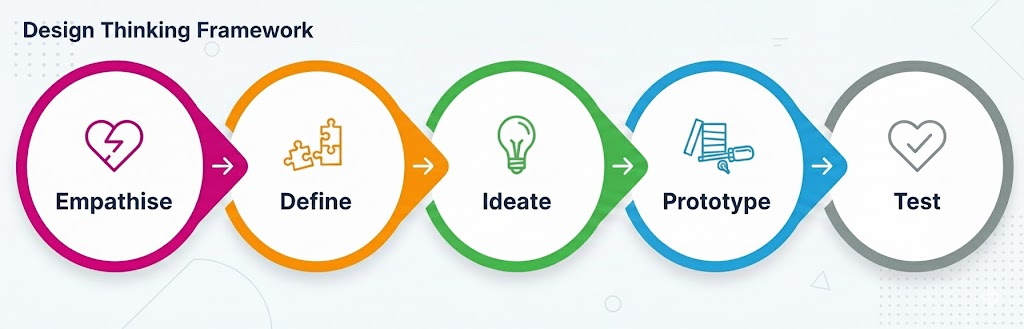
Empathise
Empathy is the foundation of effective problem-solving. It requires setting aside your own assumptions to understand the psychological and emotional needs of your users. In this phase, you aren’t just looking at data; you’re looking at lives.
Understand users’ goals, motivations, behaviours, wants, needs, challenges & frustrations.
The objective is to move beyond “what” users do and uncover why they do it. Ask yourself:
– What are they thinking and feeling?
– What makes their life miserable (pain points) and what would make it easy (gains)?
– What is meaningful to them?
What to Capture:
– Personas (The Character): Fictional profiles of typical users.
– User Journey Maps (The Story): The steps a user takes to reach a goal with your product or service. It highlights their thoughts and emotions at each touchpoint, making it easy to spot pain points and improve the experience.
Toolkit – Empathise Phase:
- User Interviews (For depth)
- Direct Observation (For truth)
- Personas (For alignment)
- User Journey Maps (For context)
- Empathy Maps (For synthesis)
- Role Playing (For perspective)
Define
Use the research data from the empathise phase, to identify the pain points. Define the who, what, and why in a sharp, actionable problem statement.
Kidlin’s Law: If you write down the problem clearly and specifically, it is already half solved.
Kidlin’s Law works because writing forces clarity. What feels overwhelming in your head becomes manageable on paper.
- The Problem Statement Formula: A great statement avoids jumping to solutions. Focus on:
- Who is experiencing the problem?
- What is the problem?
- Where the problem occurs?
- Why it matters?
- Example: “Families (Who) at the airport (Where) feel overwhelmed by the visa process (What), which ruins the start of their holiday (Why).”
- “We are experiencing [issue] in [location/time], affecting [who], resulting in [specific negative impact].”
- Deep Clarity – 5 Ws and 1 H: When a problem feels vague, use this journalistic approach to get clarity:
- What is the problem?
- Who is affected by the problem?
- Where does the problem occur?
- When did the problem start or when does it occur?
- Why is it a problem (what is the negative impact)?
- How is the problem currently being handled?
Example: Instead of saying, “The project is delayed,” you would define it as: “What: The marketing deliverable is three days late. Who: The design team is waiting on content. When: It became noticeable over the last 48 hours. Why: It will cause us to miss the product launch window.”
- Root Cause Analysis: 5 Whys & Fishbone
Symptoms are what you see; root causes are what you fix. Before you solve the problem, determine why the problem is happening. Use the 5 Whys or a Fishbone Diagram to find the Root Cause.
- The 5 Whys: This is a powerful technique for finding the root cause of a problem. Write the symptom at top; ask “Why?” five times (or as many times as it takes) until you reach a controllable cause; validate with data.
Symptom: The server crashed.- Why did the server crash? Because the application ran out of memory.
- Why did the application run out of memory? Because there was a sudden spike in traffic.
- Why was there a sudden spike in traffic? Because the advertising campaign launched early.
- Why did the advertising campaign launch early? Because the marketing and development teams weren’t coordinated. (Root Cause)
- Fishbone (Ishikawa) Diagram: Categorize potential causes under People, Process, Tech, Data, or Environment.
- Stakeholder Map: Identify who is affected (customers), who decides (owners), and who helps (enablers).
- Example: Finance ops (owners), Sales leaders (customers), IT data team (enablers).
- Example: Finance ops (owners), Sales leaders (customers), IT data team (enablers).
- SMART Goal: Turn your definition into a target. Make your desired outcome Specific, Measurable, Achievable, Relevant, and Time-bound.
- Example: “Reduce EU month-end reporting delay from 2 days to 4 hours by next quarter.”
- “Achieve [target] by [date], measured by [metric], owned by [team/person].”
Toolkit – Define Phase:
- Problem Statement Formula (For focus)
- 5 Ws and 1 H (For investigation)
- 5 Whys & Fishbone (For root causes)
- Stakeholder Mapping (For alignment)
- SMART Goals (For measurement)
Ideate
Ideation is a two-part rhythm: first, you open your mind to every possible solution (Divergent Thinking), and then you ruthlessly narrow them down to the best ones (Convergent Thinking).
- Divergent Thinking:
- Brainstorm. Just get as many ideas as possible on paper. Don’t judge or critique the ideas yet. The goal here is quantity over quality.
- Brainwriting: Participants write ideas individually for 5 minutes before sharing. This prevents the loudest person in the room from dominating the conversation.
- SCAMPER: A mental checklist to stretch your thinking:
- Substitute, Combine, Adapt, Modify, Put to another use, Eliminate, Reverse.
- Constraints Flip: Force creativity by changing the rules.
- “How would we solve this if we only had $10?”
- “If we had to deliver this in 1 hour instead of 1 week, what would we have to change?”
- Reverse Brainstorming: Ask, “How could we make this problem 10x worse?” Then, flip those “anti-solutions” to find innovative fixes.
- Convergent Thinking:
- Sort the ideas generated (Card Sorting). Find patterns, Translate ideas into insights. Use the Decision Matrix & Concept Voting, to select the best solution based on feasibility and impact.
- Impact–Effort Matrix: Map your ideas to find your Quick Wins—those high-impact solutions that require low effort.
- How Might We (HMV) Questions: Transform your heavy challenges into opportunity-focused questions. Instead of saying “The visa process is too slow,” reframe it:
- “How Might We make the visa process simpler for the whole family?”
- “How Might We remove the logistical load from the traveler?”
For complex choices, a simple Pro/Con list isn’t enough. A Decision Matrix helps you weigh options against specific criteria:
| Solution Option | Criteria 1 (Cost) (Weight: 3) | Criteria 2 (Time to Implement) (Weight: 2) | Criteria 3 (Impact) (Weight: 5) | Total Score |
| A: Buy New Tool | Score: 2 (2×3 = 6) | Score: 4 (4×2 = 8) | Score: 5 (5×5 = 25) | 39 |
| B: Re-train Staff | Score: 5 (5×3 = 15) | Score: 3 (3×2 = 6) | Score: 3 (3×5 = 15) | 36 |
(Higher scores win. Multiply the option’s raw score (1-5) by the criteria’s weight to get the final points.)
Toolkit – Ideate Phase:
- Brainwriting & Crazy 8s (For rapid ideation)
- How Might We (For reframing)
- SCAMPER (For stretching ideas)
- Impact–Effort & Decision Matrix: When you must select among several viable options.
- Miro / Slido (For collaborative digital brainstorming)
Prototype
Pilot before scale. Bring the best Ideas to life quickly, with a low-fidelity, scaled down version. Put the prototype into the hands of real users. Observe. Understand how they use, their pain points. The goal is to identify strengths and weaknesses quickly before you commit significant time, money, or resources.
The Mantra: “Fail fast to succeed sooner.”
- Low-Fidelity (Physical & Digital): Start with paper sketches, Lego/clay models, or wireframes.
- Experience Simulation (Services): If your solution is a process (like a new airport check-in flow), use Role-playing or Scenario Flows.
- Storyboarding: Draw a comic-strip version of the user’s experience to visualize how they move from the problem to the solution.
Why Prototyping Works?
- It creates alignment: It’s much easier for a team to discuss a physical model than a vague concept.
- It uncovers “Hidden” flaws: You’ll often find that what looked great on a slide deck doesn’t actually work when a human tries to use it.
- It encourages iteration: Because you haven’t spent much money yet, you aren’t “married” to the idea and are more open to changing it based on feedback.
Toolkit – Prototype Phase:
- Paper Sketches & Wireframes (For layout and flow)
- Storyboards & Scenario Flows (For the user narrative)
- Lego & Clay Models (For physical spatial awareness)
- Role-playing & Experience Simulation (For service design)
- Interactive Mockups (Using tools like Figma or InVision)
Test
Put your prototype into the hands of real users. Observe them. Don’t explain or defend your idea to the user. If they can’t figure it out on their own, the design has failed, not the user.
- Listen to frustrations: Pain points are actually “data points” for your next iteration.
- Test your assumptions: Every prototype is built on a “guess.” Testing is how you turn those guesses into facts.
- Learn & Iterate: Use the feedback to go back to the Prototype or even the Ideate phase to refine the solution.
Measuring Success – to know if your solution actually works, you need to track the right data:
- Leading Metrics (The “Now”): These are early indicators that you are on the right track.
- Example: If you are automating a report, a leading metric is the % of data sources successfully connected.
- Lagging Metrics (The “Result”): These are the final outcomes that confirm the problem is solved.
- Example: The total hours saved per month once the report is fully automated.
Closing the Loop – A solution only stays a solution if you maintain it and learn from its implementation.
- Feedback Loops: Establish weekly check-ins with your stakeholders to capture new issues or decisions as the solution scales.
- Visual Controls: Use simple dashboards or status boards so the entire team can see progress and “blockers” in real-time.
- After-Action Review (AAR): Once the project is live, gather the team and ask:
- What was expected?
- What actually happened?
- Why was there a difference?
- What will we do differently next time?
Toolkit – Test Phase:
- User Testing & Observation: Watching real people interact with your prototype.
- Pilots & Metrics: When uncertainty is high and you need evidence fast.
- A/B Testing: Comparing two versions of a solution to see which performs better.
- Surveys & Feedback Forms: Gathering quantitative data from a larger group.
- Dashboards: For visual control and real-time monitoring.
- After-Action Review (AAR) Template: For formalizing the learning process.
Don’t let analysis paralysis keep you stuck. Next time you face a challenge, grab a piece of paper and write down the four steps, then use the 5 Whys to drill down to the true cause. You’ll be surprised how quickly you move from confusion to clarity! The best thing you can do to solve a problem: Start.
If I’m gifting books to a new grad, Are Your Lights On? is my top pick for problem-solving, paired with The Design of Everyday Things for a foundation in design.
Are Your Lights On? How to Figure Out What the Problem Really Is – Donald Gause and Gerald Weinberg
This classic is a masterclass in Problem Definition. The authors argue that most failures happen not because we lack the skill to solve a problem, but because we rush to “fix” something before we truly understand it. They define a problem simply as the gap between a perceived state and a desired state. Since perceptions vary, a problem is never objective—it is personal and contextual.
The book’s philosophy is captured through two iconic examples from real events:
- The “Slow” Elevator: When tenants complained that office elevators were too slow, engineers proposed expensive motor upgrades. However, the real problem wasn’t the speed; it was the boredom of waiting. The solution? Installing mirrors next to the elevator doors. People became so occupied checking their appearance that they stopped noticing the wait entirely.
- The Lake Geneva Tunnel: The book’s title comes from events involving a long tunnel built through a mountain above Lake Geneva. At the end of the tunnel, drivers frequently forgot to turn off their headlights—especially at a scenic overlook where they stopped for sightseeing—resulting in drained batteries.
- The Technical Solution: Engineers considered an expensive automated sensor system, which was dismissed as too costly.
- The Literal Solution: A sign saying “Turn off your lights” failed at night, while a more detailed instruction—“If it’s daylight and lights are on, turn them off; if it’s dark and lights are off, turn them on”—was far too complex for drivers to process at speed.
- The “Weinberg” Solution: A sign that simply asked: “Are your lights on?” This prompted drivers to check their own situation and take the correct action.
- The Lesson: Sometimes the best solution isn’t a complex system, but a well-timed reminder that prompts the user to be mindful of their own situation.
**********
The Design of Everyday Things – Don Norman
The “Bible” of user experience. Don Norman’s core argument is simple: when users struggle with a product, the fault lies with the design, not the human. Good design is “human-centered,” matching how our brains naturally work. To achieve this, Norman introduces a toolkit of essential concepts:
- Affordances & Signifiers: An affordance is what an object can do (a handle allows pulling); a signifier is the signal that tells you to pull it. Think of a “Norman Door”—a door that looks like it should be pushed but actually needs to be pulled. Without a clear signifier, the design fails.
- Mapping & Feedback: Controls should logically align with their effects. For example, stove knobs should be arranged in the same pattern as the burners. Once an action is taken, the system must provide immediate, clear feedback (a click, a light, or a sound) so the user knows it worked.
- The Two Gulfs: Design must bridge the Gulf of Execution (how do I do this?) and the Gulf of Evaluation (did it work?).
Norman redefines “human error” by distinguishing between slips (accidental wrong actions) and mistakes (wrong plans). Instead of blaming users, designers should build in “forcing functions” to prevent errors and “undo” options to make them reversible.
Some more books on Problem Solving, suggested by Gemini
- Stop Guessing: The 9 Behaviors of Great Problem Solvers – Nat Greene
Most people try to solve problems by guessing. Greene teaches you how to actually behold the problem and stop trying to find the “fix” before you understand the “why.” - Thinking, Fast and Slow – Daniel Kahneman
Understanding System 1 (fast, intuitive) and System 2 (slow, logical) thinking. If you want to solve problems formally, you have to know when your brain is taking shortcuts that lead to errors. - Creative Confidence – Tom & David Kelley
Written by the founders of IDEO, this book is about the Ideate and Prototype phases. It’s about building the “muscle” of creativity to solve problems that don’t have a clear manual. - Thinking in Systems: A Primer – Donella Meadows
It teaches you to see the world as a series of interconnected loops. This is critical for solving “big picture” problems where a simple fix in one area might cause a collapse in another. - Algorithms to Live By: The Computer Science of Human Decisions – Brian Christian and Tom Griffiths
It applies computer science logic (like sorting, caching, and optimal stopping) to messy human problems. It’s perfect if you want a mathematical approach to everyday life. - The Goal: A Process of Ongoing Improvement – Eliyahu M. Goldratt
Introduces the Theory of Constraints. It teaches you that a problem in a system is always caused by a single “bottleneck,” and if you aren’t fixing the bottleneck, you aren’t actually solving the problem. - Learning to See – Mike Rother and John Shook
The definitive guide to Value Stream Mapping. If you want to solve problems in a workflow, you have to be able to map where the “waste” is.
Lean Problem Solving
Lean philosophy was popularized by Toyota. Eliminating waste & maximize value.
Resources: Time, Money, People.
Problem: Deviation from the standard or expectation
Problem solving is a structured activity to get a process back to achieving the standard
7 types of waste (TIMWOOD+1)
– Transport
– Inventory
– Motion
– Waiting
– Over-processing
– Over-producing
+ Intellect
Just In Time: Trouble shooting. Just do it.
(Might take mins)
Level 0: Foundation of problem. Investigating non adherence to standards. 4 steps.
(Might take hours)
Step 1: Problem Definition
Step 2: Process Verification
Step 3: Root Cause Identification
Step 4: Counter measures & process confirmation
Methods: PDCA , (Plan, Do Check, Act) Go & See, Checklists, 5 Whys
Practical Problem Solving: If L0 fails to solve the problem, then move to PPS. 8 steps
(Might take days)
Step 1: Clarify the problem
Step 2: Identify the point of cause
Step 3: Set the target
Step 4: Cause and effect(brainstorming) and root cause investigation
Step 5: Identify the countermeasures
Step 6: Implement countermeasures
Step 7: Check results
Step 8: Standardise and share
6 Sigma: Used to solve highly complex issues. DMAIC.
(Might take weeks)
Define the Customer critical parameters
Measure how the process performs
Analyse the causes of the problem
Improve the process to reduce defects/variability
Control process to ensure sustained improvement
Please click & expand for a wealth of resources & the references
- Problem Solving – Pinterest Board
- How You Define the Problem Determines Whether You Solve It – HBR
- The Power of Leaders Who Focus on Solving Problems – HBR
- Solve Any Problem by Kidlin’s Law
- Kidlin’s Law: The Key to Solving Your Hardest Project Problems
- Problem Solving – Untools
- Design Thinking 101
- The CIRCLES Method
- How to Build a Problem Statement
- https://www.instagram.com/reel/DRfHPS1gJvz/
- https://www.instagram.com/p/DVJuriJiI_X/
- https://www.instagram.com/p/DQdIryODaFn/
- https://www.lean.org/explore-lean/problem-solving/
- https://www.gembaacademy.com/resources/gemba-glossary/practical-problem-solving
- https://www.beyondlean.com/problem-solving.html
- Do Things that Don’t Scale
- Lean Manufacturing
- 5S Methodology
- Muda
- Kaizen
My Learning on Storytelling
“The most powerful person in the world is the storyteller.” ~ Steve Jobs
Storytelling is one of the most powerful forms of communication known to humanity. Weather giving a presentation, launching a product, making a movie, or inspiring change, if we need to connect with the audience on a deeper and emotional level, we need to tell captivating stories.
Why Stories Matter?
Stories are more than mere communication tools. Storytelling provides a unique way to engage and resonate with people across generations. Stories are sticky and embeds into our subconscious mind easily. Stories establish connections. Stories empathise. Stories evoke emotions. By crafting compelling stories, individuals and organizations can convey complex ideas, evoke emotions, drive action and transform the way we communicate, influence, and connect with others.
My Learnings & Lessons
In the realm of storytelling, few names resonate as profoundly as Steve Jobs, whose visionary approach not only revolutionized technology but also transformed the very essence of how stories are told. In “Creativity, Inc.,” Ed Catmull, the co-founder of Pixar Animation Studios, sheds light on Jobs’ remarkable ability to weave narratives that captivate and engage. Catmull delves into how Jobs’ intuitive understanding of storytelling played a pivotal role in shaping the successes of Pixar and Apple, illustrating that a compelling story is at the heart of every groundbreaking innovation. Pixar operated with the first principle “Story is the King” and reviewers of Toy Story talked mainly about the way Toy Story made them feel and not about the computer wizardry. Pixar’s effective storytelling has created blockbuster movies. Through the journey of Pixar and Apple’s triumphs, we uncover the principles of storytelling that can inspire creativity and drive success across industries.
The 3 Ps of Storytelling
Becoming a great storyteller involves mastering three key principles:
Passion: Your story must convey a sincere and passionate message, stripped of all unnecessary elements, focusing intensely on core ideas.
Point of View: Have a credible and relatable perspective. Answer the “so what” question by offering your audience a new way to look at familiar data, finding the human element that makes the story memorable.
Practice: Like renowned speakers who rehearse tirelessly, storytelling excellence requires rigorous preparation and an understanding of your narrative flow.
Elements of an Effective Story
When telling your story, remember these essentials:
- Audience Engagement: Tailor your narrative to what resonates with your audience, understanding their worries, hopes, and motivations.
- Emotional Connection: Use personal anecdotes to humanize your narrative and make it relatable.
- Call to Action: Empower your audience to act by providing them with a clear direction grounded in a shared vision.
- Humility and Honesty: Authentic stories often involve vulnerability, openness about failures, and a willingness to show growth.
Practicing and Perfecting Stories
Creating compelling stories is not just about telling them but about practicing and perfecting them. Workshops encourage using quick, informal conversations to shape stories, simplifying complex ideas into engaging, actionable narratives.
Visual and Digital Storytelling
With the rise of digital platforms, storytelling now extends beyond words into visuals and videos. Encouraging rich, sensory experiences in storytelling aligns with how platforms like Pixar and TED present their narratives, ensuring that they are not just informative but transformative.
Conclusion: Your Storytelling Snapshot
To master storytelling is to refine your ability to connect, inspire, and lead. Whether in crafting brand narratives or everyday communication, weaving stories that resonate emotionally ensures not just communication but connection. Remember, as you develop your storytelling skills, focus on authenticity, empathy, and relevance, making every story both a shared journey and a memorable venture.
Took down the below content, to refine. Please excuse…
My Learning on Presentations
A few years back, while preparing for an internal company presentation, I thought how to make the presentation exciting and useful? A few good presenters flashed in mind. They told stories, showed enthusiasm, had a sense of humour, followed some structure, used props and had a keen understanding of the audience’s needs. I also read how Steve Jobs’ keynote presentations continue to attract thousands of views. Based on the learnings, here’s a three part guide to ensure your presentations not only inform but also entertain and inspire. Prepare, Practice and Present.
1. Prepare: Building Your Foundation
Start With the End in Mind
Before crafting your presentation, define the key message you want your audience to take away. This becomes your guiding star. Also consider if the topic is interesting. Will the audience care about the topic?
Ex: Steve Jobs often used “Twitter-friendly headlines”—concise, impactful phrases that encapsulated his message, such as “Apple reinvents the phone.”
Narrate with a Story
A compelling story forms the backbone of a great presentation. Before diving into the specifics of your slides, construct a narrative that weaves together your key points. As Steve Jobs famously demonstrated, storytelling is more impactful than a slew of statistics. Your story should have a clear unifying message that resonates with your audience even after the presentation concludes.
Structure Your Content
Organize your presentation into an easily followed structure. Consider a three-part format: introduction, challenge/resolution, and conclusion that would leave your audience with a clear takeaway message. This approach keeps the audience engaged and ensures your message flows naturally.
Keep It Simple
Avoid losing your audience with lengthy speeches or jargon-heavy language. Keep your language simple, clear, and direct so that it is easy to understand & remember. Your presentation should engage and stimulate your audience, pulling them into your narrative.
Write and Revise
Writing is a powerful tool. You’ll be able to organise and present at a much better level. Begin by drafting your presentation on paper, organizing your thoughts clearly. Integrate meaningful data and examples that support your story. Avoid clutter and aim for clarity and simplicity. A well-organized presentation aids in effective delivery.
2. Practice: Perfecting Your Delivery
Rehearse Relentlessly
Great presentations aren’t born overnight; they are the result of rigorous practice. Follow a structured approach:
- 30 Hours on researching and refining your story.
- 30 Hours on constructing simple, visual slides. (“A picture is worth 1,000 words.” Not only do we remember visual input better, but we also process visual information much much faster in the brain than we do text. Please refer the illustration below)
- 30 Hours on rehearsing the delivery with a focus on clarity, pacing, tone of voice, posture, body language and facial expressions.
- Speak clearly & slowly. Practice in front of a mirror, record yourself, rehearse in front of friends, seek feedback, refine and enhance. Practicing out loud, can help identify and edit any awkward phrasings or speed bumps.

Master Non-Verbal Communication
Audiences respond well to the physical energy and enthusiasm. Your body language is as crucial as your words. Maintain eye contact, use gestures to emphasize key points, and exhibit confident posture. Remember, relaxed and deliberate movements are more engaging than stiff or nervous gestures. If looking someone in the eye makes you uncomfortable, here’s another tip you can try: Look at a person’s forehead instead of directly in their eyes. Smile and nod as you speak to put your audience at ease. Avoid slouching, crossing your arms, having your hands in your pockets, or playing with your hair or clothes. For virtual presentations, make sure to look directly at your webcam. This will help the audience feel as if you’re looking at them, through the screen.
Simulate the Real Environment
Most presenters prepare by flipping through their slides quietly. That process won’t help you build the confidence you’ll need when you’re really standing and speaking in front of an audience. Conduct dress rehearsals in settings similar to your final presentation. Familiarize yourself with the equipments and room setup. This not only reduces technical glitches but also boosts your confidence. Jobs was legendary for his preparation and was even prepared for unexpected surprises. When he faced a technical glitch during the presentation, he casually laughed off the glitch, told a story, and got back to the presentation when his team resolved the issue. It is said, he would rehearse on stage for many hours over many weeks prior to the launch of a major product. He paid attention to every detail of every demo and every font on every slide, making suggestions and improvements. He even paid careful attention to the gestures he made with his hands at key moments, as well as the pace of his delivery. He picked up his vocal pace during some parts of a presentation and slowed down when he wanted the message to sink in. As a result the presentation was delivered flawlessly.
Positive Visualization
Calming your nerves by engaging in relaxation and visualization exercises like deep breathing, before stepping onto the stage can significantly reduce anxiety and enhance your confidence. Don’t worry about what could go wrong. Visualize yourself giving an awesome presentation. Try a power pose to improve your confidence. Anticipate and be prepared to answer audience questions. This mindset fosters a positive performance.
Ask yourself the following questions:
- Am I being concise? Did I stick to the main points I need the audience to remember?
- Is my tone conversational? Did I sound robotic or like I’m reading from a script?
- Did I use stories effectively, including relatable and specific examples to illustrate points?
- Did I allow pauses in my delivery?
- Did I appear confident?
- Did I practice making eye contact by addressing different locations around the room?
Being a great public speaker means displaying confidence. That almost always comes from being familiar with your content, speaking clearly, and learning how to tell a story that engages listeners. Expert speakers carefully, painstakingly plan, storyboard, script, design, and rehearse their presentations like an Oscar-winning Hollywood director prepares their film for the big screen.
Rehearse, Rehearse and Rehearse. Record & Review.
3. Present: Captivating Your Audience
Open with Impact
A well-crafted opening sets the tone for the rest of your presentation. You audience will come in a range of different moods. Begin your presentation with a strong, memorable opening— an icebreaker, bold statement, short video, relevant anecdote, story or comparison— to capture the audience’s attention and set the tone.
Engage with Stories and Analogies
Stories and analogies help the audience connect with your message on a personal level. They make complex ideas relatable and memorable. Steve Jobs, for instance, didn’t just introduce products—he told stories that highlighted their significance and innovation.
Humanise the Data
While revealing the iPod, Jobs didn’t talk about it’s storage or weight. He pulled out a device and said “1000 songs in your pocket.” Similarly while revealing the MacBook Air, he didn’t talk about it’s size. He pulled out the MacBook Air from a manila envelope, showing how thin it was. Simplifying concepts with analogies helps the audience understand and remember your message.


Be Concise and Enthusiastic
No matter the subject, a great speaker will use natural charisma, humour and language to convey their points and get the audience excited. Keep your message clear and your enthusiasm palpable. Use humor judiciously to make the session lively but ensure it aligns with your message. Audiences are more likely to engage when they sense your energy.
Ex: When Jobs introduced the MacBook Air, the slide had only one phrase, “There’s something in the air.”
Interactive Engagement
Encourage audience interaction through questions and polls. This breaks monotony and fosters participation. Be prepared to handle questions with grace and confidence, repeating them for clarity and responding thoughtfully. Audience can ask difficult questions! Don’t get defensive. Don’t rush to respond. Be polite and professional. If you are unsure about how to answer a question, you can say “That’s a good question. Let me think about that for a moment.” If a few seconds isn’t long enough to find a good response, you can say, “I might need to think on that some more. Can I get back to you?”
Close with a Strong Takeaway
End your presentation on a high note. Summarize your key points, inspire with a memorable quote or idea, and leave your audience with a thought-provoking question to ponder.
Conclusion
Delivering an effective presentation is about creating a memorable experience for your audience. By intertwining thorough preparation, relentless practice, and dynamic presentation skills, you can captivate your audience, much like Steve Jobs, and leave a lasting impact.
PS: Thanks to my current & previous employers, for supporting my growth through valuable trainings. Thanks to ChatGPT for helping me finetune this post.
Please click & expand for a wealth of resources & references
How to Give a Killer Presentation – HBR
The Best Public Speakers Put the Audience First – HBR
What the Best Presenters Do Differently – HBR
How to Rehearse for an Important Presentation – HBR
How to Stop Saying “Um,” “Ah,” and “You Know” – HBR
Tips for Reading the Room Before a Meeting or Presentation – HBR
How to Calm Your Nerves Before a Big Presentation – HBR
The 48-Second Hack to Calm Your Nerves Before a Presentation
To Overcome Your Fear of Public Speaking, Stop Thinking About Yourself – HBR
5 Ways to Project Confidence in Front of an Audience – HBR
6 Ways to Look More Confident During a Presentation – HBR
8 Ways to Deliver a Great Presentation (Even If You’re Super Anxious About It) – HBR
The Art of the Elevator Pitch – HBR
What It Takes to Give a Great Presentation – HBR
Be the Most Persuasive Person in the Room
5 Ways Neuroscience Can Help You Give Better Presentations | Psychology Today
How to Master the Art of Public Speaking
Don’t Just Memorize Your Next Presentation — Know It Cold – HBR
3 Ways to Nail Your Presentation to the Board – HBR
To Overcome Your Fear of Public Speaking, Stop Thinking About Yourself – HBR
The Power of Talk: Who Gets Heard and Why – HBR
Follow These 8 Public Speaking Tips to Nail Your Next Presentation – RD
How to Present to Investors – PG
How to Craft a Memorable Message, According to Science – HBR
Nancy Duarte: The secret structure of great talks – TED
6 techniques for clear and compelling speech – TED
Julian Treasure: How to speak so that people want to listen – TED Talk
Making more impactful design presentations | by Chuck Rice | UX Collective
How to Speak – MIT OpenCourseWare
My Learning on Writing
When I draft emails, I always remember the below mnemonic, I read in a magazine.
The ABC of writing – Accuracy, Brevity & Clarity.
At work, I learnt a similar mnemonic: KiSS – Keep it Short & Simple)
Also like this essay Write Simply by Paul Graham.
Remember: Audience first. What is the 1 core message you want the audience to remember?
I learnt to write short & simple emails. My blog posts are very lengthy. Gradually learning to make what I write short & simple.
Please click & expand for a wealth of resources & references. Please remember the KiSS principle.
- How to Write Usefully
- Write Like You Talk
- Writing and Speaking
- 5 Surprising Tips to Help You Write Like a Pro – HBR
- Helpful advice for aspiring writers of all ages – TED
- David Ogilvy 10 Tips on Writing
- The writing exercise that made my career
- How to write less but say more – TED
- https://x.com/dickiebush/status/1482350752819470344
- https://x.com/paraschopra/status/1961297060793356785
My Learning from ‘We are LimITless’ – phase 2
Who is Elvis?
The ones who shine a bit brighter, the ones who are maverick, the ones with lots of energy and charisma.
Felt good to be part of a program “We are LimITless.” The phase-2 of the culture journey focused on building a culture of collaboration by expanding your network. Why do we need to expand our network?
Collaborating effectively and working well in a matrixed organisation is crucial to achieve collective goals and progress. When we only reach out to people we know, for advice & support, we are limiting ourselves to same team, same routine and missing out on the diversity of opinion & perspectives, thereby slowing down on innovation process. By expanding our networks within the company, we increase our exposure to fresh perspectives, new ideas, opportunities and insights, build new skills and grow our self-confidence.
Volunteered to be a culture influencer, running a few experiments with support of org’s toolkit. In one of the experiments, we nudged & reiterated the teams to try Diversity Collision.
A few more experiments were, networking at leisure, pair and share, scheduled networking, sense checking with someone before presentation or sending a mail, discover hidden value about a colleague, happy-to-help, mentor-mentee and crowdsourcing.
Below are a wealth of resources that will help you network better and collaborate. In case you do not have subscriptions to the respective publishers, you might be allowed to read 3-5 articles free, per month.
Please click & expand for a wealth of resources & references:
- Connecting with others is a vital source of happiness — cos can create simple ways to achieve this and build sustainability
- 4 Simple Ways to Make Yourself Really Happy in 10 Minutes or Less, Backed by Harvard Research
- Get Better at Networking: Our Favorite Reads
- A Beginner’s Guide to Networking
- How Leaders Can Build Connection in a Disconnected Workplace
- How to Ask For What You Want (And Get It)
- 5 Networking Tips for Introverts (and Anyone Else)
- How to Make Small Talk with Anyone from Anywhere
- How to talk to strangers
- Amber Cabral: 3 steps to better connect with your fellow humans | TED Talk
- The 4 Best Openers: How to Break the Ice With Absolutely Anyone, Anywhere
- Beyond ‘How Are You?’: The Art of Asking Powerful Questions | by Phil Roberts
- Why talking to strangers is good for you
- Mastering the Art of the Request
- Your Guide to Working on Global Teams
- Millennial Managers Can Change Company Culture for the Better
Experiments with Diversity Collision
A few years back, at the Construkt fest, I witnessed an induced networking called “Construkt Collision.” The hall was filled with people, standing. When the conductor of the event says, “Change,” every 1 min, we say “Hi” to the person around us, briefly introduce ourselves and also get to know the other person, exchange business cards, until we hear the next “Change,” after which, we move and meet someone new. It was interesting.
During the “Power of Diversity” week celebration at office, wanted to try something similar, help people meet diverse colleagues they haven’t interacted with and we came up with “Diversity Collision.”
I felt we were not able to achieve active participation in this collision probably because colleagues were shy to reach out to people they do not know or have never interacted with. To overcome this, in one of the offsite gathering, we requested the host to announce and nudge participants to sit alongside someone they have never interacted with and when breaking for lunch, to share the lunch table with someone new and get to know them better. Slight force or nudge helped to break the inertia/shyness 🙂
In hindsight, I thought, we also could have also tried placing a bingo sheet on colleagues desks and asked them to meet, interact briefly and get signatures or names of people, under questions/options like:
- Someone born in specific month
- Someone wearing a particular colour shirt
- Someone from another state/country than yours…etc.
Why I linked December with Dessert?
When we end the meal with a dessert, the sweetness lingers on our tongue, for some more time. It feels satisfying. I had a terrible 2024 and wanted to end the last month of 2024, doing/learning something for the sake of fun. Somethings feel like therapy. I intentionally visited sweet shops & cafes to lift my mood. My wife learnt home baking of cakes & cookies and I feel thankful for that. Taking inspiration from this blog, casually clicked and shared random beautiful pics. Decided to watch one TED video on photography daily in the evening. Some were pleasing and some showed the difficulties/realities, as shared by photo journalists. The compilation of the talks are below. Also, below are a lot many resources, I found on the internet, which I plan watch later, at leisure. Happy video watching at leisure 🙂
- Steven Addis: A father-daughter bond, one photo at a time | TED Talk
- JR: One year of turning the world inside out | TED Talk
- Becci Manson: (Re)touching lives through photos | TED Talk
- Erik Johansson: Impossible photography | TED Talk
- Cesar Kuriyama: One second every day | TED Talk
- Five great moments in time-lapse photography | TED Blog
- Levon Biss: Mind-blowing, magnified portraits of insects | TED Talk
- Alec Soth and Stacey Baker: This is what enduring love looks like | TED Talk
- Jimmy Nelson: Gorgeous portraits of the world’s vanishing people | TED Talk
- Stephen Wilkes: The passing of time, caught in a single photo | TED Talk
- Giles Duley: When a reporter becomes the story | TED Talk
- Sebastião Salgado: The silent drama of photography | TED Talk
- Lisa Kristine: Photos that bear witness to modern slavery | TED Talk
- Paul Nicklen: Animal tales from icy wonderlands | TED Talk
- James Nachtwey: My wish: Let my photographs bear witness | TED Talk
- Jonathan Klein: Photos that changed the world | TED Talk
- David Griffin: How photography connects us | TED Talk
- Frans Lanting: The story of life in photographs | TED Talk
- Taryn Simon: Photographs of secret sites | TED Talk
- Kristen Ashburn: The face of AIDS in Africa | TED Talk
nb: TED encourages sharing the talks, under Creative Commons license. Please refer TED Talks Usage Policy
A wealth of resources on photography, from the internet.
- Good photography channels on YouTube – Reddit
- National Geographic – YouTube
- Recommendations from Shaikh Samar
- “Tales by Light”: Explore breathtaking visuals and storytelling behind the lens.
- “Abstract: The Art of Design”: Gain insights into the creative process of various artists, including photographers.
- “Photography Masterclass” (Annie Leibovitz)
- 20 Best Photography YouTube Channels To Follow in 2024
- 9 Must-Watch YouTube Channels for Photographers | ISO Republic
- The 8 Best Photography Youtube Channels for Beginners – FilterGrade
- 9 YouTube channels that will help you become a better photographer
PS: I don’t aspire to be a professional photographer, but like to click random beautiful things that are pleasing to my eyes, using mobile phone. Thanks to my friend Ravisuriya, my school senior Balaji man & Ram, whom I met at Kabini, whose photographic works, I admire.
As we end 2024, I whole heartedly thank my family, friends & relatives, for all the support in times of extreme distress.
How might we enable better UPI adoption at petrol bunks?
- Jay drives to the petrol bunk and requests petrol refill of Rs. 1000 to his car.
- The attender refills and asks the mode of payment.
- Jay says UPI, scans a QR pasted near the pump pillar and sends money.
- The attender interrupts and annoyingly asks why he sent the money through that QR. The attender then said Jay needs to scan the QR from a card board he was holding onto his hand, which had a QR printed in A5 sheet and pasted.
Looks like the petrol bunk has different modes of UPI payment. This is apart from cash and card payments.
- Some QR payments are processed through the petroleum companies payment gateway
- Some QR payments are processed through the petrol bunks bank account
- Some QR payments go directly to the petrol bunk owners bank account
The QRs were, either pasted on the dispenser or printed and held on hand or printed to plastic holders supplied by payment aggregators or generated through the POS machine. There is some confusion and delay in processing the payment. The next vehicle waiting is honking.
How might we enable faster & easier UPI payments at petrol bunks?
I could think of a user feedback from the office tea stall:
“Do you feel, opening the app at tea stall, adding the amount and then entering the PIN, a painful process? The user says, he is used to it daily and it feels like a ritual. While he asks the tea vendor, 1 ginger tea, the user is parallelly scanning the QR code and much before he gets the tea, he finishes the payment and waits for the tea.”
Similarly, if the petrol bunks can display QR codes for UPI payments, prominently, (Ex. Red circled space in the dispenser image below) the drivers can intimate the quantity or the amount of fuel (Ex. 10 litres or for Rs. 1000) to be refilled and while it is getting refilled, they can scan the QR code and make payment. Each pump or dispenser can have unique QR code so that it is easy for each servicing attender to generate his end of day accounts and make settlements.

Also, to improve trust and efficiency, apart from the innovative soundbox the UPI app has provided, we can think of a low energy consuming display like Kindle readers, that can be placed near the petrol dispenser and display the amount received from the customer or the vehicle no.
The UPI app can allow users to create a label of his vehicle type and vehicle number.
Ex. Maruti Swift: IQ 01 AM 3499
The label can be tagged and displayed alongside each refuel payment acknowledgement for easier visibility and acknowledgement, thereby improving trust and increasing the speed of payment.
If the user has leased the car through his office, she/he might like to have receipts for all the spends on fuel and receipts for driver’s salary. How might we enable the petrol bunks to share digitally generated receipts back to the user after refueling?
*”Petrol Bunk” is the most widely used term in India, for a fuel station. Different terminologies used across the world are: Gas Station, Petrol Station, Fuel Station, Filling Station, Petrol Pump…etc.
Sidewalks, Health & Peace of Mind
I am a software tester, finding flaws in products. I am also passionate about user experience & design and find it exciting to simplify & improve the experience of products we use. One such thing I wanted to simplify & make it better accessible is the side walks. Something that’s part of our public space.
Like many, I’ve tried to de-stress by going for a walk, only to be forced off the sidewalk and into the street. Our sidewalks are often unusable—either encroached or poorly designed. The intersection of my experiences in testing, design and walking, made me view these sidewalks not just as civic problem, but as a design & behaviour problem. I began to capture pictures of various footpath patterns I encountered, trying to understand what makes some pathways easily walkable and others a nightmare. How might we reclaim these vital public spaces? How might we build better & pedestrian friendly sidewalks? The solution might be right beneath our feet. Let’s design our way to a better walk.
Think about the Nudge Theory, the Nobel Prize-winning concept that shows how subtle cues can guide our behavior. If we put a sign to switch off lights before leaving the room, we are most likely to do so. What if we could apply this same principle to our public spaces?
In his book, The Tipping Point, Malcolm Gladwell argues that for an idea, trend or behaviour to spread, the Power of Context is crucial. He shows how small changes in our environment can trigger significant behavioral shifts. The environment itself becomes the nudge.
My idea is simple, yet I believe it holds the potential for significant impact: a new standard for footpath design based on these behavioral insights. What if we started using indicative colors on our sidewalks? Imagine clear, universal visual markers painted along the edges of our sidewalks, sending a subtle, non-intrusive message to vendors, to vehicle owners, and to pedestrians themselves: “This is the pedestrian zone. Please respect it.” We’re not just painting lines; we’re changing the context. We are nudging people not to encroach, not drive vehicles on the sidewalks and guiding pedestrians to walk on the designated path. A small modification to our public space can potentially create a positive change in how we use it.
As a first step, let’s understand some examples that hinder pedestrians from using the sidewalks.
Pedestrians prefer to walk on even surfaces. Unevenly built sidewalks like shown in the examples below, where houses and shops add kurb ramps/driveway ramps, forces pedestrians to get down and walk on the even road. Pedestrians also avoid sidewalks that are too high to easily step on.


Illustration of better sidewalk with side markings. (Image generated with the help of Gemini AI. Learning to refine the prompt to get better output. )


Curb ramps/driveway ramps shall be built like illustrated below. (Image generated with the help of Gemini AI.)


Also, pedestrians find it easy to walk when the starting point and end point of the sidewalks are built like a ramp rather than like a step.
*The article is being drafted. Apologies for publishing a not fully drafted post. Just published today as it is a day of significance for me.
Additional reading: How a broken wall led me explore the modern management principle, Therblig?
How a broken wall led me explore the modern management principle, Therblig?
During the 2010 rainy season, a 3 feet portion of my house compound wall broke. (The wall was built using stone blocks, red sand and plastered on top with cement, in 1970 period i.e. approx. 40 years back, by my grandfather.) We hired a local mason and requested to rebuild the damaged portion, in the same way, reusing the stone blocks so that it looks even with the rest of the wall. The mason, along with a helper, took 4 days to place the uneven stone blocks, fill the gaps in between carefully, with smaller sized stones and plaster it. In another 2 years, an even larger portion of the compound wall too fell during the rainy season. The wall was about 40 ft in length. Once again, called the same mason and requested him to rebuild the damaged wall using the fallen down stone blocks. He said, it would take weeks to rebuild with same stone blocks and labourers with him are all aged people who cannot carry such blocks. He said, demolishing the entire wall quickly using a JCB and rebuilding using hallow block bricks would only take 2-3 days, cost much less and look even across. We agreed and rebuilt the entire eastern side of our house compound wall using hallow block bricks.


12 years later, i.e. in 2022-2023, I glanced on an article through Medium or Linkedin, explaining modern scientific management and referring to Frank Bunker Gilbreth’s Bricklaying Ergonomics. I was quickly able recollect what our mason said while we were rebuilding the damaged wall and corelate this with how evenly sized and lesser weight hallow block bricks helped build the wall quicker, without compromising the purpose of the compound wall.
A few months later in 2023, when I had to shift my house, one of the many aspects, I had to decide the house, was based on the furniture we had with us and one of the decision point was the size of bedroom, kitchen & living room. Every house we saw had different room dimensions, making it difficult to make a decision faster. Post shifting to the new house, we had another difficulty. The window curtains and velcro based mosquito nets we had used in the previous house was not fitting here. I was then recollecting Gilbreth’s Bricklaying Ergonomics and a thought striked!
How Might We Create Standards in Home Construction?
- What if real estate builders and regulators like RERA came up with standard room dimensions? Something similar to T-shirt sizes.
For example,- S-Small (Kids Bedroom) – 10’ x 10’
- M-Medium/Regular – 12’ x 14’
- L-Large (Master Bedroom) – 14’ x 16’
- Wardrobes could be mass produced, keeping in mind the room dimensions, which in turn could be cost effective and easy for the buyer to decide, while buying a house.
- What if builders and carpenters came up with standard door dimensions? Doors with defined standard dimensions can be mass produced and hence will be cost effective. When a need arises to replace, we can just tell the door size and buy one, which can also be fixed much quicker than custom made ones.
For example,- S-Small (Bathroom door)
- M-Medium/Regular (Bedroom door)
- L-Large (Main entrance door)
- What if builders and carpenters came up with standard window dimensions? Same like doors, windows with defined standard dimensions could be mass produced.
- There can be various combinations of room dimensions, based on where the room door faces, where the windows are, where the wardrobes are and to which side the bathroom is built. However, based on experience a standard room will fit a wardrobe for 2 people, a king sized bed with space for side tables on either side, some space for a study table and some space to walk around.
- The size of bedroom and kitchen could be standardised and the size of living room could be adjusted as per the left over available space.
If I were to build an apartment complex for the middle class, how would I design?
- I ll build a 3 bedroom+study+kitchen+living room(hall)+utility+foyer. Why___
- Walking track___
- Social balcony at each floor___
- Having a study room, with a proper study table and chair lets us focus, concentrate and ultimately improves learner outcome. What if every house is built with a study room?
- Having guests at home and socialising, improves ones happiness. What if every house has a guest room?
If I were to build a studio apartments for the lower income people, how would I design?
- Foyer___
- Utility___
- Study___
- I would use simple and easy to maintain objects.
- Stairs – ideal width & inclination?
- *Will update my thoughts
I have observed that, in villages, lands are sold with price per acre, whereas in cities lands are sold with price per sqft or price per ground (40ft*60ft=2400sqft.) What if all housing plots formed as 40*60ft sizes so that it is even and construction can be planned accordingly.
“The most important, and indeed the truly unique, contribution of management in the 20th century was the fifty-fold increase in the productivity of the manual worker in manufacturing.”—Peter Drucker
PS: Another example I could think of is my Diwali dress stitching. When I was young, it was a tradition to buy / stitch a new dress. Like us almost a maximum percentage of people stitched new dresses during Diwali. we had to buy the cloth a month in advance, visit the tailor shop, take measurements and then wait for weeks to get the newly stitched dress, to be worn on Diwali. Fast forwarding, I have never stitched a dress for more than a decade and buy readymade ones, which comes marked with sizes like S, M, L, XL, XXL…etc for T-shirts and shirt sizes like 36, 38, 40…etc, specific to India. I visited a garment factory in Tirupur, from where lots of garments are bulk manufactured and exported to many countries and saw how cloths in hundreds are laser cut and sent to tailoring sections, which speeds up the mass production process.
*Will refine this post with some more thoughts
Hackathon Idea: Asa – fly at ease
Today’s newspaper carried a full page advertisement on The Gen AI Hackathon. Also, glanced similar ads on X a few days back. The deadline is today. The problem statements are interesting to solve. Due to personal obligations, and time constraints I wasn’t able to plan and prepare detailed solutions. On this Gandhi Jayanthi holiday, spent time on this simple chatbot solution: Asa.
Done is better than Perfect. Publishing a solution to the below problem statement.
“Indian is the 7th largest country. Can you make it #1 for flight experience.”
I expanded on my earlier idea on Air Safety Awareness, by picking one use case with two personas:
Subbu & Eswari are retired couples visiting their son in New York, US. Their ticket from Chennai to New York via connecting flight at London, has been booked in advance by their son . How might the airlines guide them to fly at ease.
Recommending them to install an app might not work out as many travellers don’t want to install one more app. How might we utilize WhatsApp or RCS messages to help them fly at ease.
Since the problem statement was shared by Akasa, came up with the chatbot Asa. (name suggested by Gemini) Since the Akasa logo is called the “Rising A,” contemplated on some names like “The Guiding A,” “Fly at Ease,” “A-hostess” but settled with Asa, because when the chatbot interacts with the passengers on WhatsApp, “Hi, I’m Asa…” sounds easy. Referred to branding guidelines from AkasaAir: Sunrise Orange: FF6300 & Passionate Purple: 5C0FD9. Gemini suggested that the font used in the logo might be a custom one. “AS Circular” or custom “Poppins.”
*n.b: Referring to the name Akasa and its branding guidelines, as the problem statement I picked has been shared by Akasa. No intention to infringe on Akasa’s brand identity in any way.
Let’s delve into Asa‘s role:
- The airline collects the mobile no. of passengers, while booking the ticket.
- Asa sends the first Hello to Subbu & Eswari, immediately after the ticket is booked.
- Asa migh have created a WhatsApp group between Subbu & Eswari and started the conversation. However, many people have the tendency to use the groups to forward casual messages, videos and photos and the actual guiding conversation from Asa might get lost in between other unimportant forwards. So, Asa will stick to messaging individuals 🙂
- Asa sends a reminder 2 weeks before the flight.
- Asa sends a reminder 1 day before the flight.
- Asa sends guiding instructions on the day of departure.

- The users updates a list of items or photo of items in the bag and checks if anything is prohibited.
- The user shares the dimension of the carry on luggage and checks if it will fit in the storage cabin.
- Asa lets users to enter the language of choice and send voice based responses.
Why this matters to the airlines?
An exceptional customer experience goes beyond service – it’s about trust, communication, and support at every step of the flyer journey. Being supportive and providing easy access to information can transform the flyer experience, build trust, increase loyalty, besides saving hours of wasted time.
Please click & expand for a wealth of resources & references
My Learning through GIG – Gamification
I had the privilege of being part of an internal GIG, which provides opportunities for employees to gain experience in different teams or business areas, outside of their day-to-day jobs, without moving role. I was hosted, part time by the UX team, to assist them in setting up a Center of Excellence (CoE) for Behavioural Design & Applied Psychology and, learn on the go. Thankful for the opportunity and thanks to Haydyn for hosting me and to my team members Miryam & Vaishnavi.
“Knowledge shared is knowledge squared.” Pleasure to journal my learnings here. This is the fifth post in the series “My Learning through GIG.”
References & a wealth of resources:
Jane McGonigal popularised Gamification through her TED Talk, “Gaming Can Make a Better World”
The Octalysis Framework – The Power of Behavioral Science behind Gamification
Five Psychological Principles Fueling Gamification : Articles – The Learning Guild
Understanding Gamification Series: Game Mechanics and Game Dynamics – Upshot.ai
Gamification: What It Is and How It Works (With 8 Examples) – Built In
12 Best Examples of Gamification Across Business Spheres
12 Examples of Gamification from the Top Mobile Apps in 2024
29 Successful Real-World Gamification Examples
How might we simplify air safety awareness?
I was reading the below news and was able to correlate to the check-in experiences my colleagues had shared. A few were first time travellers and a few seasoned travellers. Summarised the problems with a few personas below:
Over 1,200 hours wasted daily confiscating cigarette lighters, perfume sprays, power banks
Meenu, an IT executive, who took her first international trip a few years back said, she was very anxious while preparing for her trip. She had reached out to her friend Kiru, who had experience of travelling to a few countries. Meenu had saved the below instructions shared on WhatsApp, by her friend:
********************
*Check-in*
- Get into airport, find your airlines counter from signboard.
- Get in to the respective queue (Business/Economy & Web check-in/Counter check-in.)
- Drop the check-in bag. It will be weighed. Should be under weight of the limit. Collect your boarding pass. Make sure you collect back your passport after verification.
- Collect the Immigration form. It will be distributed by your airline staff in front of the counter (mostly when you are entering in the counter or you might need to collect it in front of the immigration location.)
- You will be pointed to the immigration area.
*Immigration*
- Fill the immigration form. Its good to have a pen always with you.
- Get into the immigration queue. One at a time in the immigration counter even if you are going as a family except kids who can join mom/dad.
- You will be interviewed and photographed and will be the exit approval from India.
- Note: Have your travel documents in a file or folder handy as you need to produce respective ones as they ask for verification. Sometimes your office ID card too.
- Collect your passport & boarding pass back.
- You will be pointed to security check counter.
*Security check*
- Separate counters for each gender.
- Get into appropriate counter. Take out the items to be scanned individually- laptop, tablet, phone, jacket, belt, watch, shoes & toiletry (depends on the airport). Basically no steel. Empty your pockets. You will be provided with trays to place these items. Place these trays and your bags on the running belt to scan and give your passport & boarding pass to the staff at this place.
- Note: Your carry-on bags should not have any pointed materials like knife, scissor so on. No lighters. No water. No liquids more than 150ml of each.
- Get into the scanner.
- If you are beeped, then you will be inspected separately again.
- Else, collect all you stuff. Re-pack and wear back your shoes and you are free now to find your gate.
*Getting to Gate*
- Check your boarding pass to see gate number.
- Watch out for sign board and walk to your respective gate.
- Note: When you are in transit and taking connecting flight, periodically check the flight information board to confirm there is no flight time or gate change.
- Once you reach your gate, confirm once with the screen over there that your destination and flight number is correct and you are at the right place to board.
- Be here, max by 45 mins early to your flight timing. Eg: Flight time: 8.45AM, Boarding time: 8.15AM, You should be at gate: 8.00AM.
*Shopping*
- If you have enough time for boarding, you can roam around or chill out or do some shopping.
- If done, get back to your gate and rest until your boarding starts.
*Boarding*
- Get into the boarding queue as per instructions provided by the airline staff over there.
- Your boarding pass will be scanned and torn apart. You will carry your part of it.
- Walk into the flight belt. Keep your pass in hand as there will be staffs to assist you and they will ask for it.
- Note your seat number from the pass.
- Step into the aircraft. Air hostess will greet you, acknowledge and get in. Sometimes they will ask your seat number to route you to the right pathway.
- Find your seat and get settled. Drop your bag in the cabin.
- Take things which you wanted with you like tablet, book to read or MP3 player or neck pillow…etc.
- Put your gadgets in airplane mode or switch it off.
- Now, you are set to fly.
********************
Leka, a leisure traveller who had flown abroad a few times, said she once took a Swiss keychain which had her house keys. The security officer who screened her bag adviced she can put that in her checked in baggage, as it is not allowed in the cabin luggage since the keychain had small knife, screwdriver…etc. But she was anxious to go and see if the baggage was still there in the check-in counter. So she just removed the keys alone and discarded the Swiss keychain at the security desk itself.
Mani, a first time air traveller, works for finance company, and was asked to attend a training in another city. The ticket was booked and shared by his office travel desk. The ticket had mentioned, baggage of 15 kgs allowed. Mani was not clear from the ticket if he can take a check-in baggage or is it only cabin baggage that is allowed? What is the ideal size of cabin baggage? Will they allow small trolley as cabin luggage…etc. He also made his family member wait at airport till he boarded the flight, just in case he needs some support. Mani said he didn’t have weighing scale at home and felt if there was a weighing scale outside the airport entrance, he can give back excess items to his family and avoid the hassle due to overweight baggage.
Muthu, a senior citizen was travelling to another city by flight for the first time. He was initially confused if he should carry a printed ticket or he can just show the ticket from mobile. Later, he also struggled to navigate the airport security procedures. His son was constantly guiding him on phone, till he boarded the plane and once again after he landed. What if there was voice based instructions on phone, travellers can listen to and navigate the airport security check without feeling stressed? The passenger was not clear on when and how to purchase from duty free. Can purchases from duty free be carried into cabin even if it is change of multiple flights? Can he purchase gold from a foreign country and what documents he needs and how much tax will be charged for that? The passenger had heard stories of lost luggage and panicked when his luggage was not in sight for long in the luggage belt.
Suggested Solutions
The above examples show that the travellers, who were predominantly first time travellers, didn’t have sufficient information or awareness on air travel safety.
While reading “The Design of Everyday Things” by Don Norman, I learnt how the author had analysed accidents and inferred whether kitchen stove or nuclear power plant, automobile or aircraft, thermostat or computer, the same problems were present. In all cases, design faults led to human error.
How Might We design effective interventions to nudge passengers adhere to safety?
- What if the ticket clearly states or airline company designs effective advance nudges through phone messages/notifications, that would help travellers be aware of travel safety, prepare well in advance and which in turn can increase the passengers’ probability of adherence to safety?
- What is allowed in hand baggage?
- What is banned in hand baggage?
- What is allowed in checked-in baggage?
- What is banned in checked-in baggage?
- What if regulatory agencies like The International Civil Aviation Organization (ICAO), country specific regulators like The Directorate General of Civil Aviation (DGCA), The Transportation Security Administration (TSA), The International Air Transport Association (IATA) and the airline companies designs and maintains a common webpage with detailed guides like the one above Meenu had received, which can then be shared as links or QR codes in the tickets/boarding pass?
- What if the emailed tickets have 3 links/QR codes viz. ICAO safety guidelines, DGCA safety guidelines and Airline Company/Aircraft specific safety guidelines or to make it simpler for passengers, 1 common page with all safety guidelines?
- What if airports have safety rules and relevant QR codes displayed at prominent places, that would nudge passengers and make it easier for them to follow the rules?
- What if there is a common FAQ (Frequently Asked Questions) section for all air travellers, which they can search and look for specific answers, in case they are not sure of the process?
- What if there is a repository of unruly passenger behaviours and what actions were taken or be taken in case of such behaviours, so that passengers are aware and behave politely?
- What if the passengers are clearly aware of what to do and what not to do inside the aircraft?
- What if the passengers have clear information on what to do in case of missing luggage?
- What if the passengers are clearly aware of how to properly discard wastes inside the aircraft so that each aircraft can save some time in cleaning, which compounds to a huge time saved for all aircrafts and trips?
- What if there are weighing scales placed outside airports’ entry gates? Many first time travellers have family or friends accompanying them to airport. In case their baggage is overweight, they can give back not so important things and avoid the hassle of overweight baggage charges.
- What if the ticket mentions the size/volume of cabin baggage as the luggage cabins might differ in sizes based on the aircraft types. Ex. Length, Width & Height, so that the users can plan and pack accordingly.
Besides, the users tend to follow rules better if they are also given the reason/why. How Might We explain why the users are required to follow certain rules?
- Ex. The reason why seats are told to be kept upright and tray tables have to be closed while take-off/landing is to allow the passengers to move out of their seats in case of an emergency evacuation. In the case of an emergency evacuation, if the seats are reclined or if the tray tables are kept open, it would hinder the movement of the passengers to the aisle and escape the aircraft, hence wasting valuable time during the evacuation process. – Source: Quora.
- Ex. The reason window shades are required to be kept open is to get a visual of the outside environment, especially engines. In case a fire breaks out in any of the engines, the passengers can notify the flight attendants, who will, in turn, bring it to the pilot’s attention and the required emergency procedure can be followed. – Source: Quora.
Implementing some of these and enabling passengers with proper information, can reduce anxiety, increase satisfaction, and foster a positive relationship with air passengers, besides saving valuable time.
References & a wealth of resources:
Over 1,200 hours wasted daily confiscating cigarette lighters, perfume sprays, power banks
What Can I Bring? All | Transportation Security Administration
New Study: The Top 3 Mistakes That Are Slowing You Down at Airport Security
13 Things That Totally Annoy TSA Agents
15 Things Smart Travelers Always Do Before a Flight
I’ve Been to 30 Countries and These Are the Travel Mistakes I’ll Never Make Again
10 things airport passengers should stop wasting money on, according to a former flight attendant
PS: For the past one month, talking to friends and writing has been therapy for me.
HBR: To Cope with Stress, Try Learning Something New
Readers, please leave a note on the difficulties you had faced during air travel and what could have improved your situation? Thank you.
My Learning through GIG – Habits
I had the privilege of being part of an internal GIG, which provides opportunities for employees to gain experience in different teams or business areas, outside of their day-to-day jobs, without moving role. I was hosted, part time by the UX team, to assist them in setting up a Center of Excellence (CoE) for Behavioural Design & Applied Psychology and, learn on the go. Thankful for the opportunity and thanks to Haydyn for hosting me and to my team members Miryam & Vaishnavi.
“Knowledge shared is knowledge squared.” Pleasure to journal my learnings here. This is the fourth post in the series “My Learning through GIG.”
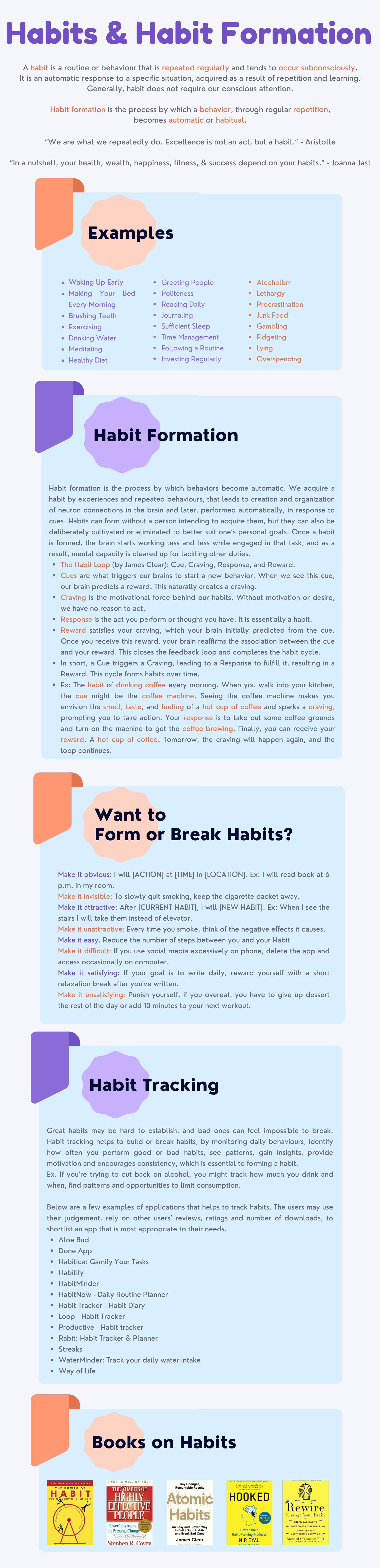
Addendum:


References & a wealth of resources:
The Habit Loop: 5 Habit Triggers That Make New Behaviors Stick
How To Start New Habits That Actually Stick
What Does It Really Take to Build a New Habit?
The Simple Art of Creating Long-Lasting Habits | by Niklas Göke | Better Humans
Habits Guide: How to Build Good Habits and Break Bad Ones
How to Break Up with Your Bad Habits
How to stop Bad Habits
When Life Gets Busy, Focus on a Few Key Habits
Break Bad Habits with a Simple Checklist
When Life Gets Busy, Focus on a Few Key Habits
25 Best Habits to Have in Life | Entrepreneur
11 Simple Health Habits Worth Adopting Into Your Life
21 Minute Habits That Can Boost Your Productivity by 100% – Calendar
Habit Formation | Psychology Today
Making health habitual: the psychology of ‘habit-formation’ and general practice – PMC
Understanding Habits and Why They are Important to our Health
4 Unknown Stages of Habit Formation
4 Ways to Quit Bad Habits Effectively
From Putting up Holiday Decorations Early to Practicing Gratitude, the Happiest People in the World Swear By These 30 Habits
The 80 Best Micro Habits to Change Your Life
50 Good Habits to Help Spur Your Mental Well-Being
101 Examples of Habits – Simplicable
Hackathon Submission: YHaB
The Persona & Problem Statement
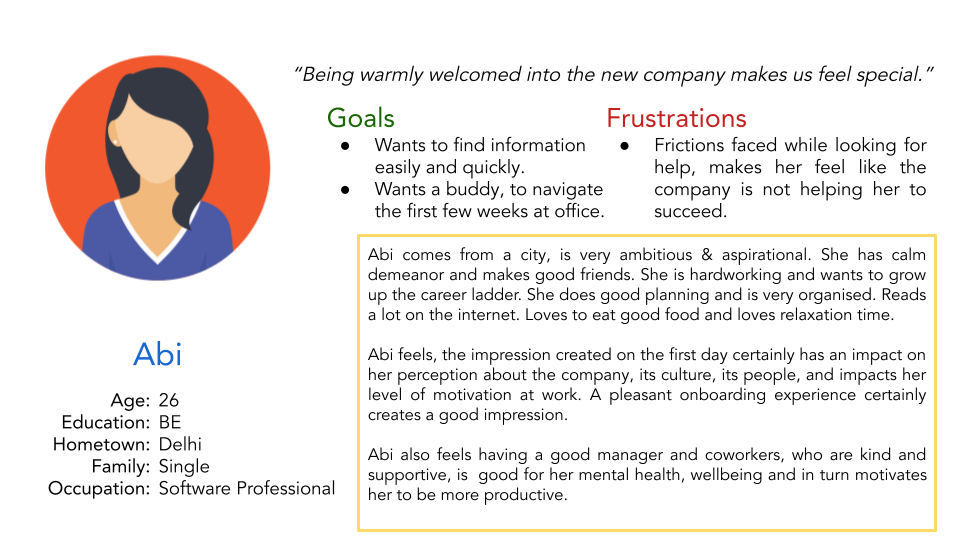
Abi joined a new company and took part in the new joiner’s induction program. The next day, she went to an HR executive for a query on insurance. The HR executive responded rudely, asking “What were you doing during the induction.” Abi was taken aback and felt this is not in line with creating a psychologically safe work environment and the “Great Place to Work” philosophy the company is advocating.
A few months down the line, when Abi wanted to book tickets for a few team members to attend a conference, she booked using a travel website instead of Concur, which is the company prescribed way for the employees to plan travel. Abi did this inadvertently, firstly because no one told her during induction, there is a system called Concur. Next, she didn’t have the mindset to check with someone from operations/HR team due to a poor first impression. Not using Concur, led to compliance issues, warnings and in turn had cascading negative effects on her career, resulting in low level of confidence, and being withdrawn from participating in office events. This had an overall impact on Abi’s morale and in turn on company’s business.
Suggested Solution
You Have a Buddy (YHaB) – A chatbot to handle employee onboarding & offboarding. This doesn’t mean, we eliminate physical onboarding sessions. This is to aid new employees beyond the induction sessions, with multi departmental support.
Poor onboarding can leave employees with lower confidence in their new roles, and worsened levels of engagement. Creating a great onboarding experience can make lives at work easy for employees, motivate them to perform well, set new hires for success and in turn greater employee retention.
From experience, we have seen checklists on Workday, to see if all onboarding tasks are complete. However, people rarely see to those. When new employees are handed over the laptop, they should have the onboarding chatbot pinned to their task bar. The chatbot should have notifications/flashing capabilities like how MS Teams flashes when a new message arrives. When the employees open the chatbot, he should get a welcome message with videos on the company, its history, various operations…etc. The employees should be presented with the list of various points of contact. The chatbot should answer questions like:
- What are my roles and responsibilities?
- How can I book a cab?
- How can I apply leave?
- Please share me the holiday lists for this year
- Who is my manager/HRBP?
- How to contact facilities team?
- How to get my laptop repaired?
- How to add a new software to my laptop?
- What are the leave policies?
- What are the various company policies?
- What are the compliance policies I should be aware of?
- What are the emergency contacts?
- What is the organisation structure?
- What does each function in the organisation do?
- Where to find my Form 16?
- What are the reimbursements I can avail?
- What is GCO? What do they do?
- Do I have a mentor at AZ?
- What are the mandatory learnings I should complete?
- Where can I see my mandatory learnings/assignments?
- What are my goals and objectives for the year?
- What is the company scorecard?
- What are the tools I should be knowing? Ex. Jira, Confluence, Workday, ServiceNow, Workplace, Degreed, SabaCloud…etc.
- What are a few examples of breach of compliance?
- What is POSH?
- The checklist before offboarding
*Above listed are a few sample questions.
Once onboarded, the chatbot should nudge the new employees on daily basis for the next 30 or 60 days prompting them to complete the mandatory trainings and guide them to plan their day.
Ex: When the employee logs in the morning, the chatbot should present a note saying,
“Good morning 😊 Let me guide you to plan your day. You have these mandatory trainings to be completed. Pick one to complete today.
Also, what is one big thing you want to focus today?”
When it comes to learning something that is in a document with option “Read & Sign”, people predominantly open and sign it without fully understanding what is in it. Not to blame the employees. This is partly because of the way such trainings are designed, which overwhelms. Probably a good way to make trainings meaningful should be to share snippets of information, at regular intervals, that is easy to grasp.
As a way for new employees to remember certain things, the chatbot can ask question from what they learnt, nudging to type the answers.
Ex: Chat bot asking, questions like “What is your understanding of leave policies at AZ?”
In toto, the virtual buddy should help new employees understand the company culture, know how to be compliant, ask for clarifications, and help establish workplace connections within the team, stakeholders, and the company, which in turn can enhance the overall employee experience.
Business Outcomes & Strategic Alignment
The chatbot can capture metrics on daily basis, from individuals, by populating some questions like:
- How was your day?
- Were you feeling stuck somewhere?
- What could have been done better today to improve your mood?
A weekly report can be generated to measure the level of satisfaction of new joiners and take measure to address their concerns.
The suggested solution, when implemented, can help new joiners with a pleasant onboarding experience, plan their career ahead at AZ, which in turn can lead to improved work satisfaction and greater retention of employees. This also aligns with company’s strategic goals of Run IT Brilliantly, Digitize Our World & being a Great Place to Work. Extensions of this chatbot solution could be to help clarify queries of patients onboarded onto studies, vendor onboarded to provide some service…etc.
Sustainability
Clear communication, and easy availability of information reduces the time wasted in navigating a matrixed organisation to find clarifications and improves overall productivity. Wanted to use the below example to corelate:
Over 1,200 hours wasted daily confiscating cigarette lighters, perfume sprays, power banks – BusinessToday
Please click & expand for a wealth of resources & references
- Question Answering – Language Understanding – Microsoft Azure
- FAQ Plus App Template
- Onboarding Can Make or Break a New Hire’s Experience
- Why People Quit Their Jobs
- Turn Departing Employees into Loyal Alumni
- The Morning Nudge & Evening Mood
- Over 1,200 hours wasted daily confiscating cigarette lighters, perfume sprays, power banks – BusinessToday
PS:
- Submitted this during a hackathon organised by my business unit in 2022 and resubmitted in an IT org wide hackathon in 2023. We were not the winners, but are glad to be in the top 10 entries amongst the 70 submissions.
- Thanks to new grads Banishree, Asaf, Sai Krupa & Sandra, who joined the company recently, for being part of the team and sharing the inputs on their employee onboarding process.
- Long back, when I was looking for a personal finance app, I stumbled upon YNAB (You Need A Budget) and that inspired the title for this idea: YHaB (You Have a Buddy)
 Attitude is Everything