“The most powerful person in the world is the storyteller.”~ Steve Jobs
Storytelling is one of the most powerful forms of communication known to humanity. Weather giving a presentation, launching a product, making a movie, or inspiring change, if we need to connect with the audience on a deeper and emotional level, we need to tell captivating stories.
Why Stories Matter? Stories are more than mere communication tools. Storytelling provides a unique way to engage and resonate with people across generations. Stories are sticky and embeds into our subconscious mind easily. Stories establish connections. Stories empathise. Stories evoke emotions. By crafting compelling stories, individuals and organizations can convey complex ideas, evoke emotions, drive action and transform the way we communicate, influence, and connect with others.
My Learnings & Lessons In the realm of storytelling, few names resonate as profoundly as Steve Jobs, whose visionary approach not only revolutionized technology but also transformed the very essence of how stories are told. In “Creativity, Inc.,” Ed Catmull, the co-founder of Pixar Animation Studios, sheds light on Jobs’ remarkable ability to weave narratives that captivate and engage. Catmull delves into how Jobs’ intuitive understanding of storytelling played a pivotal role in shaping the successes of Pixar and Apple, illustrating that a compelling story is at the heart of every groundbreaking innovation. Pixar operated with the first principle “Story is the King” and reviewers of Toy Story talked mainly about the way Toy Story made them feel and not about the computer wizardry. Pixar’s effective storytelling has created blockbuster movies. Through the journey of Pixar and Apple’s triumphs, we uncover the principles of storytelling that can inspire creativity and drive success across industries.
The 3 Ps of Storytelling Becoming a great storyteller involves mastering three key principles:
Passion: Your story must convey a sincere and passionate message, stripped of all unnecessary elements, focusing intensely on core ideas. Point of View: Have a credible and relatable perspective. Answer the “so what” question by offering your audience a new way to look at familiar data, finding the human element that makes the story memorable. Practice: Like renowned speakers who rehearse tirelessly, storytelling excellence requires rigorous preparation and an understanding of your narrative flow.
Elements of an Effective Story When telling your story, remember these essentials:
Audience Engagement: Tailor your narrative to what resonates with your audience, understanding their worries, hopes, and motivations.
Emotional Connection: Use personal anecdotes to humanize your narrative and make it relatable.
Call to Action: Empower your audience to act by providing them with a clear direction grounded in a shared vision.
Humility and Honesty: Authentic stories often involve vulnerability, openness about failures, and a willingness to show growth.
Practicing and Perfecting Stories Creating compelling stories is not just about telling them but about practicing and perfecting them. Workshops encourage using quick, informal conversations to shape stories, simplifying complex ideas into engaging, actionable narratives.
Visual and Digital Storytelling With the rise of digital platforms, storytelling now extends beyond words into visuals and videos. Encouraging rich, sensory experiences in storytelling aligns with how platforms like Pixar and TED present their narratives, ensuring that they are not just informative but transformative.
Conclusion: Your Storytelling Snapshot To master storytelling is to refine your ability to connect, inspire, and lead. Whether in crafting brand narratives or everyday communication, weaving stories that resonate emotionally ensures not just communication but connection. Remember, as you develop your storytelling skills, focus on authenticity, empathy, and relevance, making every story both a shared journey and a memorable venture.
Took down the below content, to refine. Please excuse…
A few years back, while preparing for an internal company presentation, I thought how to make the presentation exciting and useful? A few good presenters flashed in mind. They told stories, showed enthusiasm, had a sense of humour, followed some structure, used props and had a keen understanding of the audience’s needs. I also read how Steve Jobs’ keynote presentations continue to attract thousands of views. Based on the learnings, here’s a three part guide to ensure your presentations not only inform but also entertain and inspire. Prepare, Practice and Present.
1. Prepare: Building Your Foundation
Start With the End in Mind Before crafting your presentation, define the key message you want your audience to take away. This becomes your guiding star. Also consider if the topic is interesting. Will the audience care about the topic? Ex: Steve Jobs often used “Twitter-friendly headlines”—concise, impactful phrases that encapsulated his message, such as “Apple reinvents the phone.”
Narrate with a Story A compelling story forms the backbone of a great presentation. Before diving into the specifics of your slides, construct a narrative that weaves together your key points. As Steve Jobs famously demonstrated, storytelling is more impactful than a slew of statistics. Your story should have a clear unifying message that resonates with your audience even after the presentation concludes.
Structure Your Content Organize your presentation into an easily followed structure. Consider a three-part format: introduction, challenge/resolution, and conclusion that would leave your audience with a clear takeaway message. This approach keeps the audience engaged and ensures your message flows naturally.
Keep It Simple Avoid losing your audience with lengthy speeches or jargon-heavy language. Keep your language simple, clear, and direct so that it is easy to understand & remember. Your presentation should engage and stimulate your audience, pulling them into your narrative.
Write and Revise Writing is a powerful tool. You’ll be able to organise and present at a much better level. Begin by drafting your presentation on paper, organizing your thoughts clearly. Integrate meaningful data and examples that support your story. Avoid clutter and aim for clarity and simplicity. A well-organized presentation aids in effective delivery.
2. Practice: Perfecting Your Delivery
Rehearse Relentlessly Great presentations aren’t born overnight; they are the result of rigorous practice. Follow a structured approach:
30 Hours on researching and refining your story.
30 Hours on constructing simple, visual slides. (“A picture is worth 1,000 words.” Not only do we remember visual input better, but we also process visual information much much faster in the brain than we do text. Please refer the illustration below)
30 Hours on rehearsing the delivery with a focus on clarity, pacing, tone of voice, posture, body language and facial expressions.
Speak clearly & slowly. Practice in front of a mirror, record yourself, rehearse in front of friends, seek feedback, refine and enhance. Practicing out loud, can help identify and edit any awkward phrasings or speed bumps.
Master Non-Verbal Communication Audiences respond well to the physical energy and enthusiasm. Your body language is as crucial as your words. Maintain eye contact, use gestures to emphasize key points, and exhibit confident posture. Remember, relaxed and deliberate movements are more engaging than stiff or nervous gestures. If looking someone in the eye makes you uncomfortable, here’s another tip you can try: Look at a person’s forehead instead of directly in their eyes. Smile and nod as you speak to put your audience at ease. Avoid slouching, crossing your arms, having your hands in your pockets, or playing with your hair or clothes. For virtual presentations, make sure to look directly at your webcam. This will help the audience feel as if you’re looking at them, through the screen.
Simulate the Real Environment Most presenters prepare by flipping through their slides quietly. That process won’t help you build the confidence you’ll need when you’re really standing and speaking in front of an audience. Conduct dress rehearsals in settings similar to your final presentation. Familiarize yourself with the equipments and room setup. This not only reduces technical glitches but also boosts your confidence. Jobs was legendary for his preparation and was even prepared for unexpected surprises. When he faced a technical glitch during the presentation, he casually laughed off the glitch, told a story, and got back to the presentation when his team resolved the issue. It is said, he would rehearse on stage for many hours over many weeks prior to the launch of a major product. He paid attention to every detail of every demo and every font on every slide, making suggestions and improvements. He even paid careful attention to the gestures he made with his hands at key moments, as well as the pace of his delivery. He picked up his vocal pace during some parts of a presentation and slowed down when he wanted the message to sink in. As a result the presentation was delivered flawlessly.
Positive Visualization Calming your nerves by engaging in relaxation and visualization exercises like deep breathing, before stepping onto the stage can significantly reduce anxiety and enhance your confidence. Don’t worry about what could go wrong. Visualize yourself giving an awesome presentation. Try a power pose to improve your confidence. Anticipate and be prepared to answer audience questions. This mindset fosters a positive performance.
Ask yourself the following questions:
Am I being concise? Did I stick to the main points I need the audience to remember?
Is my tone conversational? Did I sound robotic or like I’m reading from a script?
Did I use stories effectively, including relatable and specific examples to illustrate points?
Did I allow pauses in my delivery?
Did I appear confident?
Did I practice making eye contact by addressing different locations around the room?
Being a great public speaker means displaying confidence. That almost always comes from being familiar with your content, speaking clearly, and learning how to tell a story that engages listeners. Expert speakers carefully, painstakingly plan, storyboard, script, design, and rehearse their presentations like an Oscar-winning Hollywood director prepares their film for the big screen.
Rehearse, Rehearse and Rehearse.Record & Review.
3. Present: Captivating Your Audience
Open with Impact A well-crafted opening sets the tone for the rest of your presentation. You audience will come in a range of different moods. Begin your presentation with a strong, memorable opening— an icebreaker, bold statement, short video, relevant anecdote, story or comparison— to capture the audience’s attention and set the tone.
Engage with Stories and Analogies Stories and analogies help the audience connect with your message on a personal level. They make complex ideas relatable and memorable. Steve Jobs, for instance, didn’t just introduce products—he told stories that highlighted their significance and innovation.
Humanise the Data While revealing the iPod, Jobs didn’t talk about it’s storage or weight. He pulled out a device and said “1000 songs in your pocket.” Similarly while revealing the MacBook Air, he didn’t talk about it’s size. He pulled out the MacBook Air from a manila envelope, showing how thin it was. Simplifying concepts with analogies helps the audience understand and remember your message.
Be Concise and Enthusiastic No matter the subject, a great speaker will use natural charisma, humour and language to convey their points and get the audience excited. Keep your message clear and your enthusiasm palpable. Use humor judiciously to make the session lively but ensure it aligns with your message. Audiences are more likely to engage when they sense your energy. Ex: When Jobs introduced the MacBook Air, the slide had only one phrase, “There’s something in the air.”
Interactive Engagement Encourage audience interaction through questions and polls. This breaks monotony and fosters participation. Be prepared to handle questions with grace and confidence, repeating them for clarity and responding thoughtfully. Audience can ask difficult questions! Don’t get defensive. Don’t rush to respond. Be polite and professional. If you are unsure about how to answer a question, you can say “That’s a good question. Let me think about that for a moment.” If a few seconds isn’t long enough to find a good response, you can say, “I might need to think on that some more. Can I get back to you?”
Close with a Strong Takeaway End your presentation on a high note. Summarize your key points, inspire with a memorable quote or idea, and leave your audience with a thought-provoking question to ponder.
Conclusion Delivering an effective presentation is about creating a memorable experience for your audience. By intertwining thorough preparation, relentless practice, and dynamic presentation skills, you can captivate your audience, much like Steve Jobs, and leave a lasting impact.
PS: Thanks to my current & previous employers, for supporting my growth through valuable trainings. Thanks to ChatGPT for helping me finetune this post.
Please click & expand for a wealth of resources & references
When I draft emails, I always remember the below mnemonic, I read in a magazine.
The ABC of writing – Accuracy, Brevity & Clarity.
At work, I learnt a similar mnemonic: KiSS – Keep it Short & Simple) Also like this essay Write Simply by Paul Graham. Remember: Audience first. What is the 1 core message you want the audience to remember? I learnt to write short & simple emails. My blog posts are very lengthy. Gradually learning to make what I write short & simple.
Please click & expand for a wealth of resources & references. Please remember the KiSS principle.
The ones who shine a bit brighter, the ones who are maverick, the ones with lots of energy and charisma.
Felt good to be part of a program “We are LimITless.” The phase-2 of the culture journey focused on building a cultureofcollaboration by expanding your network. Why do we need to expand our network?
Collaborating effectively and working well in a matrixed organisation is crucial to achieve collective goals and progress. When we only reach out to people we know, for advice & support, we are limiting ourselves to same team, same routine and missing out on the diversity of opinion & perspectives, thereby slowing down on innovation process. By expanding our networks within the company, we increase our exposure to fresh perspectives, new ideas, opportunities and insights, build new skills and grow our self-confidence.
Volunteered to be a culture influencer, running a few experiments with support of org’s toolkit. In one of the experiments, we nudged & reiterated the teams to try Diversity Collision.
A few more experiments were, networking at leisure, pair and share, scheduled networking, sense checking with someone before presentation or sending a mail, discover hidden value about a colleague, happy-to-help, mentor-mentee and crowdsourcing.
Below are a wealth of resources that will help you network better and collaborate. In case you do not have subscriptions to the respective publishers, you might be allowed to read 3-5 articles free, per month.
Please click & expand for a wealth of resources & references:
A few years back, at the Construkt fest, I witnessed an induced networking called “Construkt Collision.” The hall was filled with people, standing. When the conductor of the event says, “Change,” every 1 min, we say “Hi” to the person around us, briefly introduce ourselves and also get to know the other person, exchange business cards, until we hear the next “Change,” after which, we move and meet someone new. It was interesting.
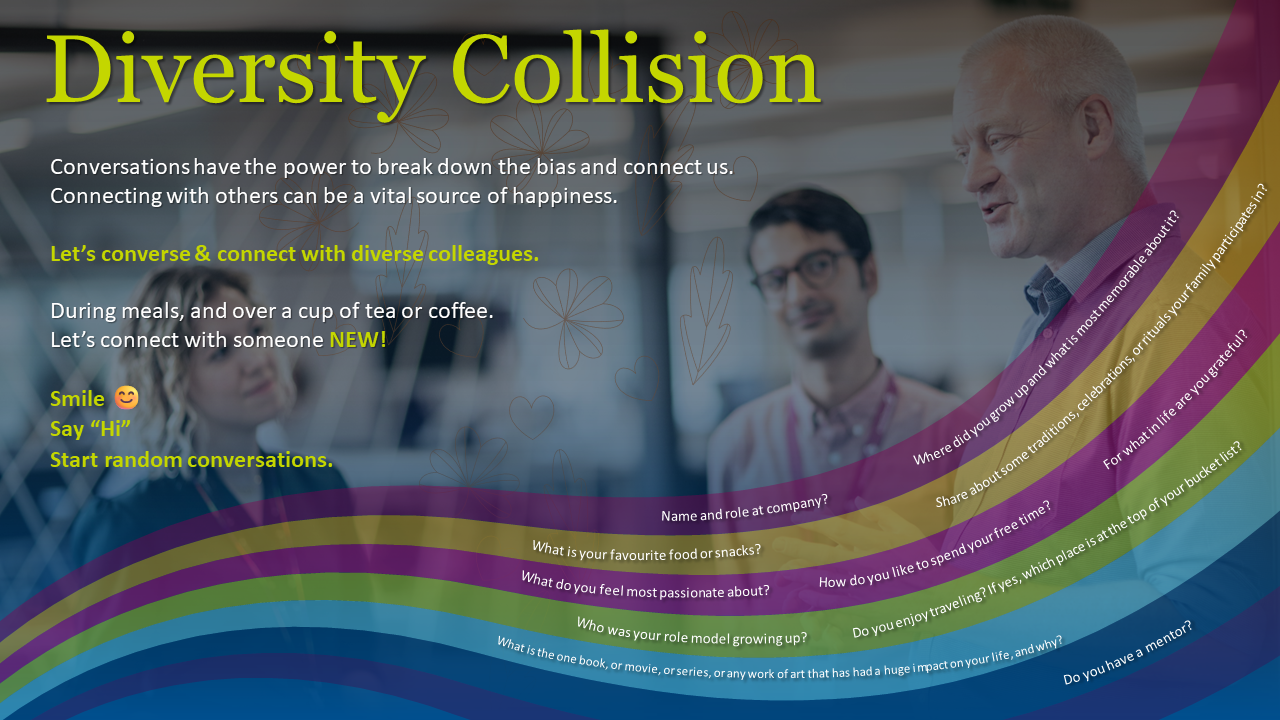
During the “Power of Diversity” week celebration at office, wanted to try something similar, help people meet diverse colleagues they haven’t interacted with and we came up with “Diversity Collision.”
I felt we were not able to achieve active participation in this collision probably because colleagues were shy to reach out to people they do not know or have never interacted with. To overcome this, in one of the offsite gathering, we requested the host to announce and nudge participants to sit alongside someone they have never interacted with and when breaking for lunch, to share the lunch table with someone new and get to know them better. Slight force or nudge helped to break the inertia/shyness 🙂
In hindsight, I thought, we also could have also tried placing a bingo sheet on colleagues desks and asked them to meet, interact briefly and get signatures or names of people, under questions/options like:
Someone born in specific month
Someone wearing a particular colour shirt
Someone from another state/country than yours…etc.
When we end the meal with a dessert, the sweetness lingers on our tongue, for some more time. It feels satisfying. I had a terrible 2024 and wanted to end the last month of 2024, doing/learning something for the sake of fun. Somethings feel like therapy. I intentionally visited sweet shops & cafes to lift my mood. My wife learnt home baking of cakes & cookies and I feel thankful for that. Taking inspiration from this blog, casually clicked and shared random beautiful pics. Decided to watch one TED video on photography daily in the evening. Some were pleasing and some showed the difficulties/realities, as shared by photo journalists. The compilation of the talks are below. Also, below are a lot many resources, I found on the internet, which I plan watch later, at leisure. Happy video watching at leisure 🙂
PS: I don’t aspire to be a professional photographer, but like to click random beautiful things that are pleasing to my eyes, using mobile phone. Thanks to my friend Ravisuriya, my school senior Balaji man & Ram, whom I met at Kabini, whose photographic works, I admire.
As we end 2024, I whole heartedly thank my family, friends & relatives, for all the support in times of extreme distress.
Jay drives to the petrol bunk and requests petrol refill of Rs. 1000 to his car.
The attender refills and asks the mode of payment.
Jay says UPI, scans a QR pasted near the pump pillar and sends money.
The attender interrupts and annoyingly asks why he sent the money through that QR. The attender then said Jay needs to scan the QR from a card board he was holding onto his hand, which had a QR printed in A5 sheet and pasted.
Looks like the petrol bunk has different modes of UPI payment. This is apart from cash and card payments.
Some QR payments are processed through the petroleum companies payment gateway
Some QR payments are processed through the petrol bunks bank account
Some QR payments go directly to the petrol bunk owners bank account
The QRs were, either pasted on the dispenser or printed and held on hand or printed to plastic holders supplied by payment aggregators or generated through the POS machine. There is some confusion and delay in processing the payment. The next vehicle waiting is honking.
How might we enable faster & easier UPI payments at petrol bunks?
I could think of a user feedback from the office tea stall:
“Do you feel, opening the app at tea stall, adding the amount and then entering the PIN, a painful process? The user says, he is used to it daily and it feels like a ritual. While he asks the tea vendor, 1 ginger tea, the user is parallelly scanning the QR code and much before he gets the tea, he finishes the payment and waits for the tea.”
Similarly, if the petrol bunks can display QR codes for UPI payments, prominently, (Ex. Red circled space in the dispenser image below) the drivers can intimate the quantity or the amount of fuel (Ex. 10 litres or for Rs. 1000) to be refilled and while it is getting refilled, they can scan the QR code and make payment. Each pump or dispenser can have unique QR code so that it is easy for each servicing attender to generate his end of day accounts and make settlements.
Also, to improve trust and efficiency, apart from the innovative soundbox the UPI app has provided, we can think of a low energy consuming display like Kindle readers, that can be placed near the petrol dispenser and display the amount received from the customer or the vehicle no.
The UPI app can allow users to create a label of his vehicle type and vehicle number. Ex. Maruti Swift: IQ 01 AM 3499 The label can be tagged and displayed alongside each refuel payment acknowledgement for easier visibility and acknowledgement, thereby improving trust and increasing the speed of payment.
If the user has leased the car through his office, she/he might like to have receipts for all the spends on fuel and receipts for driver’s salary. How might we enable the petrol bunks to share digitally generated receipts back to the user after refueling?
*”Petrol Bunk” is the most widely used term in India, for a fuel station. Different terminologies used across the world are: Gas Station, Petrol Station, Fuel Station, Filling Station, Petrol Pump…etc.
I am a software tester, finding flaws in products. I am also passionate about user experience & design and find it exciting to simplify & improve the experience of products we use. One such thing I wanted to simplify & make it more accessible is the sidewalks. Something that’s part of our public space.
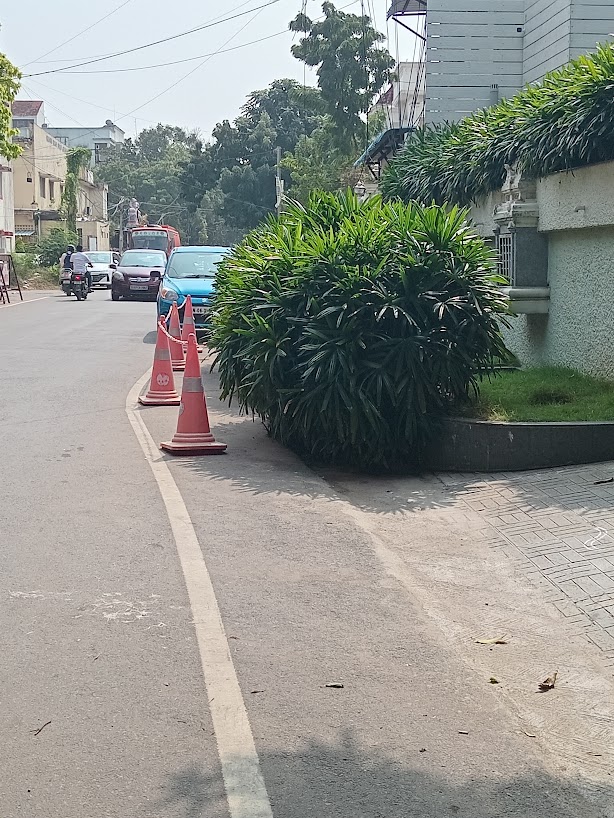
Like many, I’ve tried to de-stress by going for a walk, only to be forced off the sidewalk and into the street. Our sidewalks are often unusable—either encroached or poorly designed. The intersection of my experiences in testing, design and walking, made me view these sidewalks not just as civic problem, but as a design & behaviour problem. I began capturing pictures of various sidewalk patterns I encountered, trying to understand what makes some pathways easily walkable and others a nightmare. How might we reclaim these vital public spaces?
*Sidewalks are also known as footpaths, pavements, walkways, promenades, etc.
The Usability Flaws Forcing Pedestrians into the Road
In software, if a user interface is confusing or clunky, users simply abandon the app. On a city street, if a sidewalk is uneven, painful, or frustrating to navigate, pedestrians abandon it for the road.
Pedestrians naturally seek the path of least resistance—an even, continuous surface. Two major design flaws actively discourage people from using sidewalks:
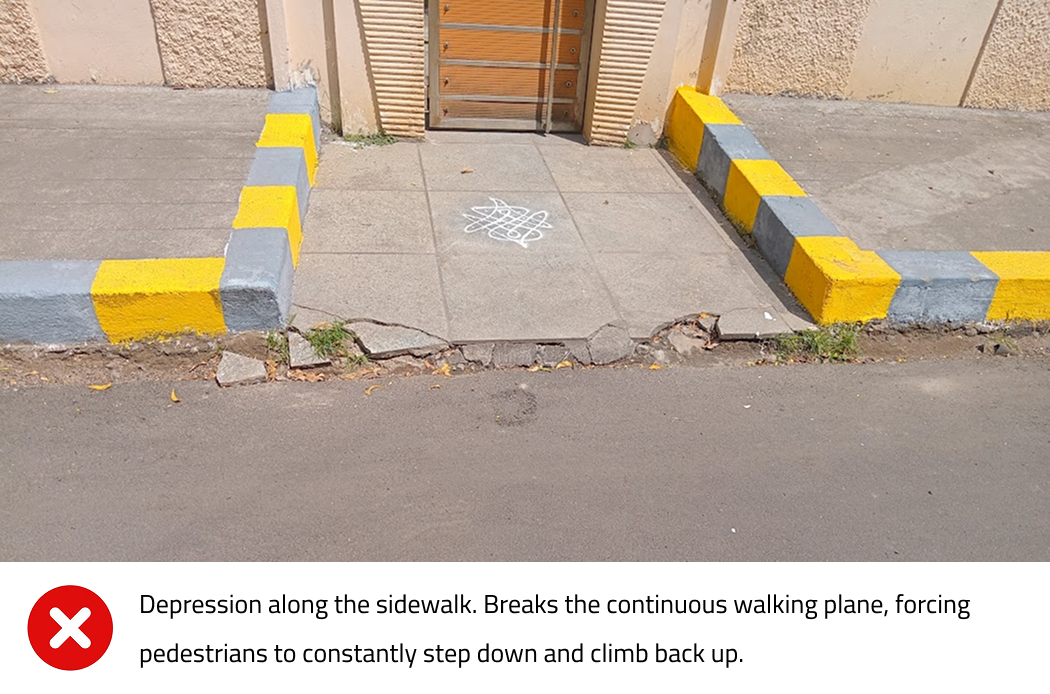
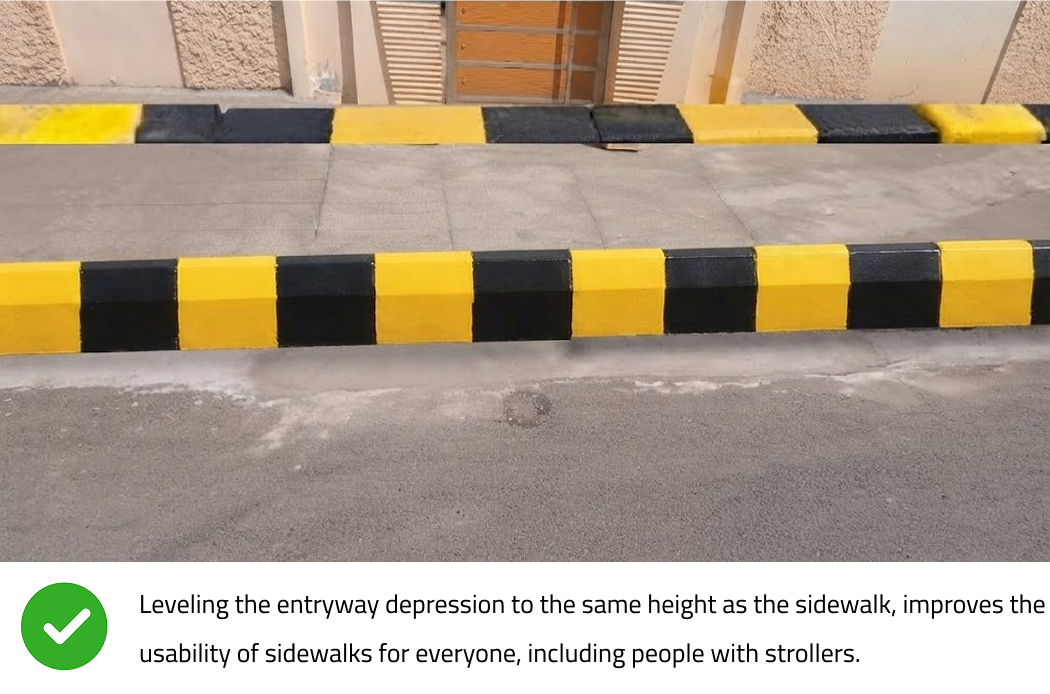
The Roller-Coaster Surface: Private homeowners and businesses frequently build steep driveway ramps or custom steps right through the sidewalks to transition into their properties. This forces walkers to constantly step up, down, and tilt sideways.
The High-Stepping Obstacle: Many sidewalks are built too high from the road level without a gradual transition. When a sidewalk abruptly forces a pedestrian to break their walking flow to climb a massive ledge, they choose to walk on the even road instead.
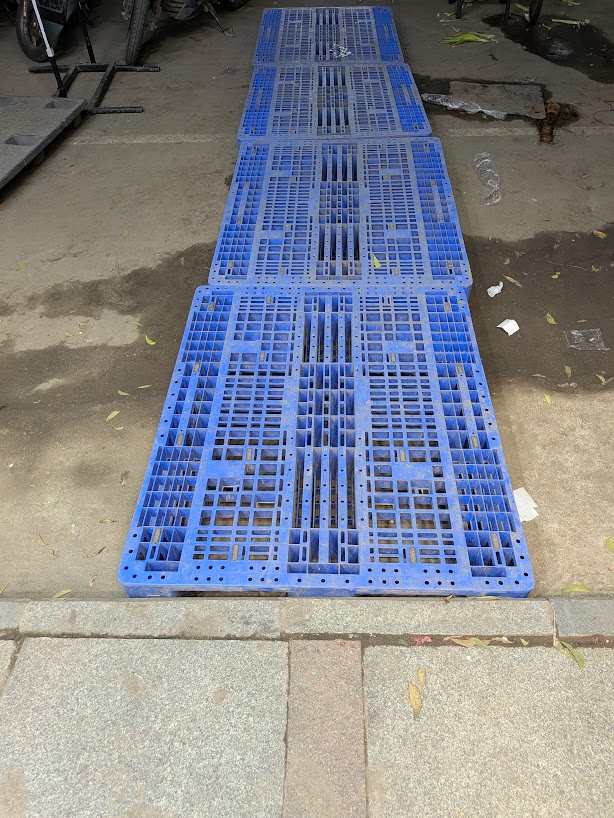
Below are some example of uneven sidewalks, which dissuade pedestrians from walking on them comfortably.
How do Sidewalks get Encroached?
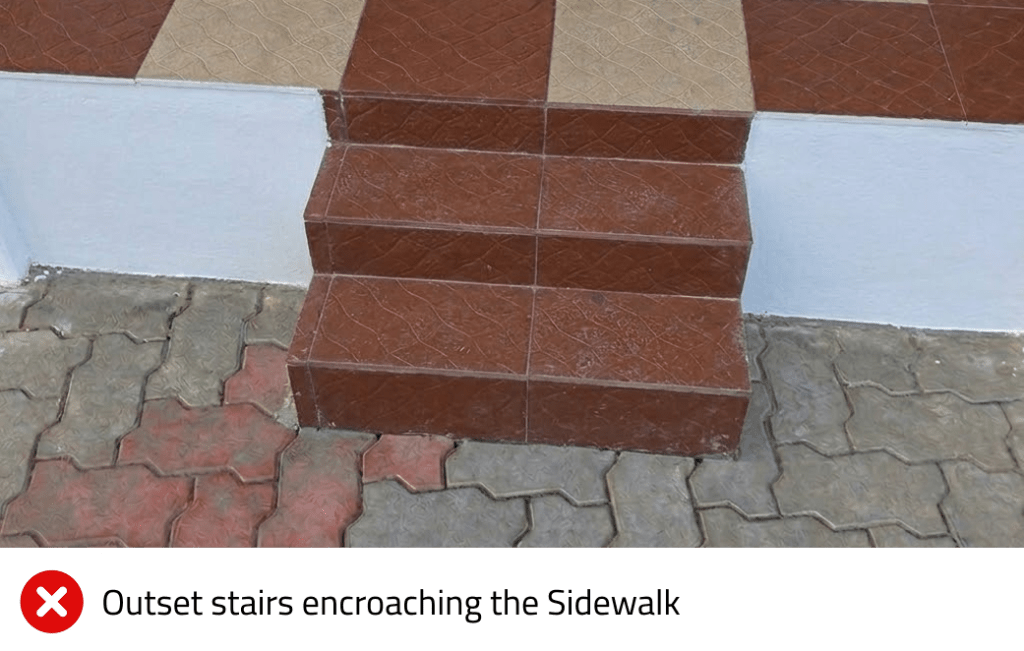
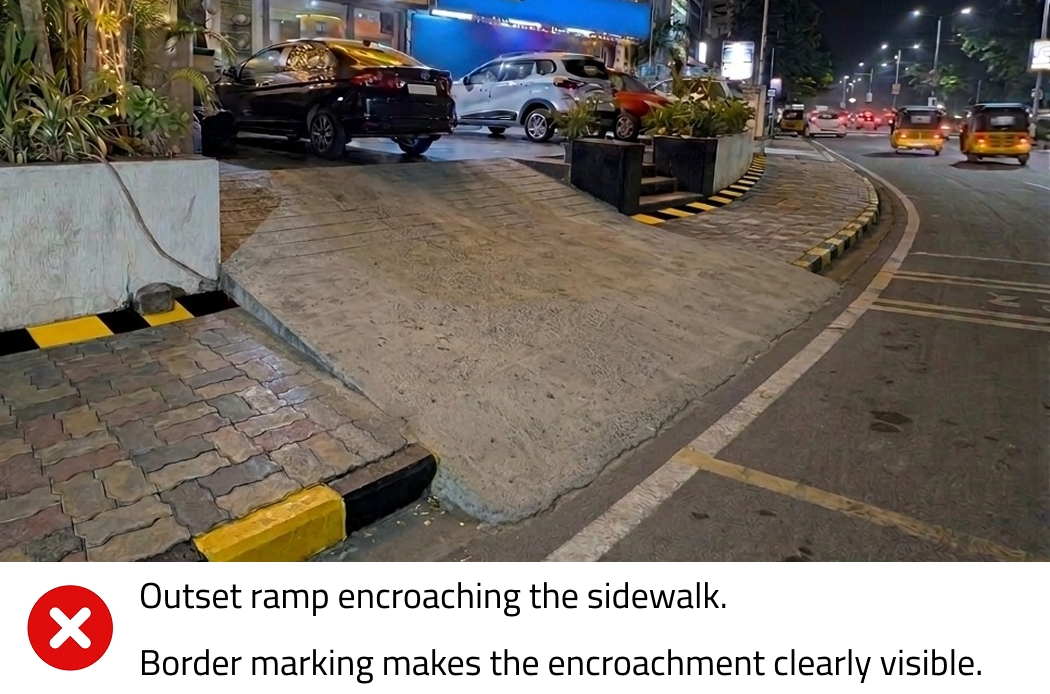
Ramps & stairs extended beyond the home boundary, onto the public sidewalk
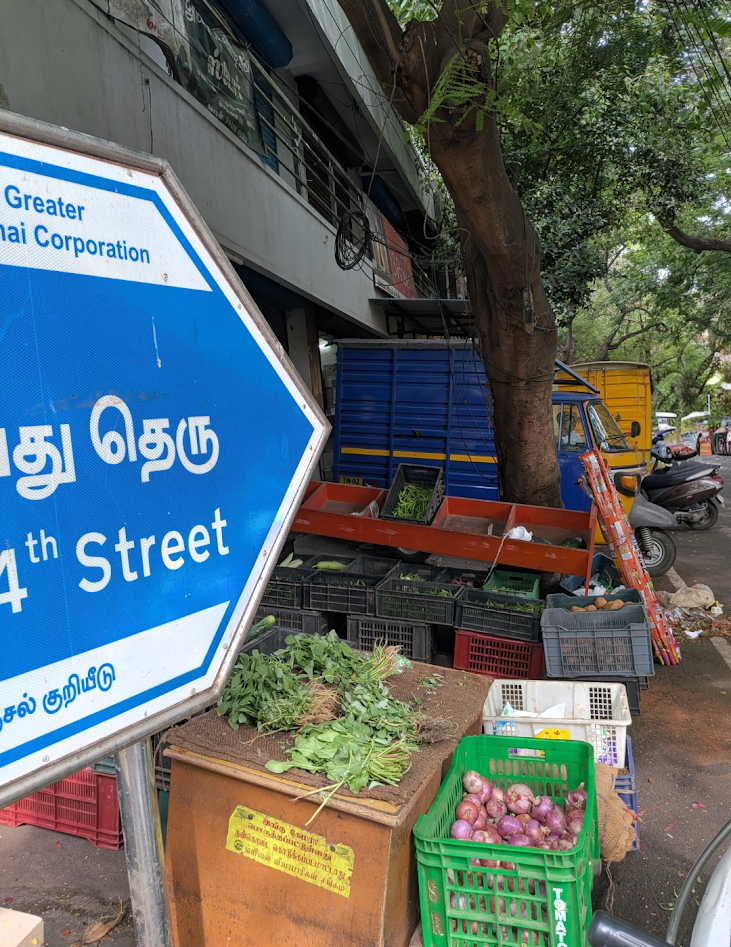
Shop advertisements placed onto the sidewalks
Shops extending their storage area onto the sidewalks
Shops converting sidewalks into customer parking
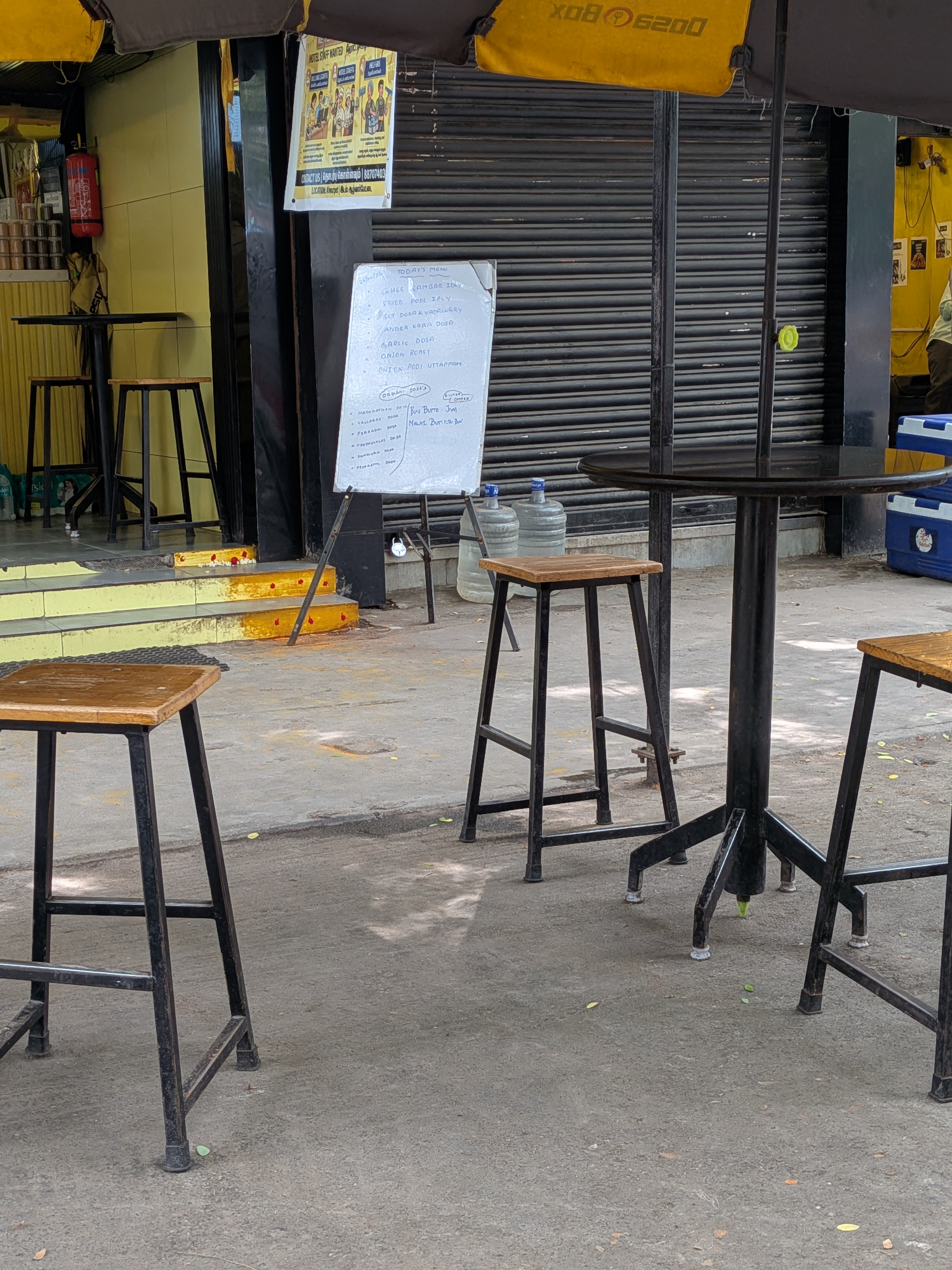
Small eateries placing tables onto the sidewalks
Food carts occupying the sidewalks
Ironing carts occupying the sidewalks
Tea shops extending the sunshades and letting customers utilise the sidewalks while refreshing
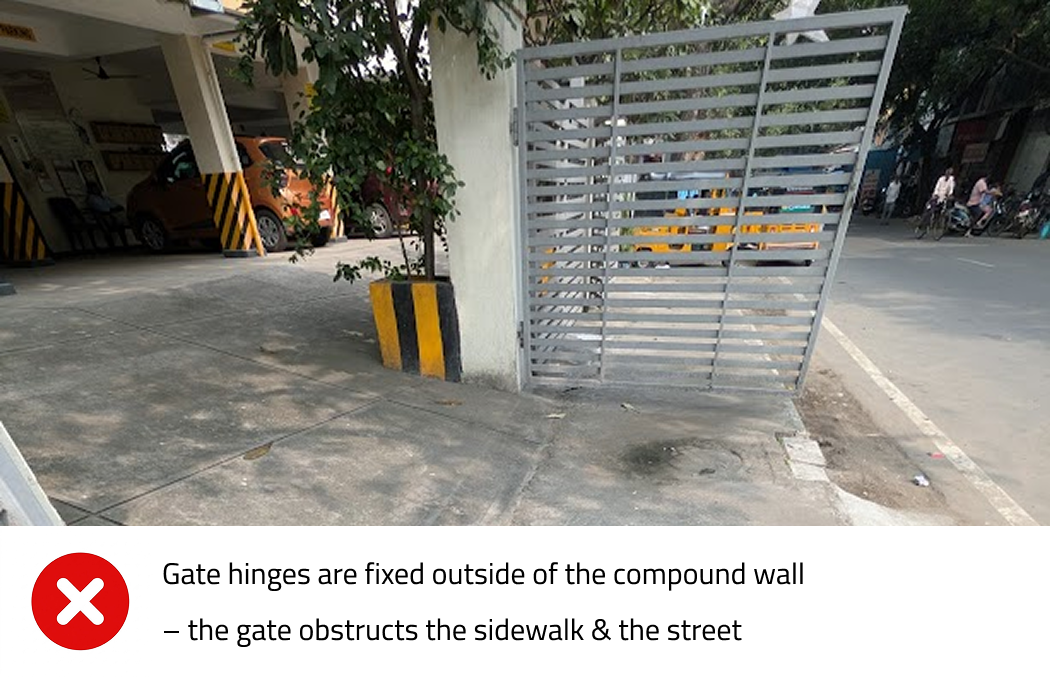
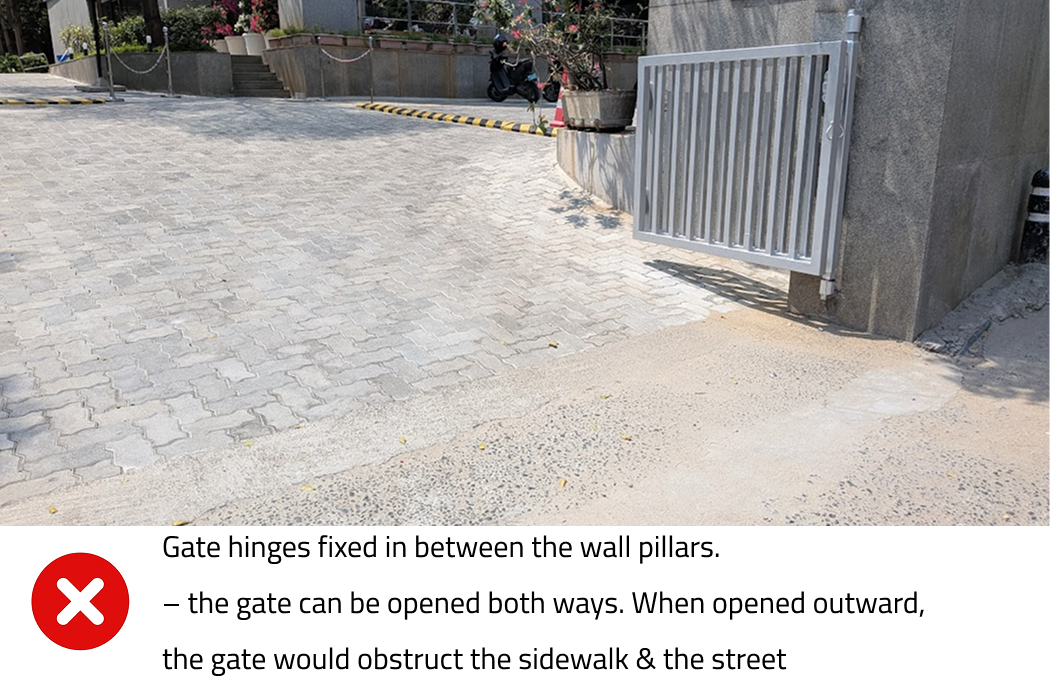
Housing building gates that opens outward rather than inwards or sliding sideward
Residents utilising the sidewalks for private gardens & security cabins
Unloading and storing construction materials (sand, bricks, cement & steel) onto the sidewalks rather than property premises.
Flex banners placed for marriage/birthday functions, political events and commercial advertisements
Municipalities and corporations using these places to erect light poles, transformers & overhead electricity/internet cables
Encroaching to Prevent Encroachment
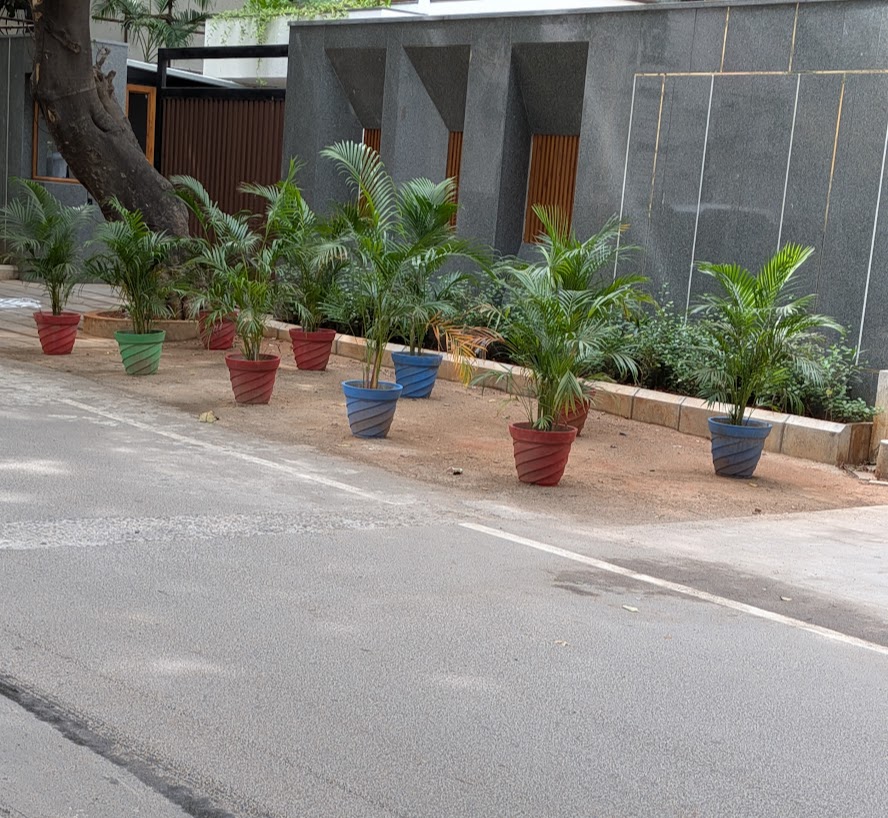
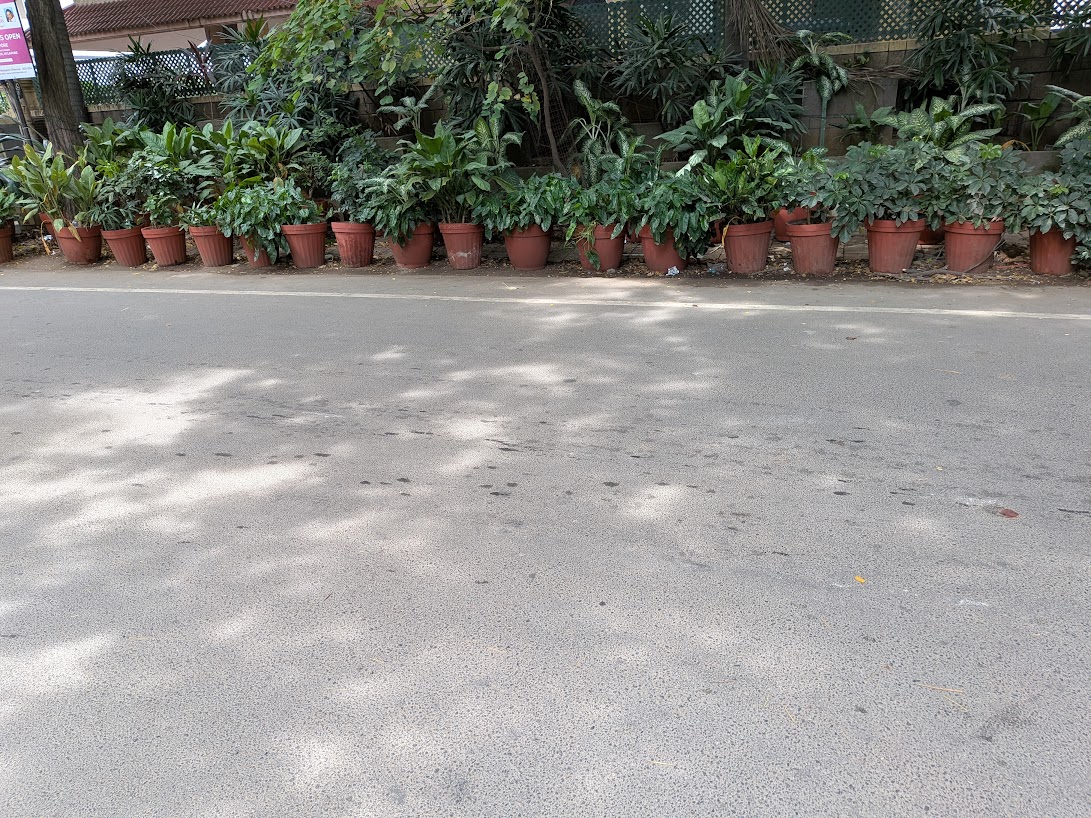
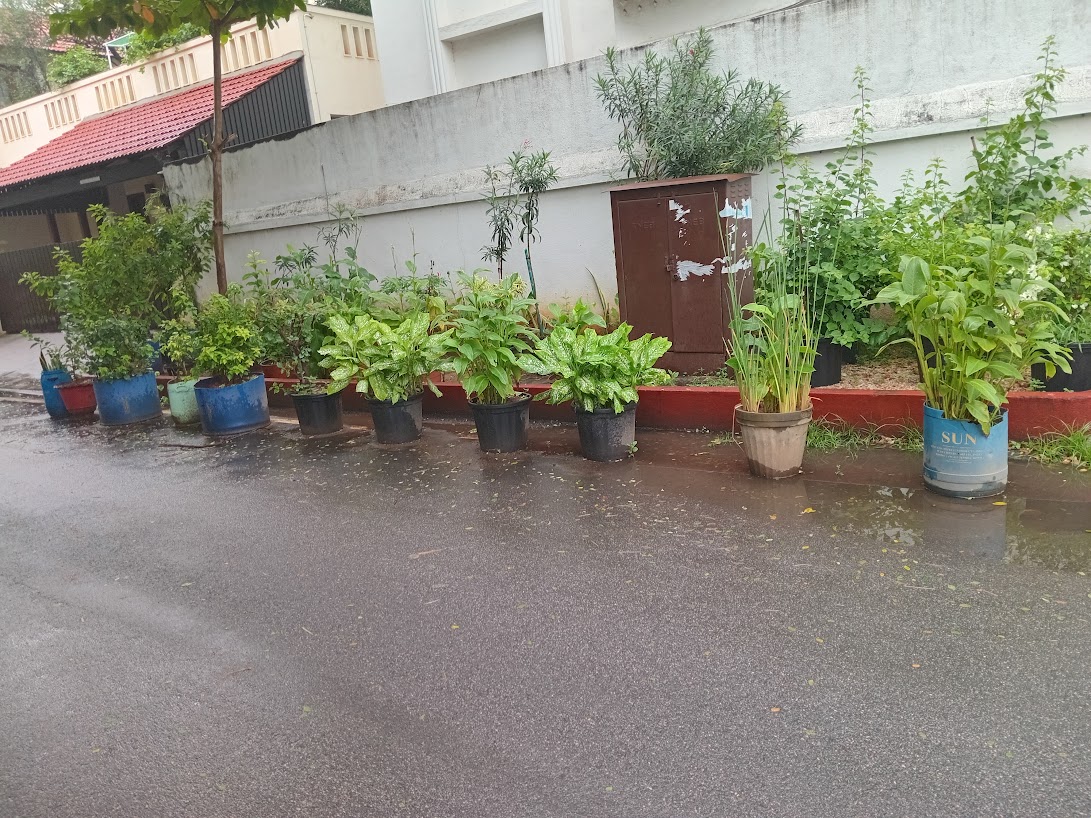
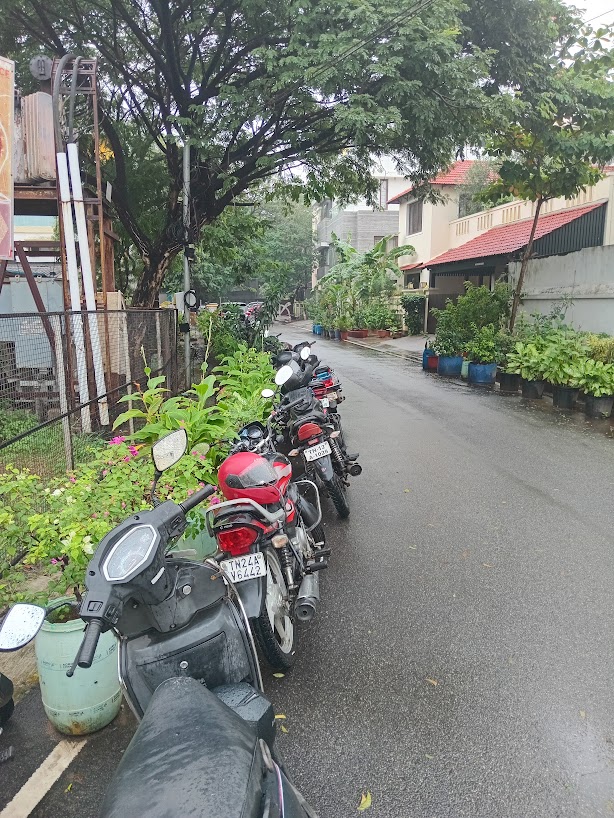
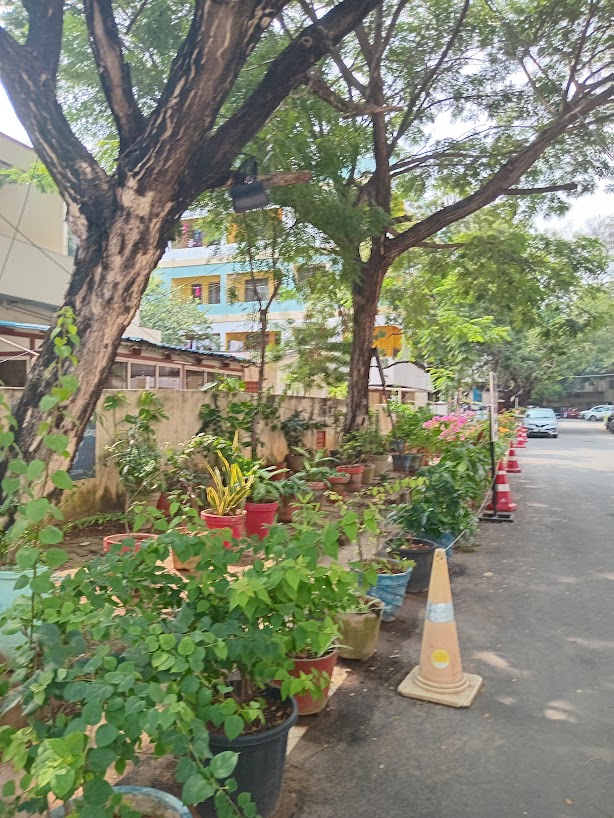
Below are a few examples of residents, shops & commercial establishments pre-emptively seizing public space to prevent others from doing the exact same thing. The rows of potted plants create a green, seemingly “innocent” barrier along the compound walls. However, it’s a passive-aggressive urban defense mechanism—using the social acceptability of nature to mask a visual land grab.
The underlying motivation is clear: “If I don’t occupy this space with something pleasant, someone else will occupy it with a vehicle or a stall.”
A Note on Design Philosophy: Design for the User, Not the Abuser
Ultimately, the biggest paradigm shift we need is in our core design philosophy. We must build our sidewalks—and all public infrastructure—with a user-first approach rather than an encroachment-prevention-first mindset.
Out of fear of street vendors and two-wheelers, municipal engineers today almost always take a defensive, containment approach. They build fortress-like, high-rise pavements or choke walkways with dense metal barricades. While this might occasionally deter an encroacher, it creates a hostile environment that entirely forgets the actual user—ultimately locking out senior citizens, children, and wheelchair users, and forcing pedestrians onto the dangerous main road. Defensive architecture that punishes the walker to deter the motorist is a fundamental failure of design. A sidewalk so deeply un-user-friendly is a failed product.
A true pedestrian-first approach accepts a simple truth: we must build for the ideal user experience first, and enforce rules against bad actors second. A user-centric sidewalk features a low-rise curb for easy access, smooth curb cuts at every intersection, and flat, continuous levels at property junctions.
Let’s build inviting, accessible walkways first. Once the usability is flawless, we can independently deploy targeted enforcement mechanisms—like structural bollards, automated surveillance cameras, tech-enabled policing, and spot fines—to keep bad actors out. We must stop punishing the pedestrian for the sins of the driver.
How might we design & build pedestrian friendly sidewalks?
How do we solve a problem that is deeply rooted in human behavior? Let’s look at behavioral economics.
The Nobel Prize-winning concept of Nudge Theory by Richard Thaler shows, how subtle cues can guide human behavior. If we put a sign to switch off lights before leaving the room, we are most likely to do so. What if we could apply this principle to our public spaces?
In his book The Tipping Point, Malcolm Gladwell argues that for an idea, trend or behaviour to spread, “The Power of Context” is crucial. Small, structural changes in our immediate environment can trigger massive, positive behavioral shifts in a community. The environment itself becomes the nudge.
What if we applied these principles to our sidewalks?
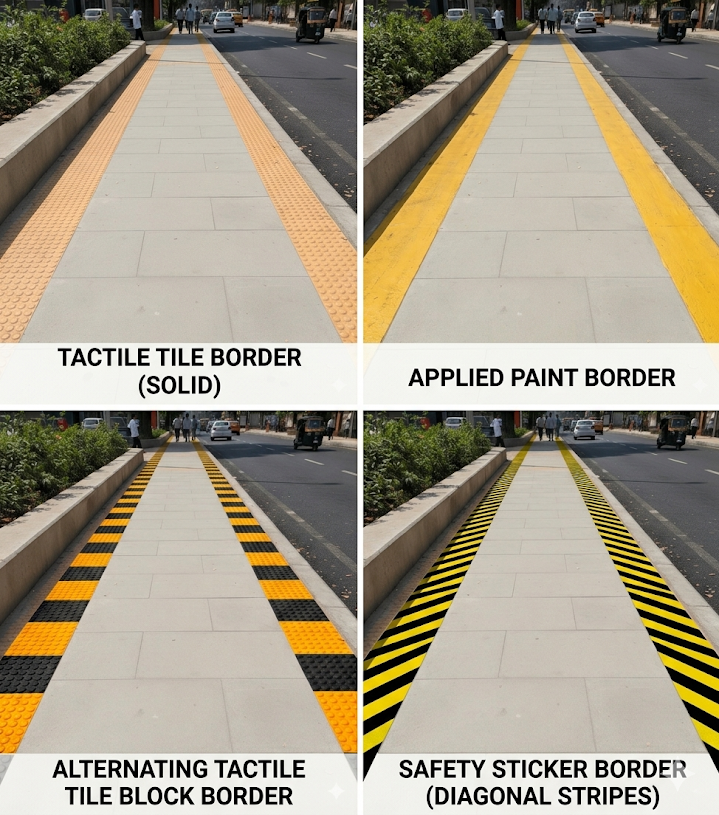
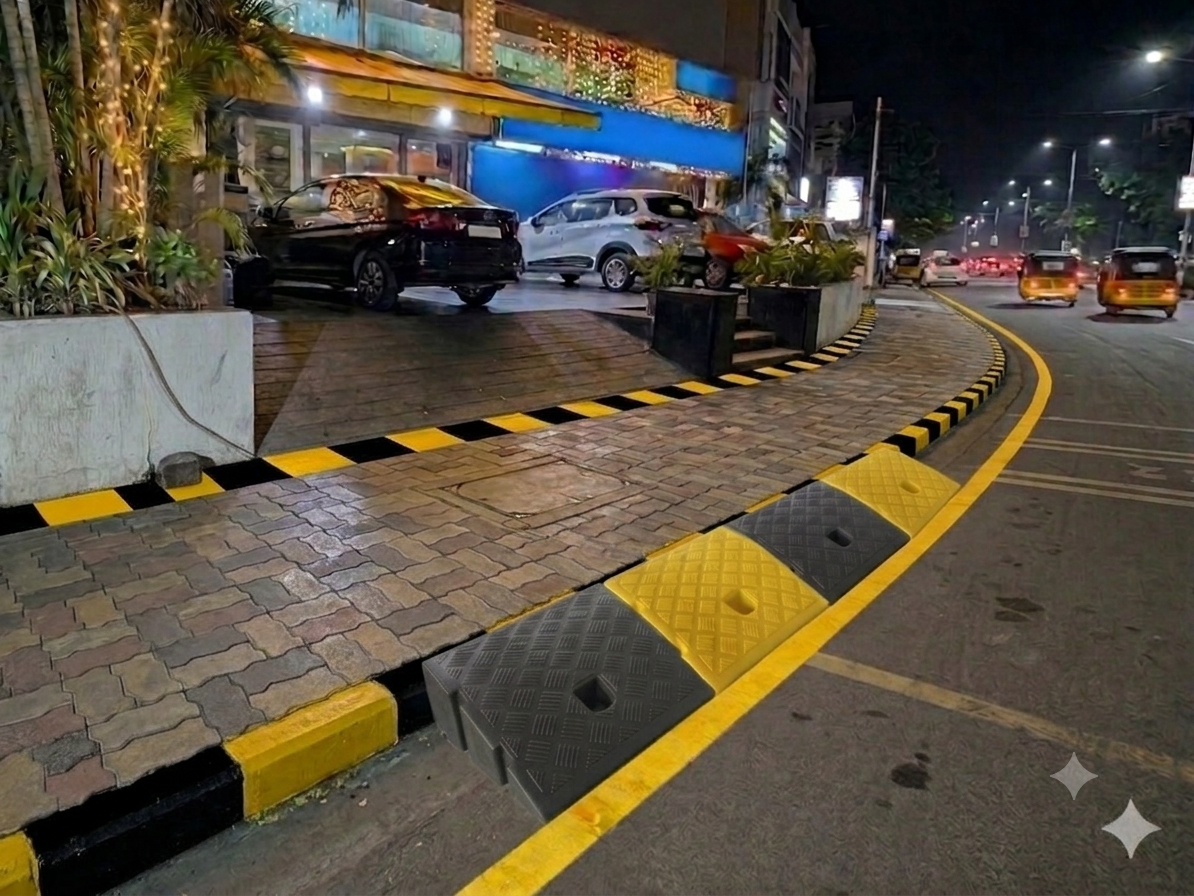
My idea is simple, yet I believe it holds the potential for significant impact: a new standard for sidewalk design based on these behavioral insights. What if we started using indicative colors on our sidewalks?
Imagine a universal standard where high-visibility, indicative colors are integrated directly into the edges of our sidewalks. These clear visual markers send a quiet, non-intrusive, but powerful message to street vendors, vehicle owners, and pedestrians alike: “This is the pedestrian zone. Respect it.”
We aren’t just painting lines; we are altering the context of the street. We are using the environment to nudge people not to encroach, not to drive vehicles on the sidewalks, not to extend their stairs, ramps and shops onto the sidewalks, and to gently guide pedestrians to walk on the designated path.
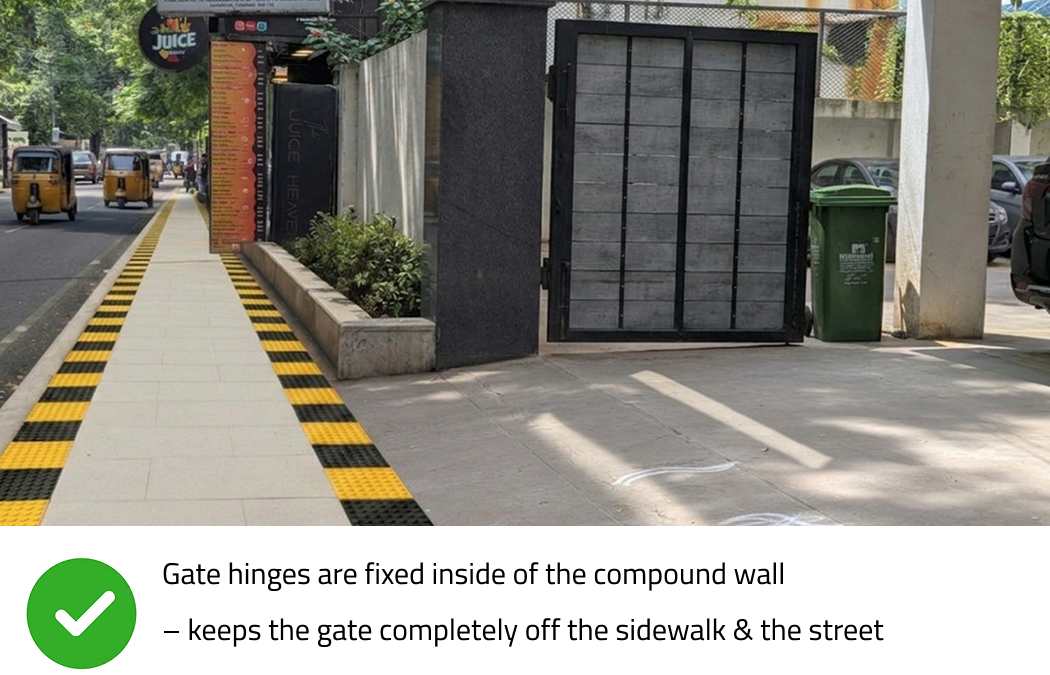
This behavioral design applies to structural elements too. Take private property gates, for instance. By standardizing gate hinges to be placed strictly on the interior of property pillars—or mandating sliding gates—we eliminate the physical hazard of gates swinging outward and blindly striking pedestrians on the sidewalk.
A small modification to our public space can potentially create a positive change in how we use it.
Illustration of a Better Sidewalk with Border Markings
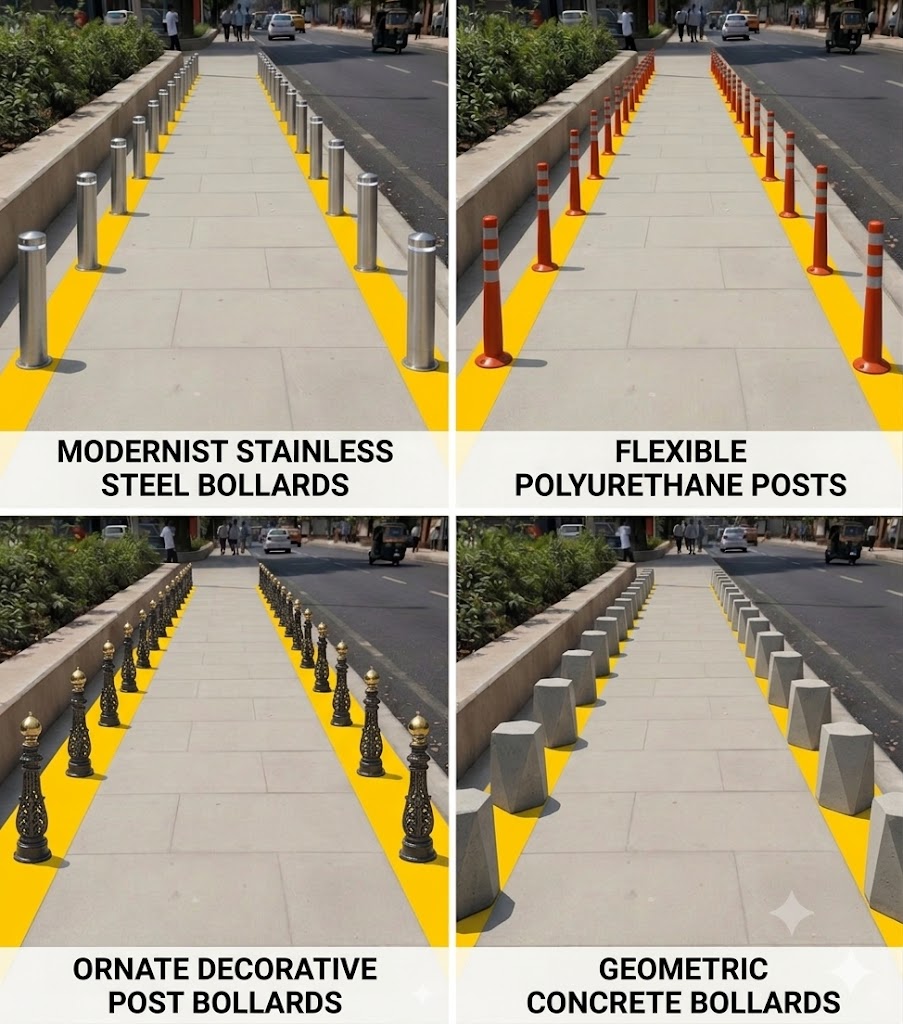
*Images generated with the help of Gemini.
Illustration of Sidewalks with Bollards. Prevents Vehicles from Encroaching
What materials to use?
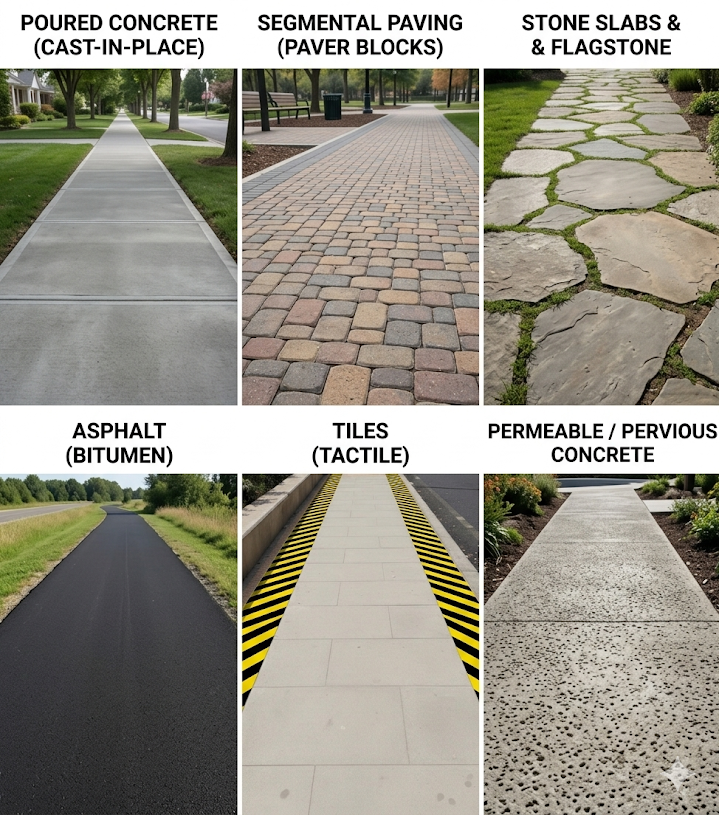
Below are a few examples of different materials with which a sidewalk could be built
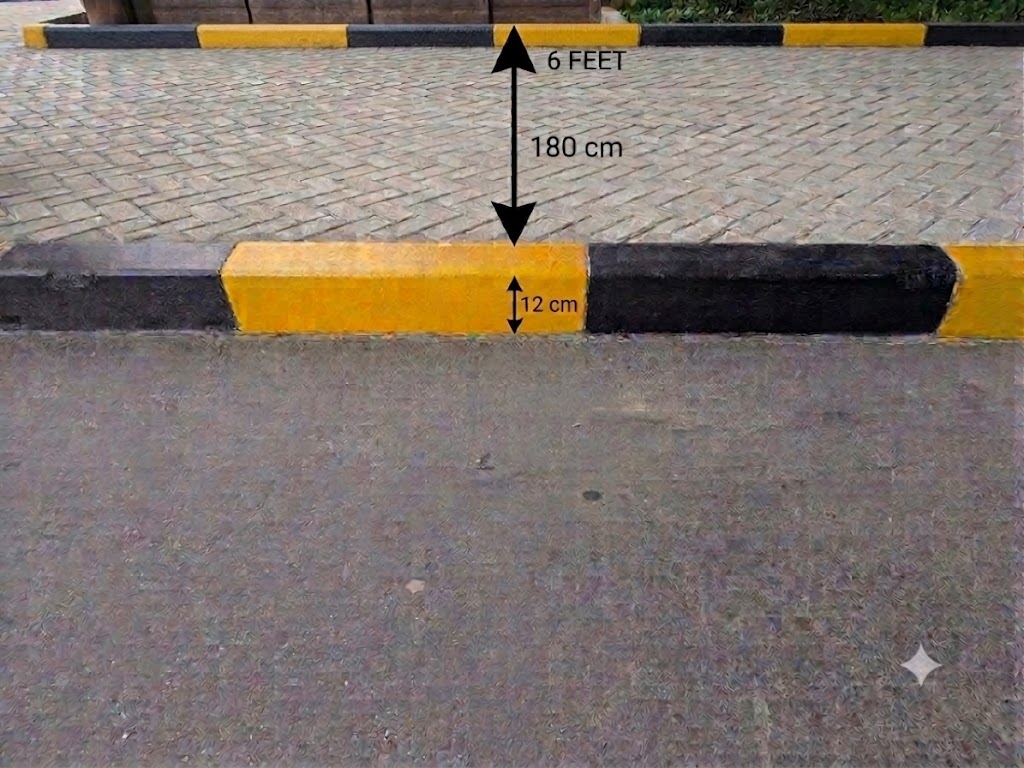
The above sidewalks are from my office complex. Found the height to be just ideal. Easy to step on. Measures 12cms in height. Third image is an AI generated depiction of sidewalk dimensions. 12cms of height. 6 feet of width that makes it easy for 2 people on wheelchair to move comfortably in either directions.
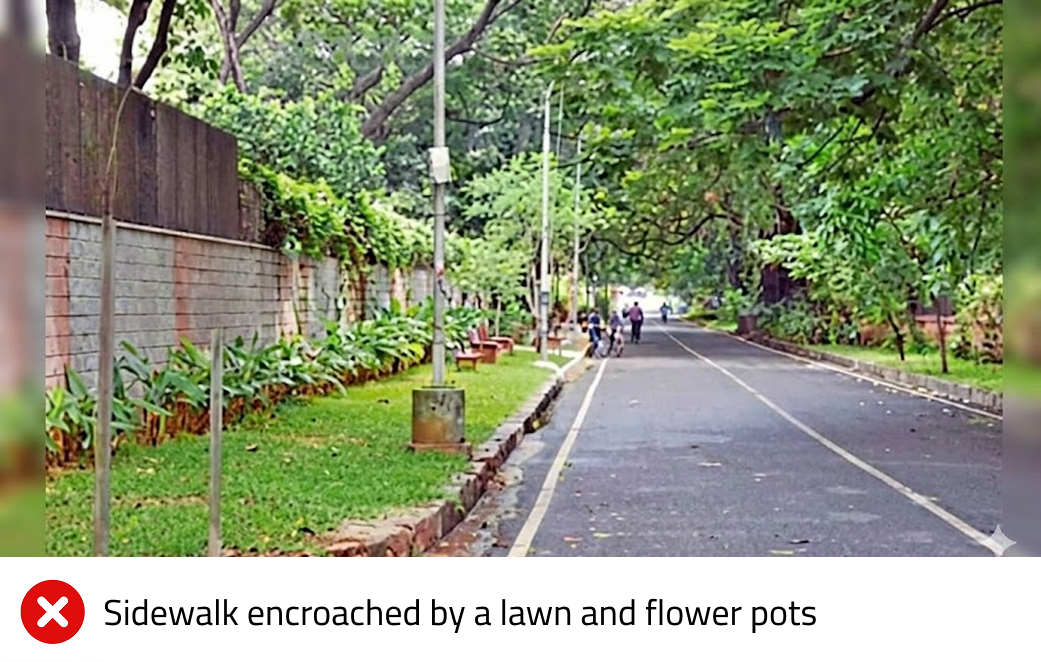
Encroachment by Private Gardens
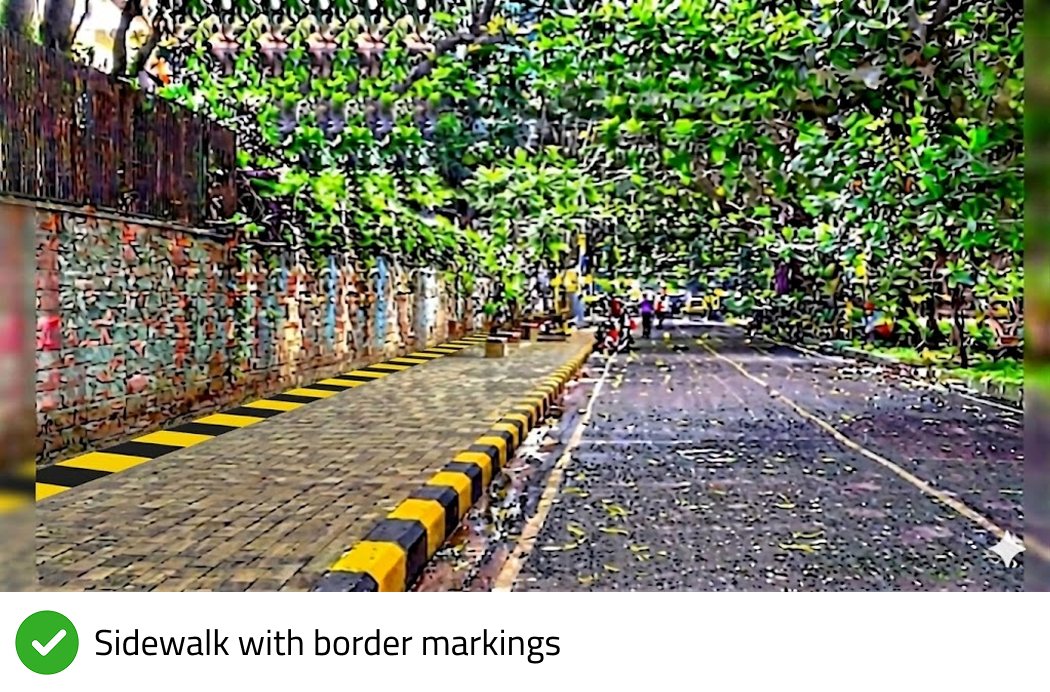
Below images show a sidewalk encroached by a lawn and flower pots and an AI generated illustration of the same sidewalk with clear border markings, so as to dissuade people from encroaching a pedestrian space.
Encroachment by Ramps & Stairs
Houses, shops and commercial establishments frequently raise their structures well above street level to prevent rain water from coming in, or for better visibility. While these structural choices are understandable, they do not give owners the right to carve private stairs or ramps directly into public space.
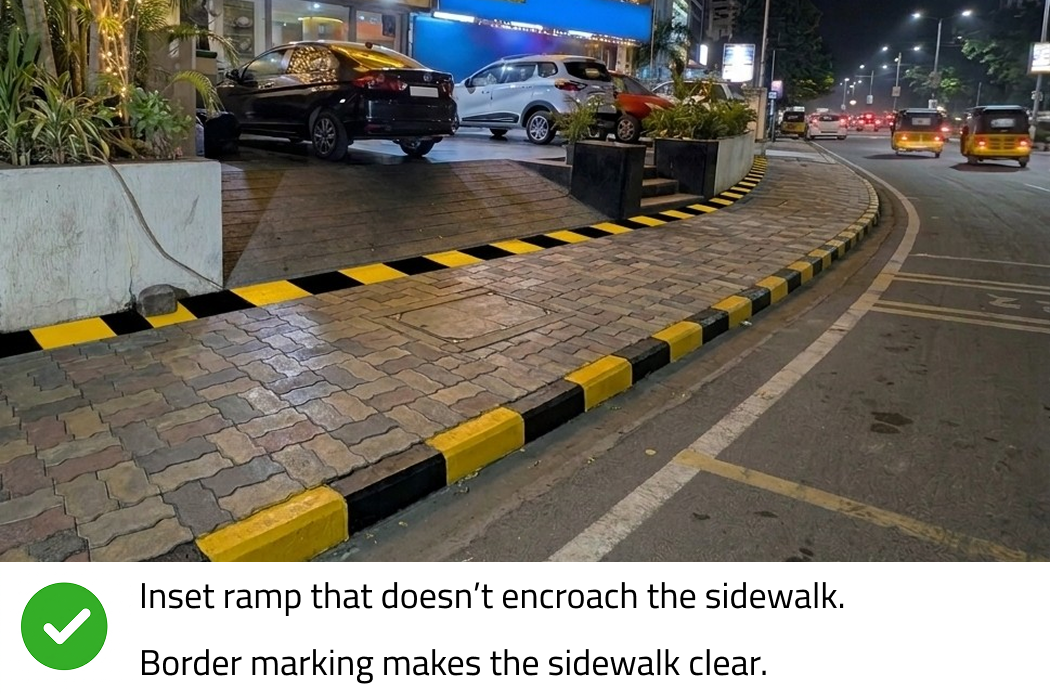
Instead, property owners should be educated and required to connect their buildings to the sidewalk using inset stairs or inset ramps built entirely within their own property lines. Any outset stairs or ramps that aggressively protrude into the public pavement/sidewalks must be legally classified as encroachments and penalized with appropriate fines. By pairing strict enforcement with high-visibility sidewalk border markings, we can create a powerful environmental nudge that prevents storefronts from spilling onto public pathways.
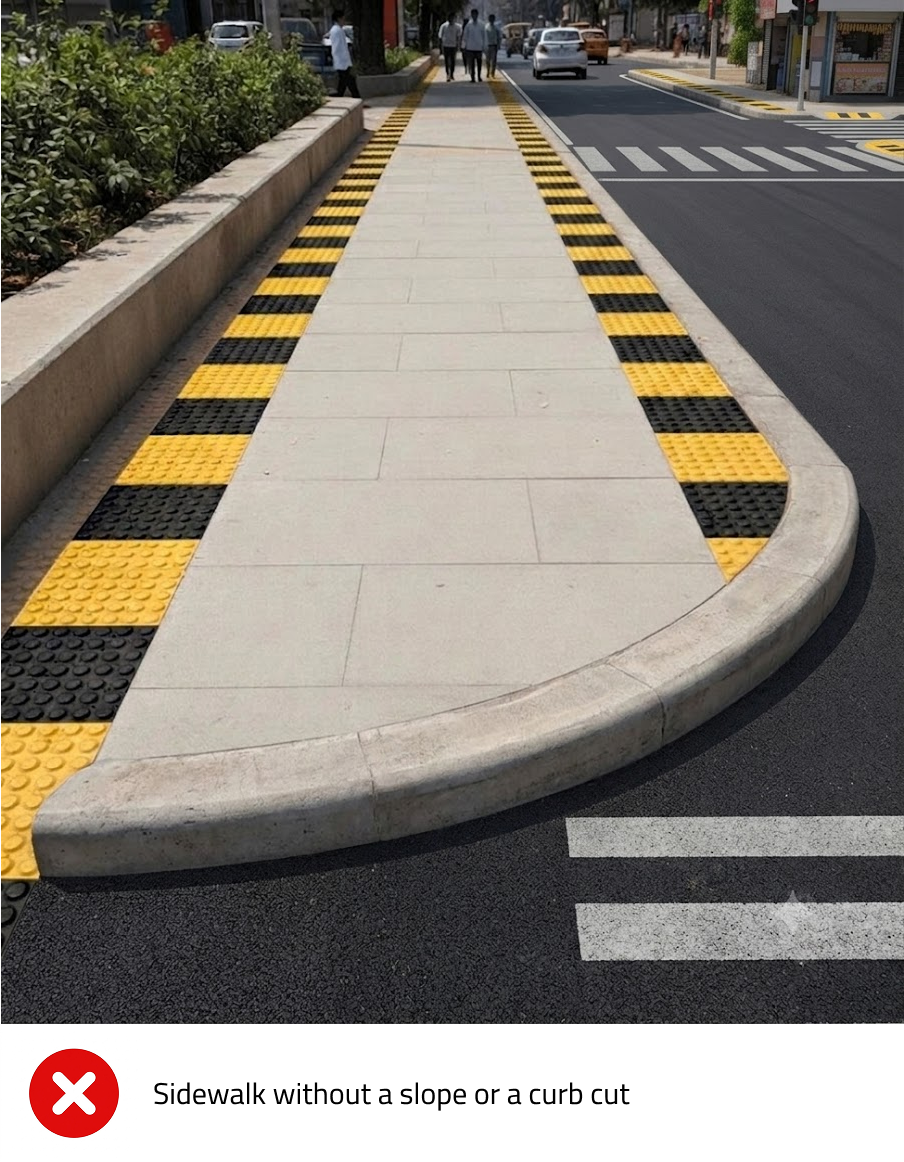
Sidewalks are infinitely easier to navigate when their entry and exit points are built as gradual ramps rather than abrupt vertical steps. In urban design, these are known as curb cuts—the small ramps graded down smoothly to meet the street level. This seemingly simple structural change makes traversing the city highly accessible for individuals with disabilities, but its benefits extend far wider.
In fact, the sweeping impact of this inclusive design is so profound that experts coined the term “The Curb Cut Effect.” The principle states that when you deliberately design for disabilities, you inherently make the experience better for everyone in the process. A curb cut built for a wheelchair user instantly becomes a massive convenience for a parent pushing a stroller, a senior citizen using a walker, or a traveler rolling a heavy suitcase.
To ensure these transitions are comfortable and safe, municipal bodies must adhere to standard ergonomic slope dimensions: 1:12 Slope
– Vertical Rise (Height): 12 cm – Required Horizontal Run (Length): 144 cms – Resulting Percentage Gradient: 8.33%
To maintain an entirely unobstructed walkway, we must be precise about how ramps are integrated into the streetscape:
From Property to Sidewalk (Inset Ramps): When connecting a raised home or commercial establishment to the sidewalk, the slope must be built as an inset ramp—carved inward into the property owner’s private plot line.
From Sidewalk to Road (Outset Ramps): Conversely, when connecting the sidewalk down to the road level at intersections or crosswalks, an outset ramp or standard curb cut should be used, grading gently downward to meet the asphalt.
By keeping private property access completely tucked away and public transitions smoothly integrated, the primary pedestrian zone remains entirely flat, free of physical obstructions, and safe from unexpected tripping hazards.
The Cross-Slope Logic: Flat for People, Sloped for Water
To make a sidewalk truly accessible and easy to walk on, the surface should feel perfectly flat. In an ideal world, we might design for exactly a 0 degree slope. However, the real-world enemy of flat sidewalks is standing rainwater. A mathematically 0 degree flat sidewalk will inevitably collect stagnant water puddles, leading to slippery moss growth and rapid structural decay.
To balance effortless walking with proper drainage, civil engineers use a cross-slope of 1% to 2% (shedding water gently sideways toward the storm drain or road). This microscopic slope keeps the sidewalk dry and safe during heavy downpours, while remaining practically imperceptible and flat to senior citizens, children, and wheelchair users.
Gate Hinge Placements
Should compound gates swing inward, outward, or simply slide? While public, crowded venues like cinema halls are legally required by emergency egress and safety codes to have doors that push outward for rapid evacuation, private properties must follow a different logic to respect the streetscape.
To preserve a completely obstruction-free sidewalk, urban guidelines should mandate specific residential gate designs:
Interior Hinge Placement: Mounting gate hinges strictly on the inner face of the compound wall pillar naturally forces the gate to swing inward into the property, physically preventing it from swinging out and striking a passing pedestrian.
Sliding Gates: Alternatively, properties can install sliding gates that move laterally along the inside of the compound wall.
Both methods ensure that the gate consumes zero public square footage when opening, keeping the sidewalk entirely clear and safe for foot traffic.
Building Sidewalks that are Good Enough, Long Lasting & Easy to Maintain
Of course, a psychological nudge only works if the underlying infrastructure is robust. In a thriving, rapidly evolving urban landscape, sidewalks face a brutal reality: they are constantly being dug up. Between electricity boards, telecom providers, water lines, and sewage repairs, standard monolithic materials like poured concrete or asphalt are highly inefficient. Patching them up after excavation leads to uneven surfaces, waterlogging, and unsafe tripping hazards. To survive this reality, and build a sidewalk that lasts long, serves its purpose, and is easy to maintain, urban planners must move away from monolithic materials and design a modular, multi-utility infrastructure based on Indian Roads Congress (IRC:103) guidelines.
I. The Surface: Heavy-Duty Pre-Cast Interlocking Paver Blocks
For the walking zone, the absolute best choice is high-strength, pre-cast concrete interlocking paver blocks (minimum 60mm to 80mm thickness with an M-30 to M-40 strength grade) laid over a compacted sand bed.
Why it works for constant digging: Paver blocks are completely modular. When a utility agency needs to repair a pipe or lay a fiber-optic cable, worker crews can physically un-interlock the blocks by hand, dig the trench, complete the work, compact the sand base, and re-lock the exact same blocks back into place. The sidewalk remains flawlessly even. There is zero need for noisy jackhammering, expensive concrete transit mixers, or curing time.
Why it works for busy streets: High-grade concrete pavers can handle severe abrasion and the occasional illegal weight of mounting two-wheelers without cracking.
Best Practice: Choose a shot-blasted or textured finish to ensure it remains slip-resistant during intense monsoon downpours.
2. The Smart Design: The Dedicated “Utility Trench & Zoning” System
Material alone cannot solve the problem if utility lines are buried haphazardly directly under the walking path. Indian sidewalks must adopt a strict Zoning System in line with Indian Roads Congress (IRC:103) guidelines. Instead of burying cables in the dirt, the sidewalk structure should be engineered into three distinct functional zones:
The Multi-Utility Zone: Should the poles, bins, transfers be kept on the inner most edge of the sidewalk or the outermost edge? Keeping them on outer most edge acts as barriers or bollards preventing vehicles from encroaching. However, there are more chances of encroachment from shops and people are more likely feel claustrophobic to walk in between a shop or wall on one side and and a transformer on the other side. Practical experiences shows where a sidewalk has been placed behind a transformer or bus stop is only encroached or filled with filth. What if all the surface level utilities like streetlight poles, tree basins, garbage bins, transformers…etc. are placed in the inner most edge.
The Sub-Surface Utility Duct: Instead of burying telecom and power cables directly under the central walking path, a continuous pre-cast concrete underground trench (utility duct) with removable concrete covers should run directly beneath the Multi-Utility Zone (the innermost edge of the sidewalk). All wires are fed through this chamber. Workers can service cables simply by lifting a panel on the edge of the walk, leaving the primary path entirely untouched. Digging up the sidewalk is not necessary.
The Pedestrian Zone (1.8 to 2.5 Meters Wide): The sacred core of the sidewalk. It is kept completely clear of any poles, trees, or structural deviations, allowing two people (or two wheelchairs) to pass each other comfortably.
3. Perimeter Defenses & Universal Access
To prevent sidewalks from becoming informal parking lots or extensions of storefronts, specific design features must be cast into the hardscape:
Optimal Kerb Height (150 mm): Per IRC standards, the kerb height must be kept exactly at 150 mm (6 inches) above the road level. Anything higher discourages senior citizens and pedestrians from scaling it (forcing them to walk on the dangerous road), while anything lower allows cars and auto-rickshaws to drive onto it easily.
Anti-Parking Bollards: Heavy-duty concrete or cast-iron bollards must be permanently anchored at all property entrances, ramps, and intersections with a clear gap of 1.2 meters between them. This gap is wide enough to let wheelchairs and strollers pass seamlessly but physically blocks two-wheelers and cars from driving up onto the pavement.
Continuous Level Property Ramps: Commercial street entrances often break sidewalks into a roller-coaster of mini-ramps for private parking access. The sidewalk must maintain a flat, uninterrupted elevation. If a vehicle needs to cross the sidewalk to enter a building, the road should ramp up to the sidewalk level at the edge, forcing the vehicle to slow down and preserving a continuous surface for the pedestrian.
4. The On-Street Parking Buffer—and Curbing Commercial Abuse
We have to acknowledge why two-wheelers mount the sidewalk in the first place: shoppers have nowhere else to put them, and our roads are intensely congested. If we don’t design a dedicated space for stationary vehicles, they will inevitably colonize the pedestrian zone.
To solve this, urban planners should explicitly paint and mark the outermost lane of the asphalt road as a dedicated parking lane. By shifting parked vehicles off the curb and onto a designated strip of the road itself, we create a natural, heavy physical buffer between moving traffic and the sidewalk.
However, in any system design, we must anticipate and prevent bad actors from exploiting public convenience. In a typical Indian urban ecosystem, ad-hoc public parking spaces are frequently hijacked by predatory commercial entities:
The Showroom Overflow: Automobile showrooms and two-wheeler service centers routinely use public sidewalks and roads as their extended inventory lots, parking dozens of customer vehicles outside and entirely choking the street for genuine neighborhood visitors.
The Valet Encroachment: Restaurants and luxury establishments launch valet services, effectively hijacking entire public residential streets for private parking. While neighborhood residents are completely understanding of a guest parking in front of a home for a short duration, the permanent commercial annexation of common public roads by restaurants is unethical and disruptive.
Therefore, designated street parking must strictly remain a public utility—never a free operational loophole for private businesses.
Summary of the Sidewalk Architecture:
Surface Material: Modular, high-strength pre-cast concrete interlocking paver blocks over a compacted sand base.
Sub-surface Architecture: Pre-cast concrete utility ducts situated under the inner edge to prevent road cutting.
Boundary Protection: 150mm high granite kerb stones paired with 1.2m spaced structural bollards at access points to negate vehicular encroachment.
This systemic approach turns a simple walkway into a resilient piece of urban infrastructure that accommodates the inevitable chaotic maintenance demands of a thriving city.
Moving from Concept to Reality: The Lean MVP Strategy
Reading essays by Paul Graham, I understand that it is nearly impossible to predict the absolute success of an idea upfront. The most effective approach is to launch a Minimum Viable Product (Do Things That Don’t Scale,) let the real users use it, observe their interactions, gather feedback and keep iterating to achieve the perfect fit.
As a resident of Tamil Nadu, I would like to humbly share a few suggestions with our state government and municipal corporations. Before committing public funds to mass-scale infrastructure, the government and its municipal corporations shall treat sidewalk design as a live, behavioral experiment. We cannot write the rulebook until we test it in the wild.
Phase 1: The University Prototyping Grounds
The government can partner with the civil engineering, architecture and design departments of elite institutions such as Anna University, IIT Madras, NIT Trichy or the National Institute of Design, and fund experimental 500-meter sidewalk loops of various designs, both inside their campuses and on adjacent public roads.
These institutes can independently design, build, and test various combinations of real-world features:
Materials: Comparing modular paver blocks, poured cement, and natural stone.
Dimensions: Testing heights (road-level, 12 cm, and 1 foot) alongside widths (6 feet for residential areas, 8 to 12 feet for busy commercial zones).
Visual Prompts: Testing different edge markings like high-visibility paint, colored tiles, and embedded textures.
Edge-Case Engineering: Developing adaptive blueprints for complex urban realities. For example:
Around Mature Trees: Designing floating wooden boardwalks or porous rubber-concrete rings around tree basins. This preserves the historical green canopy while preventing thick tree roots from bursting through and fracturing the flat pedestrian surface.
Over Open or Covered Storm-Water Drains: Designing modular, heavy-duty pre-cast concrete structural slabs that double as both the drain lid and the primary sidewalk foundation, fitted with easily liftable silt-trap panels for rapid flood-monsoon maintenance.
Around Bus Transit Shelters (The Split-Stream Design): Traditional bus shelters are often dropped directly into the center of footpaths, creating massive bottlenecks and forcing walkers onto the asphalt. The university prototype should design a “Split-Stream” layout:
The Waiting Zone: The physical bus shelter, seating, and passenger waiting area must be pushed to the outermost edge (nearest to the road), integrating seamlessly with the on-street parking or boarding buffer.
The Unobstructed Walking Zone: The sacred, flat pedestrian path must channel cleanly behind the bus shelter structure. By keeping the walking stream completely separated from the stationary waiting stream, we eliminate commuter foot-traffic friction, ensure continuous accessibility, and eliminate the dead, dark corners behind transit shelters that typically accumulate filth.
By tracking student and public pedestrian usage data, mapping material erosion, and noting which designs naturally nudge pedestrians to use sidewalks, deter encroachers, and can last long enough, these research teams can discover which design of the sidewalk actually works.
Phase 2: The Bill of Materials (BOM) Template
Crucially, this university-led MVP will produce a highly practical, open-source engineering blueprint for public works departments. Rather than vague guidelines, the template will provide precise, granular material breakdowns.
Standardized Estimation Example (Per 100 Meters of a 6-Foot Sidewalk):
Excavation & Base: Exact depth of earth to be dug and volume of gravel/sand base required.
Materials: Exact metric tonnage of cement, sand, and high-strength pavers needed.
Perimeter Guard: Exact square footage of high-visibility edge paint or colored tiles.
Bollards: Exact count, optimal material (steel vs. reinforced concrete), and exact weight specifications per unit.
By compiling these granular, standardized metrics, municipal agencies can instantly calculate the precise cost of laying every 100 meters of sidewalk, eliminating bureaucratic guesswork and streamlining transparent public tendering.
Phase 3: The Lighthouse Road Strategy (One Major Road Per Year)
Once the university prototype yields a standardized blueprint, the municipal corporation should resist the temptation to execute a rushed, city-wide rollout. Instead, the strategy must scale gradually by transforming one flagship corridor into a “Lighthouse Road” every year.
In Chennai, the city could target a definitive stretch of Anna Salai; in Bengaluru, it could be a pristine section of MG Road. The mandate for this chosen corridor would be uncompromising: redevelop it entirely to global standards. It must feature flawlessly level modular pavers, integrated sub-surface utility ducts, high-visibility pedestrian border markings, and legally designated on-street parking lanes.
Just as ward councillors can commit to delivering one neighborhood Walking Quadrangle per quarter (as detailed in the upcoming ‘Walking Quadrangle’ section), city corporations must commit to delivering one world-class Lighthouse Road per year. Experiencing a perfectly executed, continuous walkway in the heart of the city changes public expectations overnight. It gives citizens a tangible benchmark of what their streets should look like, building the immense civic and political will required to systematically upgrade the rest of the urban landscape.
Therblig & Codification: Why the regulators should create and publish definitive standards?
Once the university prototyping phase delivers data-backed clarity on the optimal design, the regulators must codify these findings into a clear, open-source public manual. When the government and affiliated regulators create and publish standards to build sidewalks, it removes the confusion and different ways in which these sidewalks are built.
In the study of ergonomics and motion economy, Therbligsrepresent the fundamental, elemental motions required for a human to complete a task. In software, we eliminate unnecessary clicks to optimize a user’s flow; in urban design, regulators must use the verified prototype data to eliminate unnecessary physical friction—or “negative Therbligs” like tripping hazards, unexpected slopes, and sudden drop-offs—for the everyday walker.
Publishing these clear standards does something magical: it channels private, organic capital into uniform public infrastructure. Walk down any commercial street and you will see business owners who willingly spend their own money to pave the mud patch in front of their properties—some out of pure civic altruism, others to give their storefront a premium look.
Because there is currently no official playbook, everyone—including different government agencies and private property owners—builds in their own haphazard way, creating a chaotic patchwork of varying tile textures, mismatched heights, and uneven steps.
WITHOUT STANDARDS (Chaotic Patchwork): [Shop A: 1-foot high granite] -> [Shop B: Mud patch] -> [Shop C: 6-inch concrete ramp]
WITH STANDARDS (Seamless Flow Based on MVP): [Shop A: 150mm Pavers] ———> [Shop B: 150mm Pavers] -> [Shop C: 150mm Pavers]
By providing a clear, open-source blueprint born from the university experiments, the government can effortlessly standardize the streetscape by leveraging the self-funded pride of local property owners. When Shop A paves their front today, and neighboring Shop B does the same next month, their footpaths will seamlessly merge at a fixed height and width.
To guarantee this frictionless flow, the final published standard manual must mandate precise rules for common structural intersections:
The Inset Rule for Buildings: Any curb or driveway ramp connecting a private building to the sidewalk must be designed as an inset ramp (carved inward into the property line), keeping the walking path entirely flat.
The Outset Rule for Roads: Any pedestrian ramp connecting the sidewalk down to the road level must be designed as an outset ramp or a standard curb cut, ensuring a smooth transition into crosswalks.
By formalizing these layouts based on proven prototype data, we remove all confusion, keep the sidewalk perfectly even and clear, and make movement easier for pedestrians, without the risk of tripping due to the obstacle created by the curb ramps.
Addendum 🙂
The Walking Quadrangle
Not everyone in our cities lives near a public park or playground, which are disproportionately concentrated in more affluent localities. To democratize access to public health, we must design a localized “Walking Quadrangle” right where people live.
The health math behind this is simple yet profound: a daily routine of 10 brisk walking rounds on a standard quadrangle circuit is approximately 5.6 km. Consistently repeated five days a week, this simple protocol drastically improves cardiovascular health, manages blood pressure, and boosts endurance. We need to make walking an accessible, highly visible civic priority.
Consider this practical blueprint for our local governance: If a single ward councillor commits to upgrading just one continuous Proximity Walking Quadrangle per quarter, by clearing all the encroachments, street parked cars, shifting existing ironing shops to the other side of the street, removing extended ramps, and paving a wide enough walking quadrangle, then the long-term impact is staggering. By the end of a single five-year term, that councillor will have delivered twenty fully cleared, continuous, and cleanly paved walking loops. This completely transforms the micro-mobility and physical health of an entire ward without breaking the municipal budget all at once. Best of all, it gives local representatives a highly visible, trackable achievement to showcase to voters every three months.
Addendum – Jul 2026:
A report by The Economic Times, titled “Crunch Time for Lifestyle Diseases as Govt Plans Fitness Push,” highlights a staggering crisis: nearly half of India’s population now suffers from non-communicable lifestyle diseases (NCDs) like diabetes, hypertension, and cardiovascular disorders. In response, NITI Aayog is actively drafting a national blueprint to incentivize active lifestyles, looking closely at international infrastructure models like the Netherlands’ integrated cycling networks.
However, scaling massive new cycling grids across dense, historically organic Indian cities requires massive capital and decades of structural overhaul. The Proximity Walking Quadrangle solves the exact same public health crisis with three distinct advantages:
Zero-Cost Infrastructure Real Estate: It doesn’t require acquiring new land; it simply reclaims and optimizes the public spatial footprints we already own.
Immediate Preventive ROI: As noted in the medical data, the simple protocol of walking 5.6 km a day directly combats metabolic disorders. By building safe walking loops right at the doorstep, we lower the friction to exercise, triggering the precise behavioral “nudge” NITI Aayog is trying to enforce nationally.
Hyper-Local Accessibility: Unlike centralized public parks that require vehicular travel, the quadrangle democratizes active infrastructure, ensuring that preventive healthcare is accessible to every citizen, regardless of their neighborhood’s economic profile.
By upgrading our everyday street margins into predictable fitness loops, local ward governance can deliver the fastest, lowest-cost execution of the country’s national fitness mandate.
The Residential Wellness Circuit
This philosophy of prioritizing daily utility over marketing fluff is a framework that private real estate desperately needs to adopt. In many Indian gated communities, premium amenities like swimming pools have turned into mere marketing tools; studies show a vast majority of homeowners rarely use them, yet societies pour massive maintenance funds into keeping them functional. Instead of chasing a superficial “100+ amenities” checklist that only looks good on a sales brochure, forward-thinking builders should channel those resources into a beautifully paved, 6-foot-wide, entirely unobstructed walking track along the inner perimeter of the housing society. This track should be lined with hardy, shade-bearing trees that can survive long-term with basic watering, replacing high-maintenance, namesake gardens. Designing for actual human habits rather than namesake luxury transforms a residential complex into a functional wellness asset.
Can a vehicle like this dissuade encroachment?
Below is a depiction of an encroachment clearance vehicle that is mounted with a camera to capture on spot evidence, generate fine and immediately remove sidewalk encroachments like shop name boards placed onto the sidewalks. The government can work with organisations like eGov foundation to create a software product that can capture evidence of encroachment using the camera (like how Google does for streetview,) add time, date and location details, generate immediate fine slips, collect payments or mark pending payments for spot fine and track repeat offenders…etc. The fine slip should have a QR code which will redirect the offenders to a page detailing the sidewalk standards or guidelines and how to build or maintain an ideal sidewalk, free of any kinds of encroachments. The software should also have options to accept evidence of encroachment from the public. Ex. the public, when they see and encroachment, should be able to capture an image on their phone and easily share it to a designated number maintained by the corporation, just through an RCS-SMS or WhatsApp message, along with details like the location, date and time.
Sample image of an Encroachment Clearance Vehicle, generated using Gemini.
Can a sticker dissuade street parking?
This might sound slightly harsh. Still expressing my thoughts. A spillover effect of corruption in real estate and the inflated real estate prices is home owners building house without parking space. An extra room brings them extra rent to justify the inflated price of purchase. This leads to street/roads being constantly encroached with cars parked in the night. What if municipal authorities take up night patrol and put an yellow sticker on the front windshield of the streetside parked cars, with a QR code that advises the car owners to pay some monthly parking charges? The software mentioned in the previous paragraph, to track encroachment can be used to track these too. Any streetside parked car that hasn’t paid up should be randomly towed. This can gradually make people park cars within their house premises in the night, rather than on roads.
Civic Social Nudge
Despite robust physical infrastructure, there will always be a fraction of reckless motorists who choose to ride on sidewalks, actively endangering pedestrians. To counter this, municipal corporations can deploy targeted digital accountability campaigns backed by automated enforcement. By identifying high-violation hotspots and installing dedicated surveillance cameras, the city can seamlessly cross-reference captured license plates with the central Vahan portal. Crucially, the evidence from these cameras can be used to instantly fetch vehicle data and issue automatic fine slips (e-challans) directly to the violators. To amplify this deterrent, the city can also clip and publish these traffic violations on official social media handles—or as civic awareness reels before movie screenings in local cinema halls—overlaying the owner’s masked name, violation date, and exact location directly onto the video. Combining automatic financial penalties with visible public accountability introduces a powerful psychological deterrent, leveraging both the law and social pressure to reclaim the sanctity of our walking spaces.
The Socio-Political Friction Points
Beyond structural engineering, reclaiming our sidewalks requires navigating deeply entrenched socio-political habits. Two massive challenges stand out:
1. The Flex Banner Hegemony How might we tackle the endless rows of political advertisements, commercial notices, and birthday or marriage wishes printed on PVC flex banners that routinely hijack our walkways? While a blanket government ban on flex banners is an obvious legislative step, true change requires a cultural shift. Can political and social organizations take a collective self-pledge to banish public road displays during rallies and events? Moving these announcements to digital spaces preserves the sidewalk for its intended user: the citizen.
2. The Legacy of the “Mud-Patch” Habit To understand our current sidewalk crisis, we must look at how our roads evolved. Decades ago, when the government built the first single or double-lane roads, a vast, unpaved mud patch was left on either side of the asphalt. Landowners naturally built their commercial establishments right up to their property lines, and their customers used that vacant public mud patch as a convenient parking lot.
Today, as traffic has exploded and those roads have expanded into dense four-lane or six-lane corridors, that public mud patch has been converted into the modern asphalt road and pedestrian sidewalk. Yet, the old habit remains. Commercial establishments still expect the immediate public road and pavement to serve as their private, ad-hoc parking zone, paralyzing micro-mobility.
How might we nudge commercial establishments to design their buildings so they stop encroaching on public paths?
The Setback Incentive: Municipalities can introduce architectural zoning rules that offer property tax rebates or minor floor-area incentives to commercial buildings that voluntarily build a set-back “parking pocket” inside their property lines.
Physical and Legal Nudges: We must use uncompromising street infrastructure—like high-quality bollards and automated towing zones—to signal that the road and sidewalk are strictly transit corridors, forcing developers to solve their customers’ parking needs internally through smart design.
3. Integrating Local Livelihoods How might we address informal street micro-economies, like the traditional ironing carts (istri boxes) that occupy sidewalk spaces. Instead of aggressively displacing these workers and harming their livelihoods, we can use an institutional nudge. Municipalities can incentivize Resident Welfare Associations (RWAs) to integrate a dedicated, micro-paved kiosk for an ironing vendor within their apartment or colony compound lines. By moving the service just a few feet inward, we completely clear the public pavement while ensuring the neighborhood retains its vital daily services.
Addendum – Sep 2026:
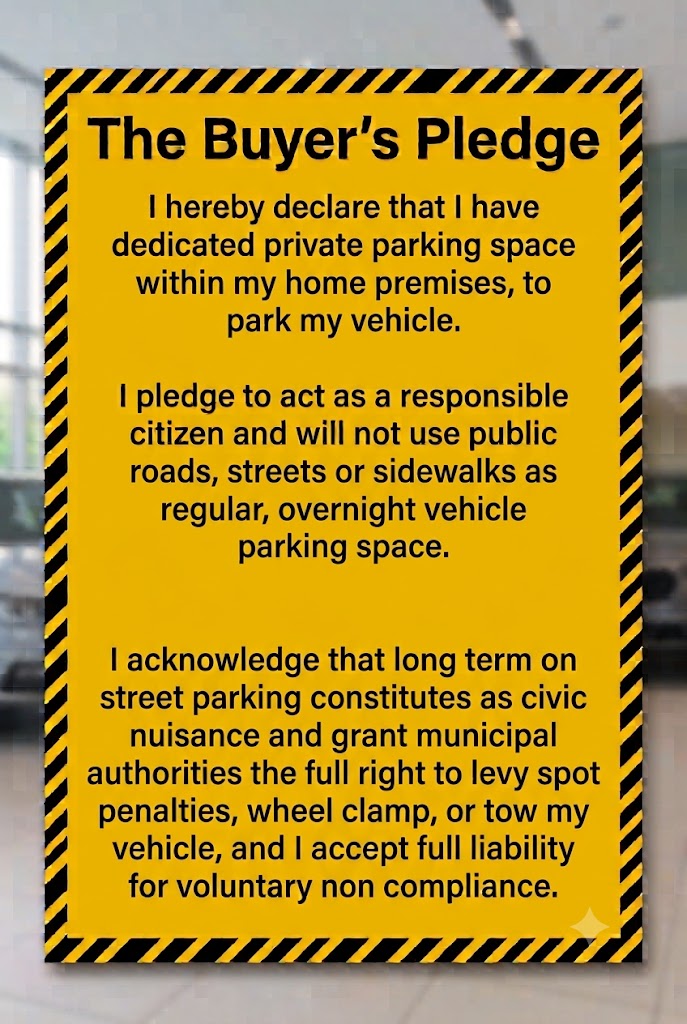
Why not use behavioral economics and nudge the vehicle buyers directly at the showroom? When a buyer books a car or bike, dealership executives already collect extensive paperwork for Regional Transport Office (RTO) registration. That registration dossier should also mandate a signed statutory declaration called as “The Buyer’s Pledge.” The same could also be printed on PVC Foam and pasted in the reception area of the car and bike showrooms.
Just as indicative markings alter the visual context of the sidewalk, a formal pledge alters the psychological context of vehicle ownership, establishing clear civic accountability before the keys are handed over.
Addendum – Oct 2026:
This might be a ruthless thought, but let’s be honest: we cannot complain about a problem while actively funding it.
We often vent our frustration about unusable, encroached sidewalks, only to pull over on our way home to buy snacks, groceries, or tea from the very vendors blocking the path. In doing so, we become part of the problem we complain about. In behavioral terms, our purchase is an incentive, a feedback loop that rewards the encroachment of public space.
If we want change, we have to examine our own habits. What if we resolve to not encourage vendors who operate on encroached sidewalks? A user friendly city isn’t just built by municipal engineers; it’s sustained by the daily choices of its citizens.
Addendum – Nov 2026: When Public Shores Are Guarded Like Private Property
The mindset of privatizing public pathways isn’t limited to city streets—it reaches our coastlines too. Numerous public complaints and discussions online highlight a recurring pattern where beachside resorts station security guards at their beach-facing gates, whistling at and turning away regular walkers under the claim that the adjacent stretch of sand is a “private beach” reserved strictly for their guests. In reality, private ownership ends at the compound wall; under India’s Coastal Regulation Zone (CRZ) rules and public trust principles, the shoreline and open sands leading to the water belong to the nation and must remain accessible to the public. Just like residents subtly claiming sidewalks with potted plants or concrete ramps, using guards to police open beaches is simply another form of encroachment—relying on intimidation to silently claim shared public space as private territory.
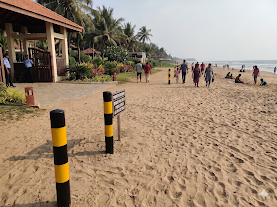
What if the government nudges this? Just like painting borders on sidewalks, the government can nudge beachside property owners to install standardized black-and-yellow bollards right along their patta land boundary. This simple visual cue draws an unmistakable line—showing where private property ends and public beach begins, replacing intimidation with clarity.
Illustration: A simple visual nudge on the coast: placing high-visibility bollards right at the private property edge eliminates ambiguity and protects public access to the sands. (Image generated with the help of Gemini)
The Impact 🙂
Many of us have dreamt of living in a place like Singapore just to experience the sheer ease of its clean, predictable, and beautiful streetscapes. But we don’t need to emigrate to experience that reality; we can build it right here.
Designing sidewalks with a pedestrian-first mindset does something far deeper than just paving a path—it directly unlocks our public health and mental peace of mind:
Activating a Natural “Blue Zone” for Health: One of the defining characteristics of global “Blue Zones”—regions where people consistently live healthy lives past the age of 100—is built-in natural movement. Longevity is cultivated when an environment naturally invites you to move. When a city provides safe, continuous, and shaded sidewalks, walking a kilometer to the local market, school, or office stops being a hazardous chore and becomes a default, healthy habit that adds years to our lives.
Restoring Peace of Mind through the Last Mile: The primary reason citizens abandon public transport isn’t the train or bus ride itself—it is the exhausting mental friction of the “last mile.” If the walk from home to the metro station is a chaotic obstacle course of broken pavers, open drains, and speeding bikes, our daily peace of mind is shattered. Flawless, walkable sidewalks seamlessly bridge this gap, restoring calm to our daily commutes and unlocking the true potential of public transit.
Defining clear standards, enforcing strict structural uniformity, and using environmental nudges to prevent encroachment ultimately transforms the cultural and behavioral fabric of our public spaces.
When our walkways become seamless and unobstructed, our streets will naturally mirror the dignified, world-class landscapes of developed nations. Reclaiming the sidewalk isn’t just a minor civic upgrade; it is how we elevate Indian cities to command global respect and offer our citizens the standard of living they truly deserve.
Thank you for reading 🙂 What is the biggest obstacle or design flaw that prevents you from using the sidewalks in your neighborhood? What structural or visual changes would make them truly user-friendly for you? Please share your experiences and thoughts in the comments section below.
During the 2010 rainy season, a 3 feet portion of my house compound wall broke. (The wall was built using stone blocks, red sand and plastered on top with cement, in 1970 period i.e. approx. 40 years back, by my grandfather.) We hired a local mason and requested to rebuild the damaged portion, in the same way, reusing the stone blocks so that it looks even with the rest of the wall. The mason, along with a helper, took 4 days to place the uneven stone blocks, fill the gaps in between carefully, with smaller sized stones and plaster it. In another 2 years, an even larger portion of the compound wall too fell during the rainy season. The wall was about 40 ft in length. Once again, called the same mason and requested him to rebuild the damaged wall using the fallen down stone blocks. He said, it would take weeks to rebuild with same stone blocks and labourers with him are all aged people who cannot carry such big stones. He said, demolishing the entire wall quickly using a JCB and rebuilding using hallow block bricks would only take 2-3 days, cost much less and look even across. We agreed and rebuilt the entire eastern side of our house compound wall using hallow block bricks.
The Broken WallThe DebrisThe Rebuilt Wall
12 years later, i.e. in 2022-2023, I read an article on the internet, explaining modern scientific management and referring to Frank Bunker Gilbreth’s Bricklaying Ergonomics. I was quickly able recollect what our mason said while we were rebuilding the damaged wall and corelate this with how evenly sized and lesser weight hallow block bricks helped build the wall quicker, without compromising the purpose of the compound wall.
A few months later in 2023, when I had to shift my house, one of the many aspects, I had to decide the house, was based on the furniture we had with us and one of the decision point was the size of bedroom, kitchen & living room. Every house we saw had different room dimensions, making it difficult to make a decision faster. Post shifting to the new house, we had another difficulty. The window curtains and velcro based mosquito nets we had used in the previous house was not fitting here. I was then recollecting Gilbreth’s Bricklaying Ergonomicsand a thought striked!
How Might We Create Standards in Home Construction?
What if the government mandates the real estate builders and regulators like RERA to came up with standard room dimensions, for homes sold to the middle class and below? (the rich can design & build bespoke homes) Something similar to T-shirt sizes. For example,
S-Small (Kids Bedroom) – 10’ x 10’
M-Medium/Regular – 12’ x 14’
L-Large (Master Bedroom) – 14’ x 16’
Wardrobes could be mass produced, keeping in mind the room dimensions, which in turn could be cost effective and easy for the buyer to decide, while buying a house.
What if builders and carpenters came up with standard door dimensions? Doors with defined standard dimensions can be mass produced and hence will be cost effective. When a need arises to replace, we can just tell the door size and buy one, which can also be fixed much quicker than custom made ones. For example,
S-Small (Bathroom door)
M-Medium/Regular (Bedroom door)
L-Large (Main entrance door)
What if builders and carpenters came up with standard window dimensions? Same like doors, windows with defined standard dimensions could be mass produced.
There can be various combinations of room dimensions, based on where the room door faces, where the windows are, where the wardrobes are and to which side the bathroom is built. However, based on experience a standard room will fit a wardrobe for 2 people, a king sized bed with space for side tables on either side, some space for a study table and some space to walk around.
The size of bedroom and kitchen could be standardised and the size of living room could be adjusted as per the left over available space.
If I were to build an apartment complex for the middle class, how would I design?
I ll build a 3 bedroom+study+kitchen+living room(hall)+utility+foyer. Why 1 bedroom for the couple, 1 for the children and can be used as guest bedroom. A utility area would accomodate the washing machine and drying. A foyer means, we need not leave our shoes on the common verandah of the apartment or inside the living room.
Walking track along the inner perimeter of the housing complex, that is wide enough approx. 6 feet so that 2 people can walk side by side. This is much better than 100+ namesake amenities that are advertised just for the sake of marketing.
Social balcony at each floor so that residents can mingle and socialise with neighbours, in the morning, evening or at leisure,
Having a study room, with a proper study table and chair lets us focus, concentrate and ultimately improves learner outcome. What if every house is built with a study room?
Having guests at home and socialising, improves ones happiness. What if every house has a guest room?
The stairs can be 5 ft wide enough, with 30 degree inclination so that it makes the climb not strenous and 3 ft sidewall that gives enough safety for children as well as elders.
If I were to build a studio apartments for the lower income people, how would I design?
Foyer___
Utility___
Study___
I would use simple and easy to maintain objects.
I have observed that, in villages, lands are sold with price per acre, whereas in cities lands are sold with price per sqft or price per ground (40ft*60ft=2400sqft.) What if all housing plots formed as 40*60ft sizes so that it is even and construction can be planned accordingly.
“The most important, and indeed the truly unique, contribution of management in the 20th century was the fifty-fold increase in the productivity of the manual worker in manufacturing.”—Peter Drucker
P.S: Another example I could think of is my Diwali dress stitching. When I was young, it was a tradition to stitch a new dress for Diwali. Like us almost a maximum percentage of people stitched new dresses during Diwali. we had to buy the cloth a month in advance, visit the tailor shop, take measurements and then wait for weeks to get the newly stitched dress, to be worn on Diwali. Fast forwarding, I have never stitched a dress for more than a decade and buy readymade ones, which comes marked with sizes like S, M, L, XL, XXL…etc for T-shirts and shirt sizes like 36, 38, 40…etc, specific to India. I visited a garment factory in Tirupur, from where lots of garments are bulk manufactured and exported to many countries and saw how cloths in hundreds are laser cut and sent to tailoring sections, which speeds up the mass production process.
Here are a few more real-world examples across different domains that illustrate the power and advantages of standards:
Intermodal Shipping Containers (The 20ft / 40ft TEU): Before the 1950s, cargo was loaded and unloaded barrel by barrel, crate by crate, taking days per ship. Standardizing container dimensions revolutionized global trade. Cranes, railcars, trucks, and ships worldwide are designed to the exact same twist-lock geometry, slashing transport costs and transit times by orders of magnitude.
Paper Sizes (ISO 216 / A4, A3): In the A-series system, folding an A4 sheet in half yields an A5; joining two creates an A3—all preserving the exact same aspect ratio (1:2). Printers, photocopiers, binders, filing cabinets, and envelopes are universally manufactured to these sizes, eliminating custom-cut stationery and mechanical jams.
Camera Tripod Mounts (1/4″-20 UNC Thread): Whether you purchase a high-end cinema camera, a mobile phone mount, or a budget tripod made decades ago, the base screw thread is almost universally a 1/4-inch standard. Photographers can swap heads, monopods, and accessories across brands effortlessly without adapters.
Automotive Tyres and Wheel Rims: You do not need to buy tyres manufactured by your car’s carmaker. Rim diameters (e.g., 15″, 16″, 17″) and bolt-pattern standards enable third-party tyre manufacturers to mass-produce tyres that guarantee safety, competitive pricing, and immediate availability during emergencies.
Light Bulb Bases (E27 / B22): Edison screw (E27) and bayonet cap (B22) sockets ensure that when an incandescent bulb burns out, you can replace it with a CFL or LED manufactured decades later by an entirely different company without rewiring the fixture.
Credit Card & ID Dimensions (ISO/IEC 7810 ID-1): Every ATM card, driver’s license, and transit pass adheres to identical dimensions (85.60 × 53.98 mm). Because of this, ATM slots, wallet sleeves, POS card readers, and turnstiles work reliably across the globe without custom engineering.
Today’s newspaper carried a full page advertisement on The Gen AI Hackathon. Also, glanced similar ads on X a few days back. The deadline is today. The problem statements are interesting to solve. Due to personal obligations, and time constraints I wasn’t able to plan and prepare detailed solutions. On this Gandhi Jayanthi holiday, spent time on this simple chatbot solution: Asa.
Done is better than Perfect. Publishing a solution to the below problem statement.
“Indian is the 7th largest country. Can you make it #1 for flight experience.”
I expanded on my earlier idea on Air Safety Awareness, by picking one use case with two personas:
Subbu & Eswari are retired couples visiting their son in New York, US. Their ticket from Chennai to New York via connecting flight at London, has been booked in advance by their son . How might the airlines guide them to fly at ease.
Recommending them to install an app might not work out as many travellers don’t want to install one more app. How might we utilize WhatsApp or RCS messages to help them fly at ease.
Since the problem statement was shared by Akasa, came up with the chatbot Asa. (name suggested by Gemini) Since the Akasa logo is called the “Rising A,” contemplated on some names like “The Guiding A,” “Fly at Ease,” “A-hostess” but settled with Asa, because when the chatbot interacts with the passengers on WhatsApp, “Hi, I’m Asa…” sounds easy. Referred to branding guidelines from AkasaAir: Sunrise Orange: FF6300 & Passionate Purple: 5C0FD9. Gemini suggested that the font used in the logo might be a custom one. “AS Circular” or custom “Poppins.”
*n.b: Referring to the name Akasa and its branding guidelines, as the problem statement I picked has been shared by Akasa. No intention to infringe on Akasa’s brand identity in any way.
Let’s delve into Asa‘s role:
The airline collects the mobile no. of passengers, while booking the ticket.
Asa sends the first Hello to Subbu & Eswari, immediately after the ticket is booked.
Asa migh have created a WhatsApp group between Subbu & Eswari and started the conversation. However, many people have the tendency to use the groups to forward casual messages, videos and photos and the actual guiding conversation from Asa might get lost in between other unimportant forwards. So, Asa will stick to messaging individuals 🙂
Asa sends a reminder 2 weeks before the flight.
Asa sends a reminder 1 day before the flight.
Asa sends guiding instructions on the day of departure.
*Chat window, designed using Figma
The users updates a list of items or photo of items in the bag and checks if anything is prohibited.
The user shares the dimension of the carry on luggage and checks if it will fit in the storage cabin.
Asa lets users to enter the language of choice and send voice based responses.
Why this matters to the airlines? An exceptional customer experience goes beyond service – it’s about trust, communication, and support at every step of the flyer journey. Being supportive and providing easy access to information can transform the flyer experience, build trust, increase loyalty, besides saving hours of wasted time.
Please click & expand for a wealth of resources & references
I had the privilege of being part of an internal GIG, which provides opportunities for employees to gain experience in different teams or business areas, outside of their day-to-day jobs, without moving role. I was hosted, part time by the UX team, to assist them in setting up a Center of Excellence (CoE) for Behavioural Design & Applied Psychology and, learn on the go. Thankful for the opportunity and thanks to Haydyn for hosting me and to my team members Miryam & Vaishnavi.
“Knowledge shared is knowledge squared.” Pleasure to journal my learnings here. This is the fifth post in the series “My Learning through GIG.”
I was reading the below news and was able to correlate to the check-in experiences my colleagues had shared. A few were first time travellers and a few seasoned travellers. Summarised the problems with a few personas below:
Meenu, an IT executive, who took her first international trip a few years back said, she was very anxious while preparing for her trip. She had reached out to her friend Kiru, who had experience of travelling to a few countries. Meenu had saved the below instructions shared on WhatsApp, by her friend:
********************
*Check-in*
Get into airport, find your airlines counter from signboard.
Get in to the respective queue (Business/Economy & Web check-in/Counter check-in.)
Drop the check-in bag. It will be weighed. Should be under weight of the limit. Collect your boarding pass. Make sure you collect back your passport after verification.
Collect the Immigration form. It will be distributed by your airline staff in front of the counter (mostly when you are entering in the counter or you might need to collect it in front of the immigration location.)
You will be pointed to the immigration area.
*Immigration*
Fill the immigration form. Its good to have a pen always with you.
Get into the immigration queue. One at a time in the immigration counter even if you are going as a family except kids who can join mom/dad.
You will be interviewed and photographed and will be the exit approval from India.
Note: Have your travel documents in a file or folder handy as you need to produce respective ones as they ask for verification. Sometimes your office ID card too.
Collect your passport & boarding pass back.
You will be pointed to security check counter.
*Security check*
Separate counters for each gender.
Get into appropriate counter. Take out the items to be scanned individually- laptop, tablet, phone, jacket, belt, watch, shoes & toiletry (depends on the airport). Basically no steel. Empty your pockets. You will be provided with trays to place these items. Place these trays and your bags on the running belt to scan and give your passport & boarding pass to the staff at this place.
Note: Your carry-on bags should not have any pointed materials like knife, scissor so on. No lighters. No water. No liquids more than 150ml of each.
Get into the scanner.
If you are beeped, then you will be inspected separately again.
Else, collect all you stuff. Re-pack and wear back your shoes and you are free now to find your gate.
*Getting to Gate*
Check your boarding pass to see gate number.
Watch out for sign board and walk to your respective gate.
Note: When you are in transit and taking connecting flight, periodically check the flight information board to confirm there is no flight time or gate change.
Once you reach your gate, confirm once with the screen over there that your destination and flight number is correct and you are at the right place to board.
Be here, max by 45 mins early to your flight timing. Eg: Flight time: 8.45AM, Boarding time: 8.15AM, You should be at gate: 8.00AM.
*Shopping*
If you have enough time for boarding, you can roam around or chill out or do some shopping.
If done, get back to your gate and rest until your boarding starts.
*Boarding*
Get into the boarding queue as per instructions provided by the airline staff over there.
Your boarding pass will be scanned and torn apart. You will carry your part of it.
Walk into the flight belt. Keep your pass in hand as there will be staffs to assist you and they will ask for it.
Note your seat number from the pass.
Step into the aircraft. Air hostess will greet you, acknowledge and get in. Sometimes they will ask your seat number to route you to the right pathway.
Find your seat and get settled. Drop your bag in the cabin.
Take things which you wanted with you like tablet, book to read or MP3 player or neck pillow…etc.
Put your gadgets in airplane mode or switch it off.
Now, you are set to fly.
********************
Leka, a leisure traveller who had flown abroad a few times, said she once took a Swiss keychain which had her house keys. The security officer who screened her bag adviced she can put that in her checked in baggage, as it is not allowed in the cabin luggage since the keychain had small knife, screwdriver…etc. But she was anxious to go and see if the baggage was still there in the check-in counter. So she just removed the keys alone and discarded the Swiss keychain at the security desk itself.
Mani, a first time air traveller, works for finance company, and was asked to attend a training in another city. The ticket was booked and shared by his office travel desk. The ticket had mentioned, baggage of 15 kgs allowed. Mani was not clear from the ticket if he can take a check-in baggage or is it only cabin baggage that is allowed? What is the ideal size of cabin baggage? Will they allow small trolley as cabin luggage…etc. He also made his family member wait at airport till he boarded the flight, just in case he needs some support. Mani said he didn’t have weighing scale at home and felt if there was a weighing scale outside the airport entrance, he can give back excess items to his family and avoid the hassle due to overweight baggage.
Muthu, a senior citizen was travelling to another city by flight for the first time. He was initially confused if he should carry a printed ticket or he can just show the ticket from mobile. Later, he also struggled to navigate the airport security procedures. His son was constantly guiding him on phone, till he boarded the plane and once again after he landed. What if there was voice based instructions on phone, travellers can listen to and navigate the airport security check without feeling stressed? The passenger was not clear on when and how to purchase from duty free. Can purchases from duty free be carried into cabin even if it is change of multiple flights? Can he purchase gold from a foreign country and what documents he needs and how much tax will be charged for that? The passenger had heard stories of lost luggage and panicked when his luggage was not in sight for long in the luggage belt.
Suggested Solutions
The above examples show that the travellers, who were predominantly first time travellers, didn’t have sufficient information or awareness on air travel safety.
While reading “The Design of Everyday Things” by Don Norman, I learnt how the author had analysed accidents and inferred whether kitchen stove or nuclear power plant, automobile or aircraft, thermostat or computer, the same problems were present. In all cases, design faults led to human error.
How Might We design effective interventions to nudge passengers adhere to safety?
What if the ticket clearly states or airline company designs effective advance nudges through phone messages/notifications, that would help travellers be aware of travel safety, prepare well in advance and which in turn can increase the passengers’ probability of adherence to safety?
What is allowed in hand baggage?
What is banned in hand baggage?
What is allowed in checked-in baggage?
What is banned in checked-in baggage?
What if regulatory agencies like The International Civil Aviation Organization (ICAO), country specific regulators like The Directorate General of Civil Aviation (DGCA), The Transportation Security Administration (TSA), The International Air Transport Association (IATA) and the airline companies designs and maintains a common webpage with detailed guides like the one above Meenu had received, which can then be shared as links or QR codes in the tickets/boarding pass?
What if the emailed tickets have 3 links/QR codes viz. ICAO safety guidelines, DGCA safety guidelines and Airline Company/Aircraft specific safety guidelines or to make it simpler for passengers, 1 common page with all safety guidelines?
What if airports have safety rules and relevant QR codes displayed at prominent places, that would nudge passengers and make it easier for them to follow the rules?
What if there is a common FAQ (Frequently Asked Questions) section for all air travellers, which they can search and look for specific answers, in case they are not sure of the process?
What if there is a repository of unruly passenger behaviours and what actions were taken or be taken in case of such behaviours, so that passengers are aware and behave politely?
What if the passengers are clearly aware of what to do and what not to do inside the aircraft?
What if the passengers have clear information on what to do in case of missing luggage?
What if the passengers are clearly aware of how to properly discard wastes inside the aircraft so that each aircraft can save some time in cleaning, which compounds to a huge time saved for all aircrafts and trips?
What if there are weighing scales placed outside airports’ entry gates? Many first time travellers have family or friends accompanying them to airport. In case their baggage is overweight, they can give back not so important things and avoid the hassle of overweight baggage charges.
What if the ticket mentions the size/volume of cabin baggage as the luggage cabins might differ in sizes based on the aircraft types. Ex. Length, Width & Height, so that the users can plan and pack accordingly.
Besides, the users tend to follow rules better if they are also given the reason/why. How Might We explain why the users are required to follow certain rules?
Ex. The reason why seats are told to be kept upright and tray tables have to be closed while take-off/landing is to allow the passengers to move out of their seats in case of an emergency evacuation. In the case of an emergency evacuation, if the seats are reclined or if the tray tables are kept open, it would hinder the movement of the passengers to the aisle and escape the aircraft, hence wasting valuable time during the evacuation process. – Source: Quora.
Ex. The reason window shades are required to be kept open is to get a visual of the outside environment, especially engines. In case a fire breaks out in any of the engines, the passengers can notify the flight attendants, who will, in turn, bring it to the pilot’s attention and the required emergency procedure can be followed. – Source: Quora.
Implementing some of these and enabling passengers with proper information, can reduce anxiety, increase satisfaction, and foster a positive relationship with air passengers, besides saving valuable time.
I had the privilege of being part of an internal GIG, which provides opportunities for employees to gain experience in different teams or business areas, outside of their day-to-day jobs, without moving role. I was hosted, part time by the UX team, to assist them in setting up a Center of Excellence (CoE) for Behavioural Design & Applied Psychology and, learn on the go. Thankful for the opportunity and thanks to Haydyn for hosting me and to my team members Miryam & Vaishnavi.
“Knowledge shared is knowledge squared.” Pleasure to journal my learnings here. This is the fourth post in the series “My Learning through GIG.”
Abi joined a new company and took part in the new joiner’s induction program. The next day, she went to an HR executive for a query on insurance. The HR executive responded rudely, asking “What were you doing during the induction.” Abi was taken aback and felt this is not in line with creating a psychologically safe work environment and the “Great Place to Work” philosophy the company is advocating.
A few months down the line, when Abi wanted to book tickets for a few team members to attend a conference, she booked using a travel website instead of Concur, which is the company prescribed way for the employees to plan travel. Abi did this inadvertently, firstly because no one told her during induction, there is a system called Concur. Next, she didn’t have the mindset to check with someone from operations/HR team due to a poor first impression. Not using Concur, led to compliance issues, warnings and in turn had cascading negative effects on her career, resulting in low level of confidence, and being withdrawn from participating in office events. This had an overall impact on Abi’s morale and in turn on company’s business.
Suggested Solution
You Have a Buddy (YHaB) – A chatbot to handle employee onboarding & offboarding. This doesn’t mean, we eliminate physical onboarding sessions. This is to aid new employees beyond the induction sessions, with multi departmental support.
Poor onboarding can leave employees with lower confidence in their new roles, and worsened levels of engagement. Creating a great onboarding experience can make lives at work easy for employees, motivate them to perform well, set new hires for success and in turn greater employee retention.
From experience, we have seen checklists on Workday, to see if all onboarding tasks are complete. However, people rarely see to those. When new employees are handed over the laptop, they should have the onboarding chatbot pinned to their task bar. The chatbot should have notifications/flashing capabilities like how MS Teams flashes when a new message arrives. When the employees open the chatbot, he should get a welcome message with videos on the company, its history, various operations…etc. The employees should be presented with the list of various points of contact. The chatbot should answer questions like:
What are my roles and responsibilities?
How can I book a cab?
How can I apply leave?
Please share me the holiday lists for this year
Who is my manager/HRBP?
How to contact facilities team?
How to get my laptop repaired?
How to add a new software to my laptop?
What are the leave policies?
What are the various company policies?
What are the compliance policies I should be aware of?
What are the emergency contacts?
What is the organisation structure?
What does each function in the organisation do?
Where to find my Form 16?
What are the reimbursements I can avail?
What is GCO? What do they do?
Do I have a mentor at AZ?
What are the mandatory learnings I should complete?
Where can I see my mandatory learnings/assignments?
What are my goals and objectives for the year?
What is the company scorecard?
What are the tools I should be knowing? Ex. Jira, Confluence, Workday, ServiceNow, Workplace, Degreed, SabaCloud…etc.
What are a few examples of breach of compliance?
What is POSH?
The checklist before offboarding
*Above listed are a few sample questions.
Once onboarded, the chatbot should nudge the new employees on daily basis for the next 30 or 60 days prompting them to complete the mandatory trainings and guide them to plan their day.
Ex: When the employee logs in the morning, the chatbot should present a note saying,
“Good morning 😊 Let me guide you to plan your day. You have these mandatory trainings to be completed. Pick one to complete today.
Also, what is one big thing you want to focus today?”
When it comes to learning something that is in a document with option “Read & Sign”, people predominantly open and sign it without fully understanding what is in it. Not to blame the employees. This is partly because of the way such trainings are designed, which overwhelms. Probably a good way to make trainings meaningful should be to share snippets of information, at regular intervals, that is easy to grasp.
As a way for new employees to remember certain things, the chatbot can ask question from what they learnt, nudging to type the answers.
Ex: Chat bot asking, questions like “What is your understanding of leave policies at AZ?”
In toto, the virtual buddy should help new employees understand the company culture, know how to be compliant, ask for clarifications, and help establish workplace connections within the team, stakeholders, and the company, which in turn can enhance the overall employee experience.
Business Outcomes & Strategic Alignment
The chatbot can capture metrics on daily basis, from individuals, by populating some questions like:
How was your day?
Were you feeling stuck somewhere?
What could have been done better today to improve your mood?
A weekly report can be generated to measure the level of satisfaction of new joiners and take measure to address their concerns.
The suggested solution, when implemented, can help new joiners with a pleasant onboarding experience, plan their career ahead at AZ, which in turn can lead to improved work satisfaction and greater retention of employees. This also aligns with company’s strategic goals of Run IT Brilliantly, Digitize Our World & being a Great Place to Work. Extensions of this chatbot solution could be to help clarify queries of patients onboarded onto studies, vendor onboarded to provide some service…etc.
Sustainability
Clear communication, and easy availability of information reduces the time wasted in navigating a matrixed organisation to find clarifications and improves overall productivity. Wanted to use the below example to corelate:
Submitted this during a hackathon organised by my business unit in 2022 and resubmitted in an IT org wide hackathon in 2023. We were not the winners, but are glad to be in the top 10 entries amongst the 70 submissions.
Thanks to new grads Banishree, Asaf, Sai Krupa & Sandra, who joined the company recently, for being part of the team and sharing the inputs on their employee onboarding process.
Long back, when I was looking for a personal finance app, I stumbled upon YNAB (You Need A Budget) and that inspired the title for this idea: YHaB (You Have a Buddy)
The mediocre teacher tells. The good teacher explains. The superior teacher demonstrates. The great teacher inspires. ~ William Arthur Ward
Sincere gratitude to all my teachers, from primary school to college, who taught and inspired us. Happy Teacher’s Day!
While at Sainik School, Class 12 cadets aka Premiers will assume the role of teachers, on teacher’s day (05-Sep.) The premiers will conduct the morning PT, followed by leading the assembly, where we get to sit on the dias in lieu of teachers, and also take classes in lieu of teachers. Some also got to receive “Best Student Teacher” award.
Also feel proud to share that my teachers who were recipients of best teacher awards. Irrespective of whether they received an award or not, my deep respects to all teachers!
Pleased to share some writings relevant to teachers, written by my school types:
I read the below letter, from a college magazine of my cousin. Found it very inspiring, had Xeroxed and pasted it on my hostel cupboard and gifted copies of it to my college professors during my final year at college.
I had the privilege of being part of an internal GIG, which provides opportunities for employees to gain experience in different teams or business areas, outside of their day-to-day jobs, without moving role. I was hosted, part time by the UX team, to assist them in setting up a Center of Excellence (CoE) for Behavioural Design & Applied Psychology and, learn on the go. Thankful for the opportunity and thanks to Haydyn for hosting me and to my team members Miryam & Vaishnavi.
“Knowledge shared is knowledge squared.” Pleasure to journal my learnings here. This is the third post in the series “My Learning through GIG.”
I had the privilege of being part of an internal GIG, which provides opportunities for employees to gain experience in different teams or business areas, outside of their day-to-day jobs, without moving role. I was hosted, part time by the UX team, to assist them in setting up a Center of Excellence (CoE) for Behavioural Design & Applied Psychology and, learn on the go. Thankful for the opportunity and thanks to Haydyn for hosting me and to my team members Miryam & Vaishnavi.
“Knowledge shared is knowledge squared.” Pleasure to journal my learnings here. This is the second post in the series “My Learning through GIG.”
Designed using Canva
References: Wikipedia, Medium & Harvard.edu
Thanks to Ravi for reviewing the draft of this post 🙂
I had the privilege of being part of an internal GIG, which provides opportunities for employees to gain experience in different teams or business areas, outside of their day-to-day jobs, without moving role. I was hosted, part time by the UX team, to assist them in setting up a Center of Excellence (CoE) for Behavioural Design & Applied Psychology and, learn on the go. Thankful for the opportunity and thanks to Haydyn for hosting me and to my team members Miryam & Vaishnavi.
“Knowledge shared is knowledge squared.” Pleasure to journal my learnings here, with one topic per post.
“a11y” is an abbreviation used for “accessibility,” the concept of whether a product or service can be used by everyone, even when those people’s abilities are limited in some way.
a11y is a numeronym, with 11 representing the count of letters between the first letter a and the last letter y. Similar numeronyms: “internationalization”, shortened to “i18n”, and “localization” which is substituted for “l10n”.
Of late, I am passionate about user experience & design and as a tester, I got an opportunity to be part of an accessibility testing advocacy group at my organisation, which incited me to explore more on accessibility, attend virtual conferences, take up a certification and finally journal my learning here.
The online course on Accessibility introduced the below video Timothy Nugent: The Game Changer, that gave me a new perspective and the need to support people with disabilities, with places and applications that are accessible. It is evident from the video, that an accessible environment and accessible learning opportunities, gave hope and life to the disabled veterans, who otherwise might have been confined to bed for life.
Designing for user with disabilities. Please click the image, to enlarge.
Stephen Hawking, the world-renowned theoretical physicist and cosmologist, had paralysis as a result of amyotrophic lateral sclerosis also known as Lou Gehrig’s Disease, but he was able to control his computer through cheek movements. In turn, his cheek movements triggered an infrared switch attached to his glasses that allowed him to select text characters on a screen in front of him which could then be rendered as text or digital speech output.
Look at the world from a different perspective. What technology can do to improve the lives of 1.3 billion people? Please spend 2 minutes closing your eyes while you listen to it while experiencing the world as some experience life.
While the course content can be viewed for free, I have added more links that I referred to learn.
Please click & expand, to view the references & a wealth of resources
PS: Thanks to my colleague Yuliya, who shared a lot of information on this topic, about courses and relevant events. Also, thank my team members Nathan, Martha, Chandra, Sandhya, Abel, Liz & Carolina, whose contributions to the accessibility advocacy group, helped improve my knowledge.
Learning to keep my writing short & simple. Please excuse the lengthy post.
We’re often told to manage our time. But managing our energy can be far more effective if we’re to fully engage with whatever we’re doing.
In line with the Great Place to Work philosophy, I had the privilege of being part of the team advocating the Energy Grid, based on the book ‘The Power of Full Engagement,’ by Jim Loehr & Tony Schwartz. Below is a summary of different energy zones:
Image source: Slideshare
Dr. Jim Loehr found that high‐performing athletes can consistently perform at a high level because they’ve developed the habit of going through rapid cycles of intense focus and relaxation.
“The richest, happiest and most productive lives are characterized by the ability to fully engage in the challenge at hand, but also to disengage periodically and seek renewal.” – Jim Loehr & Tony Schwartz
“Sadly, the need for recovery is often viewed as evidence of weakness rather than as an integral aspect of sustained performance. The result is that we give almost no attention to renewing and expanding our energy reserves, individually or organizationally.” – Jim Loehr & Tony Schwartz
“We must learn to establish stopping points in our days, inviolable times when we step off the track, cease processing information and shift our attention from achievement to restoration. Moore‐Ede calls this a ‘time cocoon.’” – Jim Loehr & Tony Schwartz
The key is to build a set of rapid recovery rituals into your day to restore your energy sources. You can execute the rituals in two scenarios:
1. After 90 minutes of continuous focus on a task.
2. Any time you start to feel slightly irritable.
The four energy sources you need to restore are physical energy, emotional energy, mental energy, and spiritual energy. To help you build your rapid recovery rituals, here is a list of rapid recovery rituals:
To perform at our best we need to focus on managing our energy rather than our time.
Optimise quality and quantity of our energy in 4 areas: physical, emotional, mental, spiritual.
Energy reserves are not unlimited; recovery is integral to sustaining high performance.
We can take small steps to expand our capacity, to build new habits every day.
Physical – quantity of energy
– Derived by an interaction between oxygen and glucose. Fundamental source of fuel in life.
How do we get physical energy?
Patterns of our breathing
Food – empty stomach loses concentration.
Sleep
Intermittent breaks
Level of our fitness
What is the physical activity we take for granted? Breathing. Breathing is a powerful tool of self-regulation.
What is the simplest antidote for anger and anxiety? Deep breaths.
To quickly restore physical energy,
Walk up a flight of stairs
Go for a jog around the block
Do a set of push‐ups
Brief exercises, oxygenates your cells and rejuvenates your brain.
Drink water. Profound impact on your physical energy because your brain and heart are made of almost 75% water.
Follow some rituals like, journal writing, reading, sipping warm tea, bathing that could relax you and enable better focus.
Emotional – quality of energy
Manage emotions skillfully to attain positive energy and reach a pleasant zone.
Practice breathing exercises.
Express appreciation
Plan events with people you care about.
Strong work or personal relationship involves rhythmic movement between:
Giving and taking
Talking and listening
Valuing other person and feeling valued
Muscles for emotional energy are are self-confidence, self-control, interpersonal effectiveness, and empathy. Patience, openness, trust and joy also contribute.
Emotional muscles such as patience, empathy and confidence can be built like biceps and triceps by pushing past the limits followed by recovery.
To quickly restore emotional energy,
Text someone you enjoy spending time with to make plans for that evening (ex: going out for dinner with spouse).
Planning events with others creates a sense of anticipation and excitement you can carry into work session.
Another emotional boost is to give praise to others around you.
“Gallup found that the key drivers of productivity for employees include whether they feel cared for by a supervisor or someone at work; whether they have received recognition or praise during the past seven days; and whether someone at work regularly encourages their development.” – Jim Loehr & Tony Schwartz
Follow some rituals like, lunch in the garden, dance classes, gardening.
Mental – focus of energy
Find time away from distractions
Concentrate
Mental capacity is what we use to organize our lives and focus attention. To perform at our best we need to be able to sustain concentration and move flexibly between narrow and broad focus as situation requires. Maximum mental capacity is derived from a balance between spending and recovering mental energy. Engaging & disengaging, thinking & letting go, activity & rest.
Tools that help mental muscles,
Mental preparation
Visualization
Positive self-talk
Time management
Creativity
To quickly restore mental energy,
Go for a walk.
Listen to music.
Let go of what you are working on, and let mind wander. By letting mind wander, you let ideas related to work incubate in the sub‐conscious. When you return to work 10‐15 minutes later, you have a burst of creative energy.
“The highest form of creativity depends on a rhythmic movement between engagement and disengagement, thinking and letting go, activity and rest. Both sides of the equation are necessary, but neither is sufficient by itself.” – Jim Loehr & Tony Schwartz
Follow ritual like, sitting and writing perceived threats in a journal and recast them as opportunities. Consider worst case-scenarios and assess whether consequences are acceptable. Focus on aspects of life worthy of appreciation.
Spiritual – force of energy / energy grounded in purpose
A sense of meaning and purpose
Allocating time to what you deem important in your life
Do what you do best & what you enjoy
We become fully engaged when purpose is clear and aligns with our values.
Muscles for Spiritual energy are : Passion, Commitment, Integrity and Honesty.
To quickly restore spiritual energy,
Take out a piece of paper and write down answers to the questions: ‘How I want to be remembered?’ and ‘Who I want to help?’. Spiritual energy comes from thinking of things bigger than yourself. The greatest spiritual energy gains come from tapping into a sense of purpose. To tap into a sense of purpose: “We needed to stop asking about the meaning of life, and instead to think of ourselves as those who were being questioned by life—hourly and daily. Our answer must consist not in talk and meditation, but in right action and in right conduct.” – Jim Loehr & Tony Schwartz
Ritual: Mentally prepare for meetings by visualising self-giving feedback.
Did you know that the World Health Organisation acknowledged burnout as an official disease in April 2019?
Burnout Zone: Burnout comes about in three different ways:
1. Overload (traditional) burnout:
Working harder and evermore frantically in search of success
Willing to risk health and personal lives in pursuit of ambition
Coping by complaining
2. Under-challenge burnout:
Not feeling appreciated
Boredom
Lack of learning opportunities
3. Neglect burnout:
Feeling helpless at work and lacking support
Feeling incompetent or unable to keep up with demands
Being passive and feeling demotivated
Survival Zone: In the survival zone, the energy in our body is not necessarily helpful. We become addicted to stress:
Loving firefighting or meeting last minute deadlines
Working at a very fast pace without breaks
Experiencing the ‘adrenaline high’ when stress hormones such as adrenaline and cortisol create a seductive rush
We believe others will see us as more important because being busier and more stressed gives us status. But when we operate at high intensity for too long it’s hard to shift to another gear. We get stuck in overdrive and unable to turn off our engine. We become ‘adrenaline junkies’.
Performance Zone: This is the zone we are aiming to be in for some of the time
Look at some of the adjectives describing this state – challenged, proud and optimistic. Stressors have not disappeared, but with high energy and pleasant/positive emotion, we feel we can succeed. Stress is not an enemy, but the key to growth
We have a choice to perform optimally. To do this we must learn to set aside negative feelings by re-framing pressure so that instead of seeing it as a ‘threat’ we recognise it as a challenge. An ‘opportunity to grow’
Recovery Zone: To be in the Performance Zone, we must make sure we spend time in ‘recovery’. The balance between the expenditure of energy (stress) and the renewal of energy (recovery) is essential
Nature is rhythmic – night follows day, and we have changing seasons, cycles of the moon and tides. Our bodies too crave oscillation between challenge and relaxation. But the trap we can fall into is ‘effort addiction’. We don’t trust anything but effort — and lots of it!
By consciously deciding to enter the Recovery Zone we can change this. It doesn’t have to be for very long periods at a time – think of it as a refreshing break to energetically recharge. What can we do to get into the recovery zone? One person’s recovery zone is another person’s survival zone, but taking time out is essential for our wellbeing:
Basic physical recovery requires good sleep, a balanced diet, sufficient water & regular exercise
Anything that brings you joy and a feeling of relaxation helps
Connecting with friends and family or spending quality quiet time with yourself is beneficial
Tips for Recovery
We need to balance stress & rest in order to sustain performance
The most effective breaks are RELAXING, SOCIAL, ACTIVE & NATURAL
Exercise is a way to improve our mood, almost any kind of exercise between 7 to 75 minutes long seems able to provide a mood boost
What we see and where we look can help us recover in our breaks > take a short walk look at the sky & anything natural around your OR simply play a video of waves or the sky on your laptop
Improve your Heart Rate Variability > Try a Physiologic Sigh. Two breaths in through your nose one breath out of your mouth, 5 seconds per in/out breath
Sleep is the foundation for sustainable performance. Improve your sleep by limiting caffeine and avoid after midday, avoid electronics 2 hours before bed, limit alcohol intake and ensure the room where you’re sleeping is dark and not too hot (~18C)
What will you do to maximise recovery?
Positive Conversations
Things to consider when talking to your teams
Ask how people really are – be prepared, you don’t know what you might hear
Don’t react – just listen without judgement
Hold the space for someone to talk – this may be the first time they’ve said it out loud
Don’t jump in to fix things – what they need may not be what you think
Ask what support they need from you – everyone’s individual, don’t assume you know
Respect confidentiality – don’t damage the trust they have shown in you
Take a few minutes to write out your own rapid recovery rituals. Include physical, emotional, mental, and spiritual recovery components.
Ask yourself, in the last week:
Which quadrant did I spend the most time in?
What are you enjoying or missing?
Habits which are helpful to continue
Energy depleting habits which should be considered changing
What three goals can you set for next week to be at your best?
Who else can you speak to about where you are?
“Physical capacity is defined by quantity of energy. Emotional capacity is defined by quality of energy. Mental capacity is defined by focus of energy. Spiritual capacity is defined by force of energy.” – Jim Loehr & Tony Schwartz
Image source: Pinterest
Credits to senior leaders at my company, Stuart and Hari, who spearheaded this initiative and to my colleagues, Taj & Nachiket, for compiling the content and presenting to team members 🙂
NB: Much of my learnings shared here can be found freely on the internet. Knowledge shared is knowledge squared. I have provided references to the content and intend no infringement on the author’s work or copyright. Thanks to my organisation for such initiatives that enable it to be a great place to work.