I am a software tester, finding flaws in products. I am also passionate about user experience & design and find it exciting to simplify & improve the experience of products we use. One such thing I wanted to simplify & make it better accessible is the side walks. Something that’s part of our public space.
Like many, I’ve tried to de-stress by going for a walk, only to be forced off the sidewalk and into the street. Our sidewalks are often unusable—either encroached or poorly designed. The intersection of my experiences in testing, design and walking, made me view these sidewalks not just as civic problem, but as a design & behaviour problem. I began to capture pictures of various footpath patterns I encountered, trying to understand what makes some pathways easily walkable and others a nightmare. How might we reclaim these vital public spaces? How might we build better & pedestrian friendly sidewalks? The solution might be right beneath our feet. Let’s design our way to a better walk.
Think about the Nudge Theory, the Nobel Prize-winning concept that shows how subtle cues can guide our behavior. If we put a sign to switch off lights before leaving the room, we are most likely to do so. What if we could apply this same principle to our public spaces?
In his book, The Tipping Point, Malcolm Gladwell argues that for an idea, trend or behaviour to spread, the Power of Context is crucial. He shows how small changes in our environment can trigger significant behavioral shifts. The environment itself becomes the nudge.
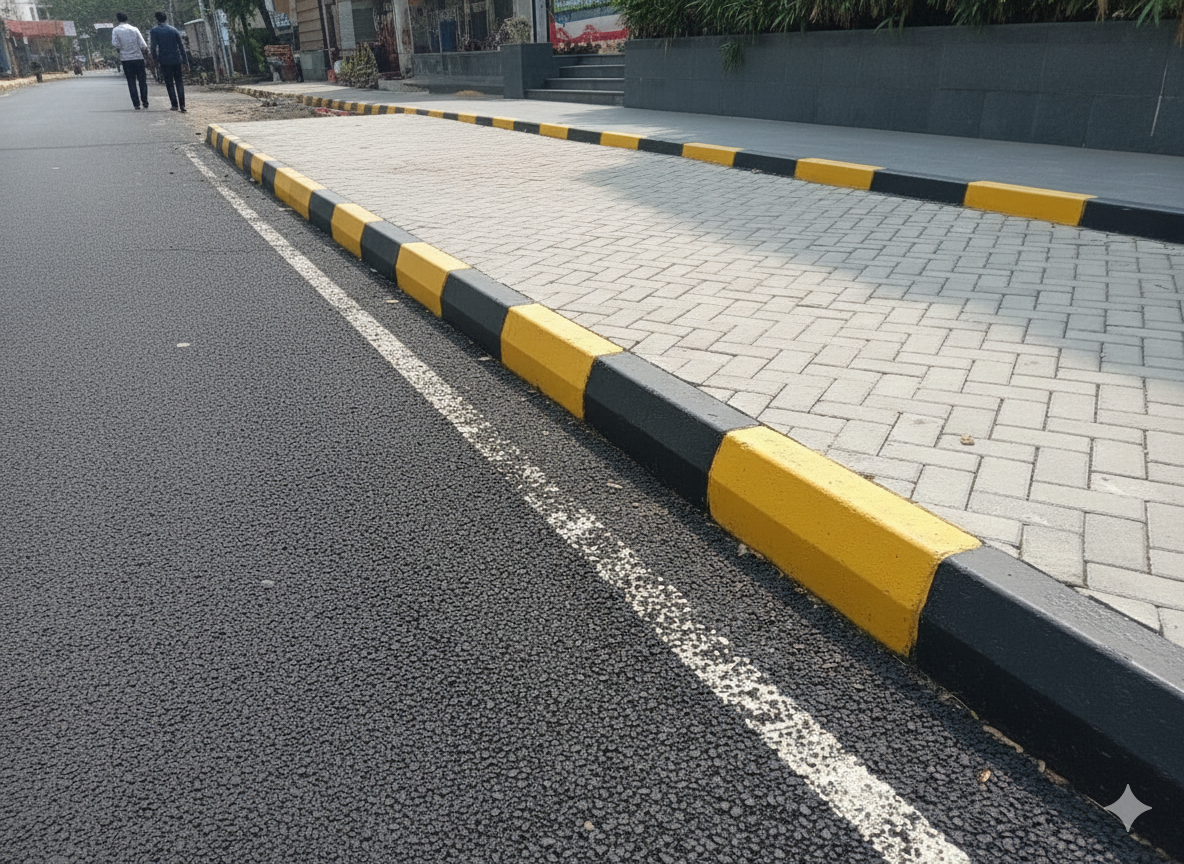
My idea is simple, yet I believe it holds the potential for significant impact: a new standard for footpath design based on these behavioral insights. What if we started using indicative colors on our sidewalks? Imagine clear, universal visual markers painted along the edges of our sidewalks, sending a subtle, non-intrusive message to vendors, to vehicle owners, and to pedestrians themselves: “This is the pedestrian zone. Please respect it.” We’re not just painting lines; we’re changing the context. We are nudging people not to encroach, not drive vehicles on the sidewalks and guiding pedestrians to walk on the designated path. A small modification to our public space can potentially create a positive change in how we use it.
As a first step, let’s understand some examples that hinder pedestrians from using the sidewalks.
Pedestrians prefer to walk on even surfaces. Unevenly built sidewalks like shown in the examples below, where houses and shops add kurb ramps/driveway ramps, forces pedestrians to get down and walk on the even road. Pedestrians also avoid sidewalks that are too high to easily step on.


Illustration of better sidewalk with side markings. (Image generated with the help of Gemini AI. Learning to refine the prompt to get better output. )
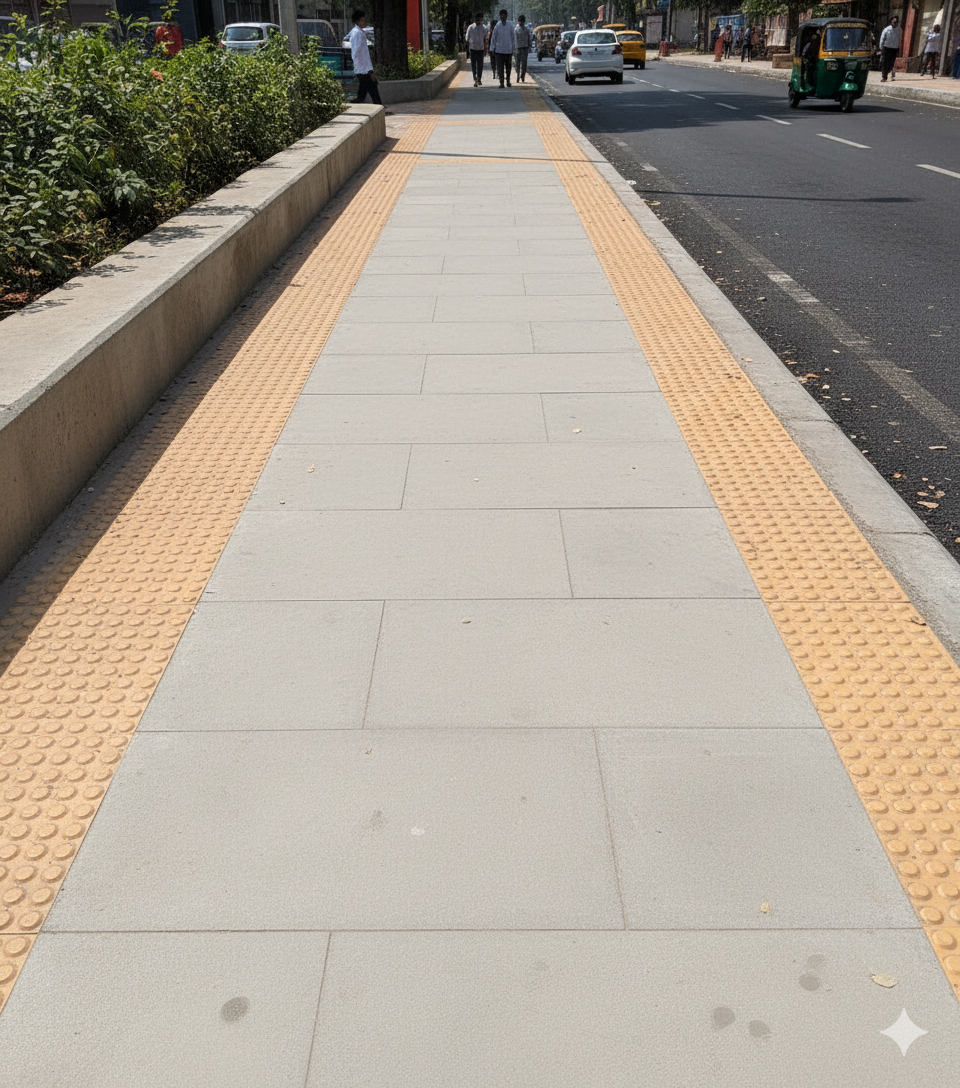
Curb ramps/driveway ramps shall be built like illustrated below. (Image generated with the help of Gemini AI.)


Also, pedestrians find it easy to walk when the starting point and end point of the sidewalks are built like a ramp rather than like a step.
*The article is being drafted. Apologies for publishing a not fully drafted post. Just published today as it is a day of significance for me.
Additional reading: How a broken wall led me explore the modern management principle, Therblig?
 Attitude is Everything