How might we enable better UPI adoption at petrol bunks?

  • Jay drives to the petrol bunk and requests petrol refill of Rs. 1000 to his car.
  • The attender refills and asks the mode of payment.
  • Jay says UPI, scans a QR pasted near the pump pillar and sends money.
  • The attender interrupts and annoyingly asks why he sent the money through that QR. The attender then said Jay needs to scan the QR from a card board he was holding onto his hand, which had a QR printed in A5 sheet and pasted.

Looks like the petrol bunk has different modes of UPI payment. This is apart from cash and card payments.

  • Some QR payments are processed through the petroleum companies payment gateway
  • Some QR payments are processed through the petrol bunks bank account
  • Some QR payments go directly to the petrol bunk owners bank account

The QRs were, either pasted on the dispenser or printed and held on hand or printed to plastic holders supplied by payment aggregators or generated through the POS machine. There is some confusion and delay in processing the payment. The next vehicle waiting is honking.

How might we enable faster & easier UPI payments at petrol bunks?

I could think of a user feedback from the office tea stall:

“Do you feel, opening the app at tea stall, adding the amount and then entering the PIN, a painful process? The user says, he is used to it daily and it feels like a ritual. While he asks the tea vendor, 1 ginger tea, the user is parallelly scanning the QR code and much before he gets the tea, he finishes the payment and waits for the tea.”

Similarly, if the petrol bunks can display QR codes for UPI payments, prominently, (Ex. Red circled space in the dispenser image below) the drivers can intimate the quantity or the amount of fuel (Ex. 10 litres or for Rs. 1000) to be refilled and while it is getting refilled, they can scan the QR code and make payment. Each pump or dispenser can have unique QR code so that it is easy for each servicing attender to generate his end of day accounts and make settlements.

Also, to improve trust and efficiency, apart from the innovative soundbox the UPI app has provided, we can think of a low energy consuming display like Kindle readers, that can be placed near the petrol dispenser and display the amount received from the customer or the vehicle no.

The UPI app can allow users to create a label of his vehicle type and vehicle number.
Ex. Maruti Swift: IQ 01 AM 3499
The label can be tagged and displayed alongside each refuel payment acknowledgement for easier visibility and acknowledgement, thereby improving trust and increasing the speed of payment.

If the user has leased the car through his office, she/he might like to have receipts for all the spends on fuel and receipts for driver’s salary. How might we enable the petrol bunks to share digitally generated receipts back to the user after refueling?

*”Petrol Bunk” is the most widely used term in India, for a fuel station. Different terminologies used across the world are: Gas Station, Petrol Station, Fuel Station, Filling Station, Petrol Pump…etc.

Sidewalks, Health & Peace of Mind

I am a software tester, finding flaws in products. I am also passionate about user experience & design and find it exciting to simplify & improve the experience of products we use. One such thing I wanted to simplify & make it better accessible is the side walks. Something that’s part of our public space.

Like many, I’ve tried to de-stress by going for a walk, only to be forced off the sidewalk and into the street. Our sidewalks are often unusable—either encroached or poorly designed. The intersection of my experiences in testing, design and walking, made me view these sidewalks not just as civic problem, but as a design & behaviour problem. I began to capture pictures of various footpath patterns I encountered, trying to understand what makes some pathways easily walkable and others a nightmare. How might we reclaim these vital public spaces? How might we build better & pedestrian friendly sidewalks? The solution might be right beneath our feet. Let’s design our way to a better walk.

Think about the Nudge Theory, the Nobel Prize-winning concept that shows how subtle cues can guide our behavior. If we put a sign to switch off lights before leaving the room, we are most likely to do so. What if we could apply this same principle to our public spaces?

In his book, The Tipping Point, Malcolm Gladwell argues that for an idea, trend or behaviour to spread, the Power of Context is crucial. He shows how small changes in our environment can trigger significant behavioral shifts. The environment itself becomes the nudge.

My idea is simple, yet I believe it holds the potential for significant impact: a new standard for footpath design based on these behavioral insights. What if we started using indicative colors on our sidewalks? Imagine clear, universal visual markers painted along the edges of our sidewalks, sending a subtle, non-intrusive message to vendors, to vehicle owners, and to pedestrians themselves: “This is the pedestrian zone. Please respect it.” We’re not just painting lines; we’re changing the context. We are nudging people not to encroach, not drive vehicles on the sidewalks and guiding pedestrians to walk on the designated path. A small modification to our public space can potentially create a positive change in how we use it.

As a first step, let’s understand some examples that hinder pedestrians from using the sidewalks.
Pedestrians prefer to walk on even surfaces. Unevenly built sidewalks like shown in the examples below, where houses and shops add kurb ramps/driveway ramps, forces pedestrians to get down and walk on the even road. Pedestrians also avoid sidewalks that are too high to easily step on.

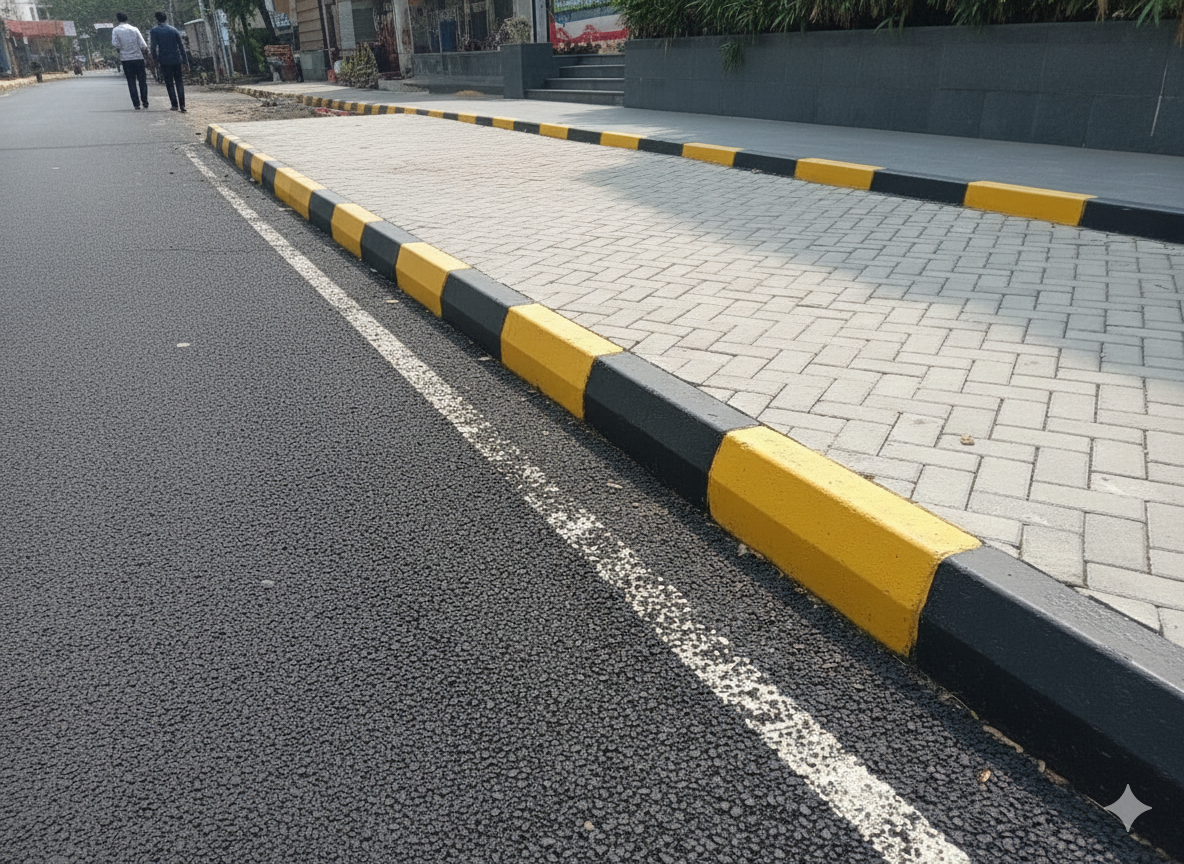
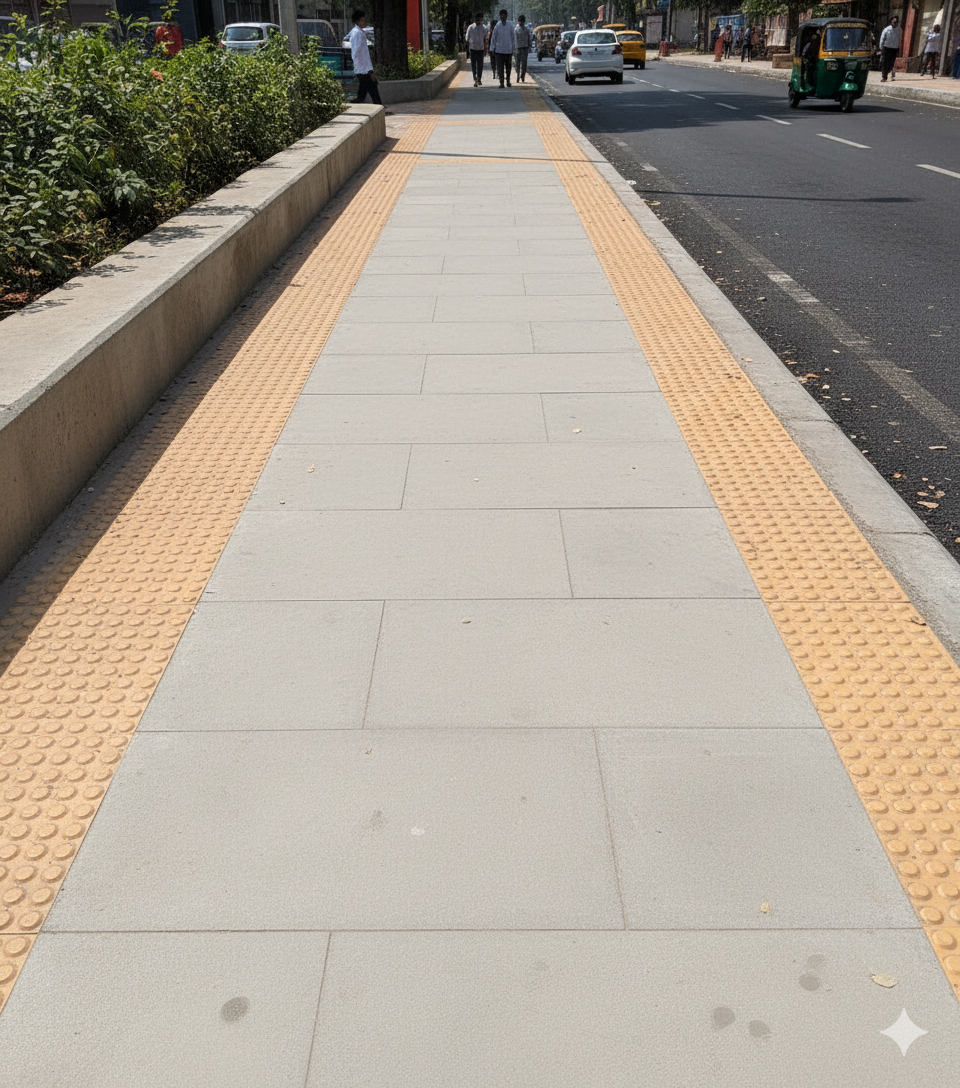
Illustration of better sidewalk with side markings. (Image generated with the help of Gemini AI. Learning to refine the prompt to get better output. )

Curb ramps/driveway ramps shall be built like illustrated below. (Image generated with the help of Gemini AI.)

Also, pedestrians find it easy to walk when the starting point and end point of the sidewalks are built like a ramp rather than like a step.

*The article is being drafted. Apologies for publishing a not fully drafted post. Just published today as it is a day of significance for me.

Additional reading: How a broken wall led me explore the modern management principle, Therblig?